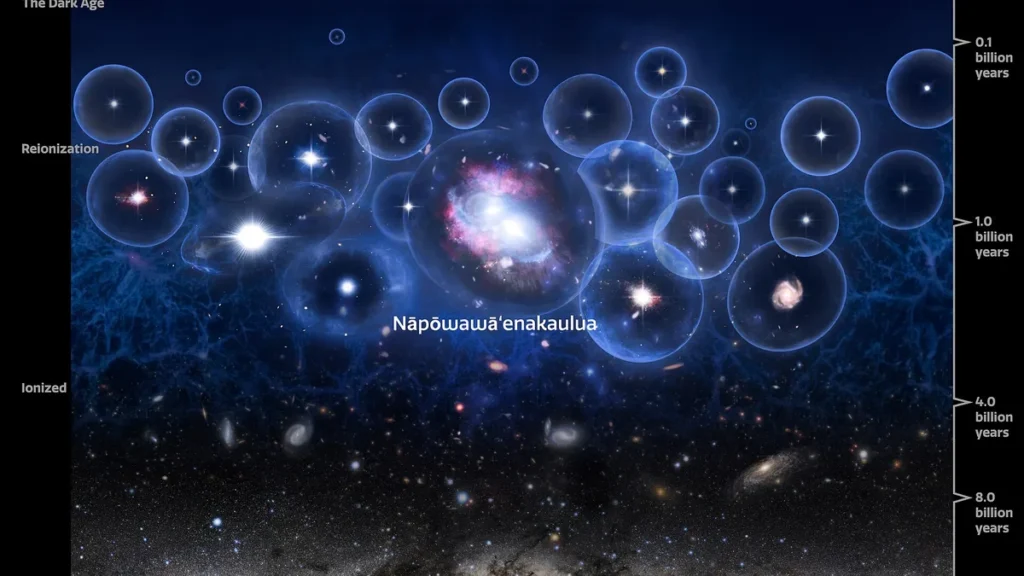
Key facts
- The pair holds black holes of 1.5 billion and 400 million solar masses, separated by about 18,100 light-years (roughly one-fifth the Milky Way's diameter; 0.98 arcseconds, about 5.56 pkpc).
- In the direction of Boötes more than 12.9 billion light-years away, the pair's light originated when the universe was 900 million years old, about a thirteenth of its present age.
- ESA's Euclid survey (launched July 2023) found 31 distant quasars including two shining when the universe was 670 million years old, about 5% of its present age.
- The discovery paper appeared in The Astrophysical Journal Letters as ApJL 1011, L59, with DOI 10.3847/2041-8213/aeb11f.
An international team led by Dr. Silvia Onorato, a postdoctoral researcher at NSF’s NOIRLab, discovered J1602+4228AB (Nāpōwawāʻenakaulua), the earliest and most distant compact quasar pair yet found, in the constellation Boötes and reported it Nov. 10-11, 2026.
The pair’s black holes weigh 1.5 billion and 400 million solar masses, nearly 2 billion together, and sit about 18,100 light-years apart. That gap is about one-fifth of the Milky Way’s diameter at 0.98 arcseconds, a tiny angular measure. A light-year is the distance light travels in a year; 5.56 pkpc means physical kiloparsecs. In Boötes, more than 12.9 billion light-years away, light left at 900 million years of age, about a thirteenth of the present age, at redshift z ≃ 6.08, where redshift tracks how much expansion has stretched that light.
The Near-Infrared Spectrograph Integral Field Unit on JWST took the first spectra of each source, confirming redshifts of z ≃ 6.0781 and z ≃ 6.0785 through Mg II and H β emission lines. Gemini North’s GNIRS instrument resolved them as separate objects at the same redshift during two nights on Maunakea, confirming a bound pair rather than a line-of-sight coincidence. “The sky over Maunakea was so clean and sharp that we managed to collect the data in only two nights,” Onorato said. GMOS tested the fainter object for a gravitational-lens mirage.
Nāpōwawāʻenakaulua is the third compact quasar pair known from cosmic dawn, and the closest and most extreme yet. Yoshiki Matsuoka and colleagues announced the first in June 2024 at z ~ 6, though its black holes were smaller. Another paired system, LID-1166, surfaced in August 2026 through JWST and ALMA observations. Its occurrence tops high-redshift quasar clustering predictions by roughly two to three orders of magnitude, pointing toward merger-triggered pairs or dense environments.
“There is no definitive theoretical explanation for how a single one of these giant quasars exists so early,” Onorato says. Both black holes accrete at or above the Eddington limit, the upper bound on how quickly matter can fall into a black hole, at rates λ_Edd of about 1.23 and 1.07. Seeds weighing tens of solar masses would require near-Eddington accretion across nearly all available cosmic time; one proposed alternative is direct collapse black holes, primordial clouds that skip the stellar stage and collapse into seed holes of 10,000 to 100,000 solar masses.
The team proposes that the pair marks an extreme peak of the early universe’s matter-density field, where galaxy interactions fueled star formation and black-hole growth at the same time, making it a laboratory for studying how the first galaxies and their central black holes assembled. It still takes a lens model to definitively exclude a foreground gravitational mirage for the fainter quasar, even though GMOS spectral-shape differences favor a real physical pair.
Nāpōwawāʻenakaulua means roughly the binary void of the heavens in Hawaiian. Larry Kimura, a professor at the University of Hawaiʻi’s Ka Haka ʻUla O Keʻelikōlani, coined the name through A Hua He Inoa at ʻImiloa Astronomy Center. The name’s parts refer to the black holes as fathomless darkness, to radiation from accreting matter, and to the pair itself; the program previously named Pōwehi, from the first black-hole image in 2019, and Pōniuāʻena, the most distant quasar known in 2020.
ESA’s Euclid spacecraft, launched in July 2023, provides broader context: its sample of 31 distant quasars shone when the universe was roughly 700 to 800 million years old, including two from cosmic dawn at 670 million years of age, about 5% of its current age. In July 2026 the survey added more high-redshift systems, including the most distant single quasar confirmed. “It is fabulous to see all this planning and hard work come to fruition,” said Professor Daniel Mortlock of Imperial College London, a Euclid quasar co-lead since 2014.
Quasar pairs are hard to find because each quasar shines for a short time, the objects lie far away and appear faint, and close pairs are difficult to separate into two members. Nāpōwawāʻenakaulua’s tight angular separation meant it was initially catalogued as a single object. Subaru’s Hyper Suprime-Cam on Maunakea started the search, flagging J1602+4228AB as a candidate using the Lyman-break dropout technique; the method works because at high redshift Lyman-alpha light shifts to about 861 nanometers, so the object vanishes from shorter-wavelength filter images.
The Astrophysical Journal Letters published the study as item L59 in volume 1011 (ApJL 1011, L59), with DOI 10.3847/2041-8213/aeb11f, in November 2026. The Aether survey, led by Emanuele Paolo Farina of NSF NOIRLab/Gemini, collected 200 quasars — roughly 43% of the known quasar population at this point in cosmic history — using JWST’s Near-Infrared Spectrograph Integral Field Unit, and visual inspections of the data turned up the companion to J1602+4228A.



Join the discussion