Key facts
- The installation finished a multiyear effort to raise station power generation from 160 kilowatts to 215 kilowatts, about 30 percent.
- Kutryk and Menon completed a six-hour, 59-minute spacewalk Thursday, switching to battery power at 8:36 a.m. EST (1336 UTC) and repressurizing the Quest airlock at 3:35 p.m. EST (2035 UTC).
- The seven-member Expedition 75 crew concluded a busy week aboard the International Space Station by cleaning up after a spacewalk, conducting biomedical assessments, and maintaining orbital systems.
- Flight controllers held deployment through an orbital night so Kutryk could inspect a power connector after ground controllers saw less current than expected from the newly connected array.
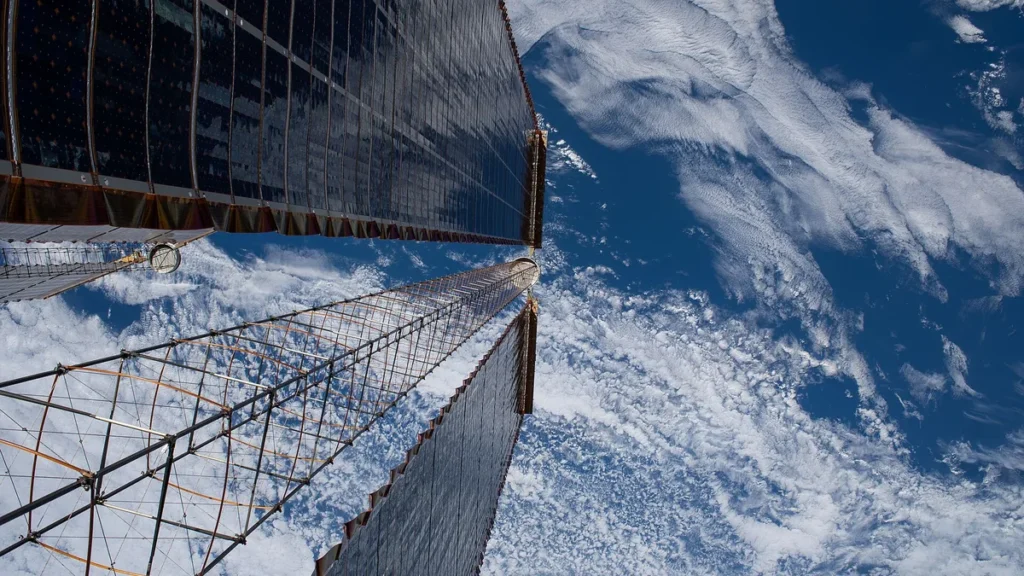
Flight engineers Joshua Kutryk of the Canadian Space Agency and Anil Menon of NASA finished a six-hour, 59-minute spacewalk Thursday outside the International Space Station, installing the eighth roll-out solar array as the seven-member Expedition 75 crew concluded a week of post-spacewalk cleanup, biomedical assessments and orbital-systems maintenance.
Battery power came on at 8:36 a.m. EST, or 1336 UTC. The Quest airlock completed repressurization at 3:35 p.m. EST, or 2035 UTC. The final roll-out solar array (IROSA) unrolled at the far starboard end of the station’s main truss at about 3:05 p.m. EST, or 2005 UTC. Mission Control radioed that deployment was complete once the array reached its full length of 63 feet.
Controllers detected lower-than-expected current from the newly connected array, so they held deployment through an orbital night while Kutryk inspected a power connector. Mission Control said currents looked good and gave the crew permission to deploy once Kutryk disconnected, checked and reconnected a cable link while in Earth’s shadow.
The agency did not immediately identify what caused the low current, which surfaced four and a half hours after the spacewalk began and stopped cable work until darkness fell. Crew members waited for the next orbital night because cables cannot be safely handled while the existing solar wing is live in sunlight.
Power generation will rise from 160 kilowatts to 215 kilowatts, about 30 percent, after this installation completed the multiyear effort, and NASA says the added capacity will support the outpost through its final years including a safe and controlled deorbit. A single IROSA generates about 8 kilowatts compared with roughly 19 kilowatts apiece for the original wings when they were new. Shuttle flights delivered the original solar wings from 2000 to 2009; the wings carried a 15-year design life and their output has slowly fallen. Work started with the first array in June 2021, and six were in place by June 2023 before the final pair flew up on a Falcon 9 on Oct. 13.
On Friday, Kutryk and Menon topped up water tanks in the suits, pulled air bubbles from those tanks and put rechargeable batteries inside them. The pair also cleaned the Quest airlock, checked tools and spacesuits, stored gear under protective covers and shut down all spacewalk-supporting equipment. Installing the batteries keeps astronauts safe and comfortable on future spacewalks, and these steps finished the post-spacewalk cleanup after the eighth IROSA installation.
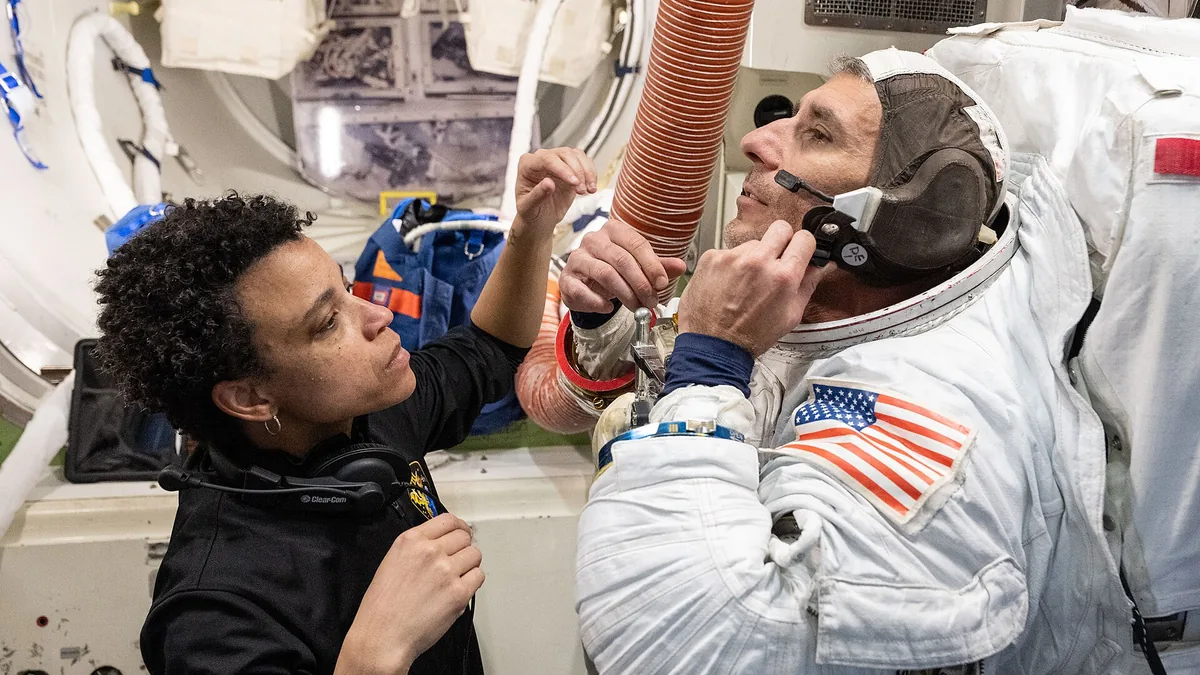
Jessica Watkins and Luke Delaney helped the spacewalkers don and doff their suits, monitored the work and positioned the Canadarm2 robotic arm on Thursday. The two NASA flight engineers also assisted with Friday cleanup, and all four astronauts set aside a couple of hours each to rest after a week of science, maintenance and spacewalking. Kutryk and Menon joined Watkins and Delaney for a post-spacewalk conference with engineers on the ground.
Sergey Teteryatnikov took his blood pressure with arm, wrist and finger cuffs at the end of the week and then ran on the Zvezda service module treadmill while sensors tracked his heart and breathing rate. Researchers can use the information to observe and study weightlessness effects on a crew member’s cardiorespiratory system. Anna Kikina cared for the station’s Roscosmos ventilation systems and scientific payload hardware throughout the day, and station commander Pyotr Dubrov performed an overnight carbon dioxide check, sent the readings to Earth-based mission controllers and inspected the modules and hatches.
Crew-13 launched Oct. 1 on SpaceX’s Dragon Grace, which launched from Cape Canaveral Space Force Station for an approximately six-month Expedition 75 stay, marking the thirteenth SpaceX crew rotation flight under NASA’s Commercial Crew Program. The Falcon 9 lifted off from Space Launch Complex 40. The seven-member Expedition 75 crew includes NASA flight engineers Anil Menon, Jessica Watkins and Luke Delaney; CSA flight engineer Joshua Kutryk; Roscosmos flight engineers Sergey Teteryatnikov and Anna Kikina; and station commander Pyotr Dubrov. Crew-13 science work is scheduled to last until spring 2027.
Jessica Meir, Jack Hathaway, Sophie Adenot and Andrey Fedyaev finished 237 days in orbit and were to undock at 8:05 a.m. EDT from Harmony’s space-facing port. Meir commanded the Crew-12 quartet and Hathaway served as pilot. NASA and SpaceX recovery teams stood by for a parachute-assisted Pacific Ocean splashdown at 11:34 a.m. EDT on Thursday, followed by retrieval and medical exams.
The departure was supposed to leave seven residents aboard the station. NASA flight engineer Anil Menon and Roscosmos cosmonauts Anna Kikina, who arrived in July, and commander Pyotr Dubrov make up the remaining long-duration crew. They stayed behind after Crew-12 left, keeping the station continuously occupied.
Gaurang Patel said at an Oct. 20 briefing that U.S. spacewalks will occur in early January to work on the Alpha Magnetic Spectrometer cosmic-ray detector, which sits on the truss. Patel serves as operations integration manager for NASA’s Low Earth Orbit Program. With the power upgrade complete, NASA is moving on to the next round of U.S. spacewalks.
NASA commentator Joseph Zakrzewski called the outing the ninth spacewalk of 2026 and the sixth for Expedition 75 crew members. Menon finished his fifth spacewalk, for a career total of 33 hours and 30 minutes outside, while Kutryk completed his second outing for 14 hours and 10 minutes across two IROSA installations. Kutryk led Thursday’s outing as EV1 in the red-striped suit, one week after the seventh IROSA installation on Oct. 29.
Researchers handled blood samples to look into clotting risks linked to spaceflight, and crew members carried out RelaxPro sleep and saliva monitoring, ultrasound vein scans and breathing checks with wearable acoustic sensors. Exercise-cycle tests followed heart and breathing rates, and cosmonauts got gear ready for the Teledroid study involving body-worn controls meant for future robotic operations.



Join the discussion