
Key facts
- Hydrogen chloride might come from a buffer zone of permafrost above magma rather than directly from magma; ice traps the gas in winter and releases it when it sublimates in spring.
- The new study identified unusual hydrogen chloride detections in the northern hemisphere, repeatedly in the same place on the northern flank of Alba Mons.
- NASA's InSight lander, which touched down in Elysium Planitia in 2018, detected more than 1,300 seismic events showing Mars still experiences marsquakes.
- Some Martian lava flows appear, based on orbital imagery, to be only one or two million years old, perhaps younger, showing that volcanism did not end entirely billions of years ago.
Researchers using the European Space Agency’s Trace Gas Orbiter detected hydrogen chloride above fissures at Mars’s Alba Mons volcano during the cold aphelion season, and announced the finding November 4, 2026, in Science Advances.
The orbiter’s Atmospheric Chemistry Suite made the detection above narrow fissures on the volcano’s northern flank, at parts-per-billion levels higher than expected. Alba Mons sits northeast of Olympus Mons and covers roughly the area of the contiguous United States. Earlier atmospheric models did not predict hydrogen chloride at low altitudes during the cold season.
The research team interprets the gas as seeping from magmatic bodies at depth through fissures, and says the results point to ongoing igneous activity inside Mars. The study identified unusual hydrogen chloride detections in the northern hemisphere, repeatedly in the same place on the northern flank of Alba Mons.
Alexander Trokhimovskiy, a researcher at the Russian Space Research Institute in Moscow, said the study identified several very unusual hydrogen chloride detections in the northern hemisphere. Kevin Olsen, an atmospheric physicist at the University of Oxford, said the intriguing thing is that these observations occur in the same place: the northern flank of Alba Mons.
Daniel Mège, co-lead author at the Space Research Center of the Polish Academy of Sciences, said, “Our findings suggest that Mars has retained enough internal heat to support volcanic activity until recently, and possibly still does.” The team describes the detection as finding a handful of molecules from a potentially intermittent source while monitoring the whole Martian atmosphere. Mège said altogether the signs point to a volcanic origin.
The researchers spotted fresh, narrow fissures under one meter wide in the Alba Mons area and interpret them as hydrogen chloride pathways rooted into magmatic bodies at depth. The cracks are several hundred meters long and tens of centimeters wide. Examining HiRISE, CaSSIS and CTX camera images beneath the detection sites, the team found narrow fissures tens of centimeters wide in swarms tens of kilometers long on topographic ridges.
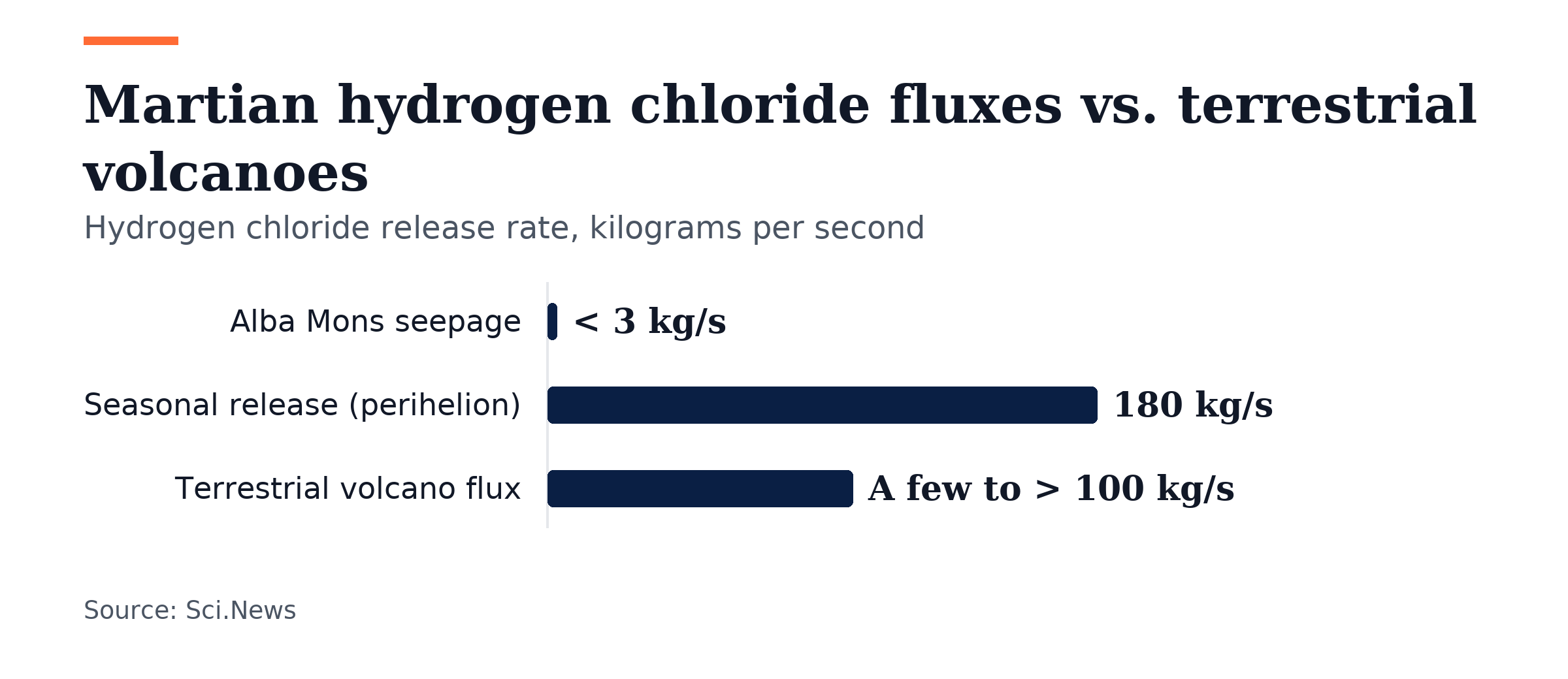
The authors said, “Assuming an atmospheric lifetime of one sol for hydrogen chloride, the authors estimate a seepage rate of less than 3 kilograms per second.” That compares with the low end of terrestrial volcano fluxes, which run upward from a few kilograms per second to beyond 100 kilograms per second.
The proposed seepage system would not necessarily require a significant thermal signature, which may explain why heat-based searches for active volcanism on Mars have come up empty. The much larger seasonal hydrogen chloride release around perihelion, estimated at around 180 kilograms per second, is not thought to be directly volcanic.
In 2021, scientists revealed that the Trace Gas Orbiter had detected amounts of hydrogen chloride in the Martian atmosphere, and during warmer southern spring and summer months the gas pervades the entire southern hemispheric sky. Hydrogen chloride occurs virtually everywhere in the Martian atmosphere, but observations typically happen during warmer seasons when the gas behaves as an aerosol of fine solid particles or liquid droplets.
During colder Martian autumn, ice particles form and lofted hydrogen chloride sticks to the falling ice, which drags it down to the surface. Mars’s orbit is less circular than Earth’s, so southern summer coincides with proximity to the Sun while northern summer falls in a more distant part of the orbit, meaning the northern hemisphere does not undergo the same intense ice vaporizing-and-freezing cycle.
Hydrogen chloride might come from a buffer zone of permafrost above magma rather than directly from magma, with ice trapping the gas in winter and releasing it when it sublimates in spring. The gas can also originate from chemical reactions between hot water and metal chlorides, and chlorides have been detected on Mars, so the warmer crust may harbor hydrothermal labyrinths.
The researchers propose that hydrogen chloride and chlorine cycle between the atmosphere and surface reservoirs such as perchlorates and ice, with some chlorine potentially having an igneous origin. Because Mars lacks plate tectonics, volcanic degassing is probably the main input to the planet’s surface-atmosphere chlorine system, unlike on Earth, where tectonic recycling also plays a role, and scientists say hydrogen chloride might be a major volcanic gas on Mars.
NASA’s InSight lander, which touched down in Elysium Planitia in 2018, detected more than 1,300 seismic events showing Mars still experiences marsquakes. InSight never detected convincing magmatic seismic signals coming from Alba Mons or the broader Tharsis volcanic province.
Tracy Gregg, a planetary volcanologist at the University at Buffalo who was not involved in the study, said some people think InSight’s odd marsquakes indicate magma, others think water, and she thinks it might be both. She noted that the Tharsis region hosted the planet’s largest and likely longest-lived magma chambers, which would take a long time to cool, degas and freeze solid.
Martian lava flows appear, based on orbital imagery, to be only one or two million years old, perhaps younger, showing that volcanism did not end entirely billions of years ago. Mars has just one-tenth Earth’s mass, so it could not sufficiently insulate internal heat from formation and radioactive decay, which escaped into space, ending its era of profuse volcanism billions of years ago.
Hot magma deeper down could heat ice and create groundwater, potentially supporting active hydrothermal systems that might provide habitable conditions for microbes below the surface. If hidden magma produces the hydrogen chloride, Mars might still produce sporadic eruptions, and subsurface magmatic activity driving hot water and chemicals could create a microbial habitat.
The team acknowledges the detection is not a smoking gun for ongoing volcanism and cannot be certain the hydrogen chloride is seeping out of the exact fissures; the nature of the source remains unknown. Even if the hydrogen chloride comes from hidden magma, nobody is forecasting an imminent Martian eruption. The study is Alexander Trokhimovskiy et al. 2026, Enigmatic HCl detections as a potential signature of igneous activity on Mars, Science Advances 12 (45), DOI 10.1126/sciadv.aeb9422.
Join the discussion