Key facts
- The European Space Agency's ExoMars Trace Gas Orbiter detected hydrogen chloride gas above fissures on Alba Mons in Mars's northern hemisphere, with anomalous spikes recurring each early northern summer.
- If rising lava meets underground groundwater, warm habitable niches could form, shielded from harsh surface conditions.
- The research was published in Science Advances as "Enigmatic HCl detections as a potential signature of igneous activity on Mars," DOI 10.1126/sciadv.aeb9422.
- Magmatic gases such as hydrogen chloride may have been more abundant in Mars's past, helping thicken the atmosphere, warm the climate, and allow liquid water to cover much of the surface.
European Space Agency’s ExoMars Trace Gas Orbiter detected hydrogen chloride gas above fissures on Alba Mons in Mars’s northern hemisphere, with anomalous spikes recurring each early northern summer. The research appeared in Science Advances in 2026.
The CaSSIS camera on the orbiter found new, tight cracks on Alba Mons. The fractures extend hundreds of meters and appear with surface color changes. NASA’s HiRISE camera also imaged fresh cracks below the gas, spanning only inches wide or up to a foot or two across. Some cracks gather in miles-long ridges reaching about 100 feet high, slicing through ice that formed just 630,000 years ago, and the team examined 78 hydrogen chloride observations above Alba Mons.
Hydrogen chloride normally peaks in Mars’s northern hemisphere winter and fades in summer, but the Alba Mons spikes return each early northern summer. Ice may block the fissures during winter, when temperatures drop to -120°C (-184°F), and the gas escapes as the ice sublimates in early summer. Researchers think the ice seals the cracks at other times of year, while warming from rising air temperatures in early summer lets underground volcanic gases reach the atmosphere.
Color changes around the fissures may result from gas deposits left by material escaping from inside Mars, much like fumaroles on Earth. Hydrogen chloride smells foul and is pungent, often venting from volcanoes on Earth where it can irritate or burn nasal tissues.
An international team under Alexander Trokhimovskiy says the hydrogen chloride release comes from hot magma below the surface, pointing to dormant volcanism. The researchers propose that the seepage links to a dormant magma chamber, a volcanic plumbing system beneath Mars. “We found that the most likely origin for the hydrogen chloride is volcanic seepage,” said planetary scientist Daniel Mège.
Daniel Mège, a professor at the Space Research Centre of the Polish Academy of Sciences and co-lead author, said Mars has kept enough internal heat to back volcanic activity until recently, and perhaps still does. He also suggested searching for Martian life in the seeping fissures of Alba Mons, since hydrothermal systems could hold ingredients and energy for microorganisms.
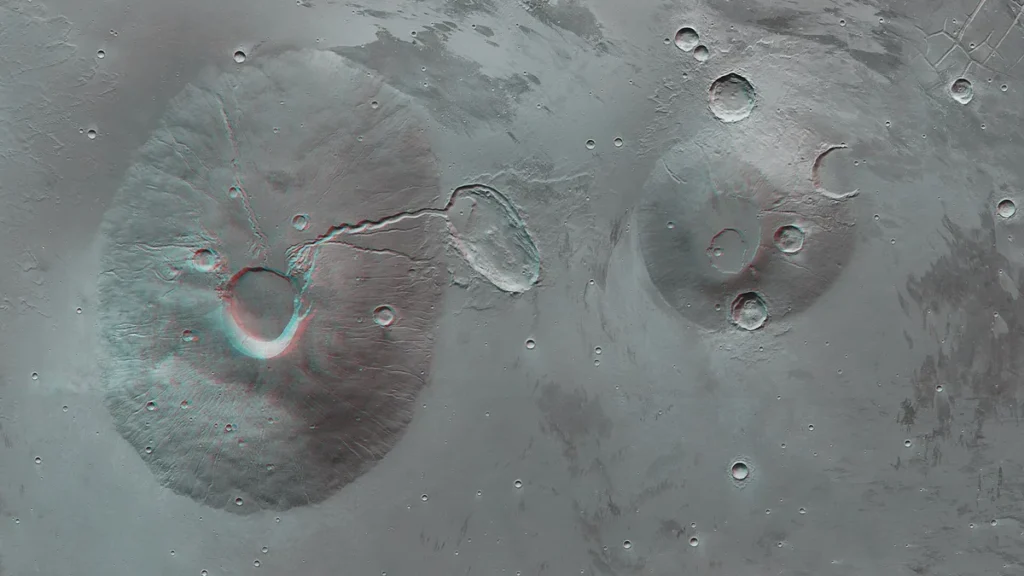
Mars is home to the solar system’s largest volcanoes, though their current activity remains unknown. Alba Mons covers the largest surface area of any Martian volcano and forms a broad shield in the northern hemisphere. Hardened lava flows and ash eruptions in Tharsis, the volcanic plateau that includes Alba Mons, date to only tens of millions of years ago, as do some flows in two other volcanic regions. Computer simulations suggest heat from deep inside Mars may still be melting rock beneath the Tharsis plateau today.
Marsquakes recorded by NASA’s InSight lander could point to magma movement shaking the ground. Images from orbit show some volcanoes were active within the last few million years, and seismometers have picked up marsquakes. Searches for heat, visible surface changes, and sulfur dioxide on Mars have turned up empty.
The only confirmed volcanically active bodies in the solar system are Earth, Venus, and Jupiter’s moon Io. Daniel Mège said researchers have documented past volcanic activity from a few million years ago on Mars, but no study had reported current magmatic activity before this study. No one has ever seen new lava flows or eruptions on Mars.
Magmatic gases such as hydrogen chloride may have been more abundant in Mars’s past, helping build the atmosphere, warm the climate, and let liquid water cover much of the surface. Martian rocks and soil carry more chlorine relative to water and sulfur than Earth rocks do, so the research team considers hydrogen chloride likely one of Mars’s most common volcanic gases. On Earth, volcanoes release more sulfur dioxide than hydrogen chloride, but Mars may be different because of its rock composition.
Warm, shielded habitable niches could form if rising lava meets underground groundwater.
The sources disagree on the year of the first hydrogen chloride detection: Phys.org says 2021, while Mashable says 2020. The orbiter first spotted the gas in Mars’s atmosphere in 2020 or 2021, depending on the source, and has tracked annual spikes along Alba Mons’s northern flank in early summer.
“These findings may prove to be TGO’s greatest success yet,” says Colin Wilson, ESA’s project scientist for the ExoMars Trace Gas Orbiter. The ExoMars Trace Gas Orbiter is a joint project of the European Space Agency and the Russian space agency Roscosmos.
The research appeared in Science Advances in 2026 under the title “Enigmatic HCl detections as a potential signature of igneous activity on Mars,” with DOI 10.1126/sciadv.aeb9422. Daniel Mège is a co-lead author of the paper.

Join the discussion