Key facts
- The Moon is thought to have formed when a protoplanet named Theia slammed into Earth, creating debris that coalesced into a body only about a quarter the size of Earth.
- Radioactive decay of elements such as potassium and uranium could not supply enough heat to form basalt two billion years ago because too little un-decayed material remained on the Moon.
- Tidal heating helped keep the lunar core warm long enough to sustain a magnetic field beyond what models originally predicted.
- The thermal model omits latent heat absorbed when rock melts and heat transport by moving magma, uses a simplified convection scheme, and relies on a numerical grid that limits fine-scale detail.
A team led by Miao Chen at the Chengdu University of Technology says Earth’s gravity-generated tidal heating kept the Moon’s interior warm enough for volcanism to continue until about two billion years ago.
China’s Chang’e-5 mission returned basalts from Oceanus Procellarum. Researchers dated the samples in the laboratory to around two billion years old.
After forming around 4.5 billion years ago, the Moon should have cooled rapidly under the standard view, following a protoplanet’s strike on the early Earth. The Moon formed when Theia, a protoplanet, slammed into Earth, creating debris that coalesced into a body only about a quarter Earth’s size. Traditional geological theory holds that basalts form only in active volcanoes or similar high-pressure, high-temperature environments, which should not have existed on the Moon two billion years ago.
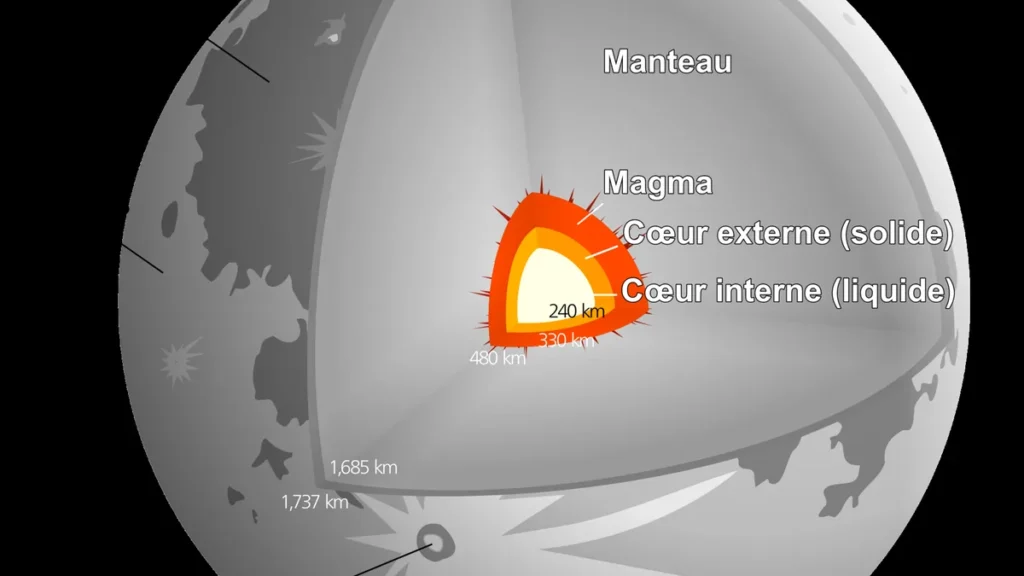
Because the debris was small, heat from formation radiated away quickly, implying the Moon turned geologically dormant early under the giant-impact origin. Radioactive decay of potassium and uranium fell short of the heat needed to build basalt two billion years ago because too little undecayed material remained on the Moon. Asteroid impacts can cause local thermal spikes, but the heavy bombardment that produced most lunar craters ended well before the basalts formed. Tidal heating helped keep the lunar core warm long enough to sustain a magnetic field beyond what models originally predicted.
Tidal heating happens when a celestial body is squeezed, stretched, and kneaded while moving on an elliptical orbit around a larger parent body. Jupiter’s moon Io erupts constantly from this tidal squishing.
Around two billion years ago, the Moon circled Earth in sixteen days instead of the twenty-seven days it takes now, and it orbited much closer on a far more eccentric, oval-shaped path. Its proximity meant Earth applied strong rhythmic tidal forces to the lunar interior during every orbit.
Earlier studies treated the Moon as a uniform sphere when examining gravitational squeezing, even though an ultra-low viscosity zone of rock lies between the Moon’s core and mantle.
The team built a convection simulation with a realistic 3D mantle that directed energy toward two symmetric regions along the lunar core-mantle boundary, naming them Tidal Heating Anomaly Zones. In the model these paired areas absorbed a large amount of energy and became the focus of power calculations. They exist as cross-section features in the simulation rather than as two underground hotspots mapped by instruments.
Tidal heating drove mantle plumes upward toward the crust, and after the tidal engine calmed billions of years later, stranded pockets of mantle melted to create the Chang’e-5 basalts. Getting heat from depth to the surface remains a separate problem that also depends on the overlying crust and lithosphere.
Around 3.2 billion years ago, tidal strain on the Tidal Heating Anomaly Zones, which cover just 2.5% of the mantle’s volume, delivered 150 gigawatts of power, exceeding radioactive decay energy by more than four times. The figure comes from a high-eccentricity orbital scenario used to test the mechanism rather than from proof that the ancient Moon followed that orbit.
In the high-eccentricity case, radioactive heating inside the same deep region reached 34.9 gigawatts, while tidal power surpassed local radioactive heating by about 4.3 times. At a low eccentricity of 0.05, tidal power dropped to 1.5 gigawatts, a hundredfold decrease.
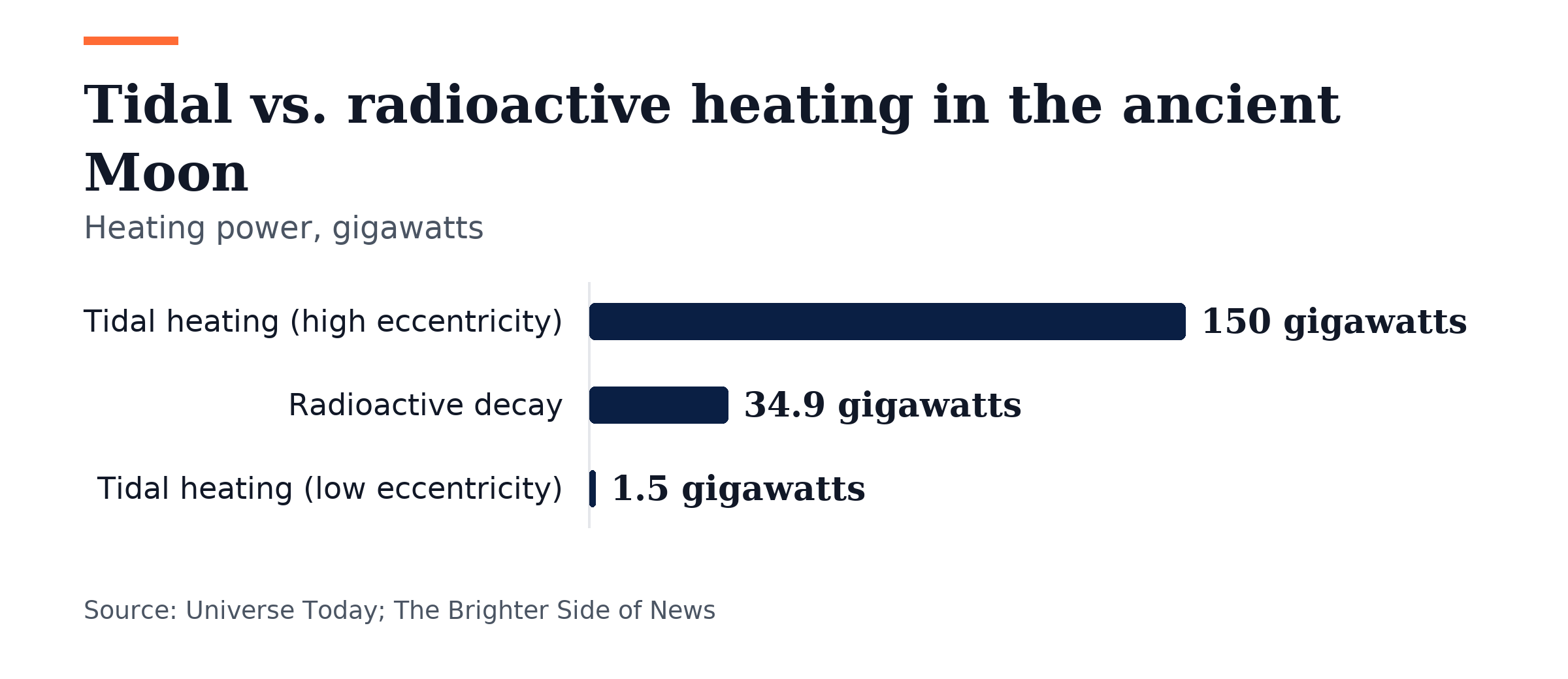
The gigawatt figures describe power, meaning the rate of heat generation, rather than a measured temperature, the Moon’s total heat output, or proof of any specific eruption. The comparison covers only the selected deep region, not the whole lunar interior.
Lunar material is not a perfectly elastic spring, so some tidal deformation turns into heat, and where that energy dissipates depends on viscosity, making the deep interior structure central to the calculation. The model combined spatially varying tidal heating, radioactive heating, and temperature-dependent viscosity, refreshing viscosity at each time step as temperatures changed. Tidal dissipation concentrated near the equatorial part of the modeled Moon’s core-mantle boundary, with cross-sections showing two matching areas of strong heating called the Tidal Heating Anomaly Zone, or THAZ.

The paired regions are model cross-section features rather than two underground hotspots mapped by instruments, and averaging heating across the Moon could miss the intensity of localized effects. The 0.5 and 0.05 eccentricity values serve as test scenarios rather than proof that the ancient Moon kept either orbit throughout the modeled interval.
In the model run with stronger heating, large upwellings formed close to the core-mantle boundary and eased cooling, creating a possible route for heat from deep inside to reach shallower layers. The model also contained a dense titanium-rich layer connected to the lunar magma ocean’s late crystallization, material that might have sunk early in a mantle rearrangement, and checked whether upwellings driven by heat could move it.
The model does not directly explain why lunar volcanic plains dominate the nearside, because generating heat at depth and letting magma reach the surface are separate issues that also require weighing crust and lithosphere differences. The link between heating-driven upwellings and titanium-rich material remains a model interpretation instead of a demonstrated reconstruction of lunar mission rock samples.
The thermal model leaves out latent heat absorbed when rock melts and heat transport by moving magma, relies on a simplified convection scheme, and uses a numerical grid that limits fine-scale detail. The next test asks whether the mechanism stays effective when melting, magma transport, and cooling combine, drawing on lunar observations and returned samples to narrow plausible interior structures and orbital histories.
The work presents a possible mechanism rather than a measured underground heat source, and its strength relies on assumptions about the Moon’s ancient orbit and deep rock characteristics; further calculations and independent evidence must show how much this mechanism contributed to real volcanism. The Moon began with considerable stored heat, radioactive heat production falls as unstable elements decay, and the lunar interior gradually cools.
The Planet paper by Miao Chen, Da Wang, and Yun Liu carries the title Tidal Heating Anomaly Zone at the core-mantle boundary of the Moon. Miao Chen led the research with Da Wang at Chengdu University of Technology, and Yun Liu co-authored the work from the Institute of Geochemistry of the Chinese Academy of Sciences.
Chen and colleagues present the model as a theory and say many lunar missions planned over the next decade could provide more definitive data to solve the Moon’s evolutionary questions. If confirmed, the model extends the Moon’s volcanic lifetime to about two billion years ago and shows how a small rocky body can stay geologically active far longer than basic cooling models predict.




Join the discussion