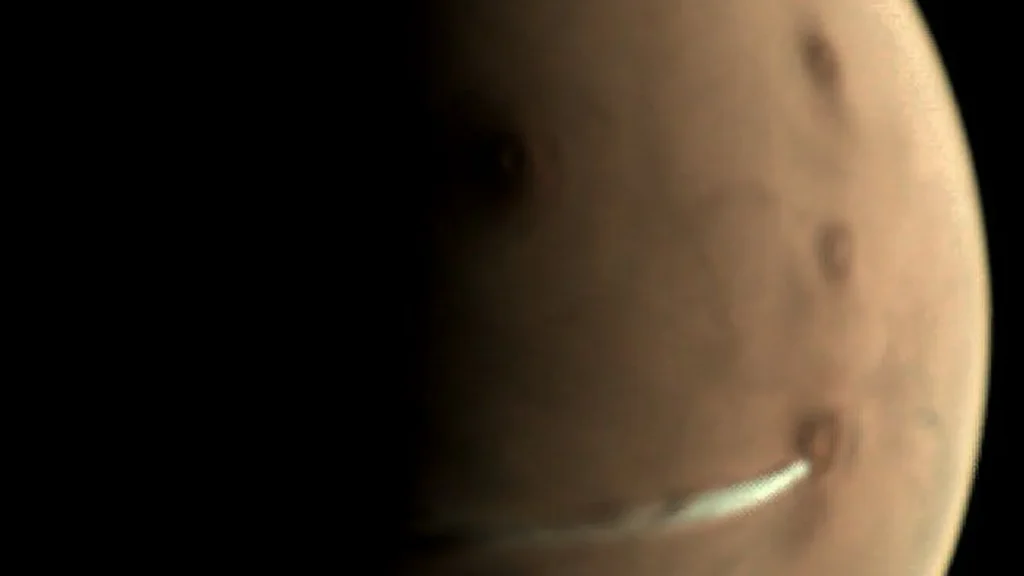
NASA’s Astronomy Picture of the Day featured a long water-ice cloud on Mars on November 2, 2026, identifying it as the Arsia Mons Elongated Cloud.
The APOD entry says the cloud begins near the volcano Arsia Mons on Mars. Wind then blows it downstream into a tail that can extend over 1,500 kilometers, and that downstream tail is the elongated feature highlighted in the entry. Water-ice crystals make up the cloud. The entry explains that cloud crystals normally form around bits of dust, but that familiar process would fail high in the thin, dust-poor Martian atmosphere, so dust is not thought to drive the cloud’s formation.
The entry says the feature appears only during Martian spring and summer, and only during morning hours, and the astronomer ties this seasonal and daily timing to what causes the unusually long cloud. NASA’s Viking Orbiter 2 first recorded the Arsia Mons Elongated Cloud in 1977. ESA’s Mars Express spacecraft has since imaged the cloud in greater detail, giving researchers a more recent look than the 1977 Viking Orbiter 2 recording. The image featured in the November 2 entry dates from 2018.
The credit line appears directly under the November 2 entry. It gives image credit to ESA, DLR, and FU Berlin, with processing and license by J. Cowart. APOD’s authors and editors, listed in the credit block, are Robert Nemiroff, Jerry Bonnell, Cecilia Chirenti, and Keighley Rockcliffe. The service credit block names ASD at NASA / GSFC, NASA Science Activation, and Michigan Tech.
U.
The entry says efforts to better understand the Arsia Mons Elongated Cloud will continue. The astronomer’s explanation concludes by linking continued Martian cloud research to broader insight into how clouds form on Earth. That connection appears at the end of the November 2 entry, and researchers will keep studying the cloud as part of that effort.



Join the discussion