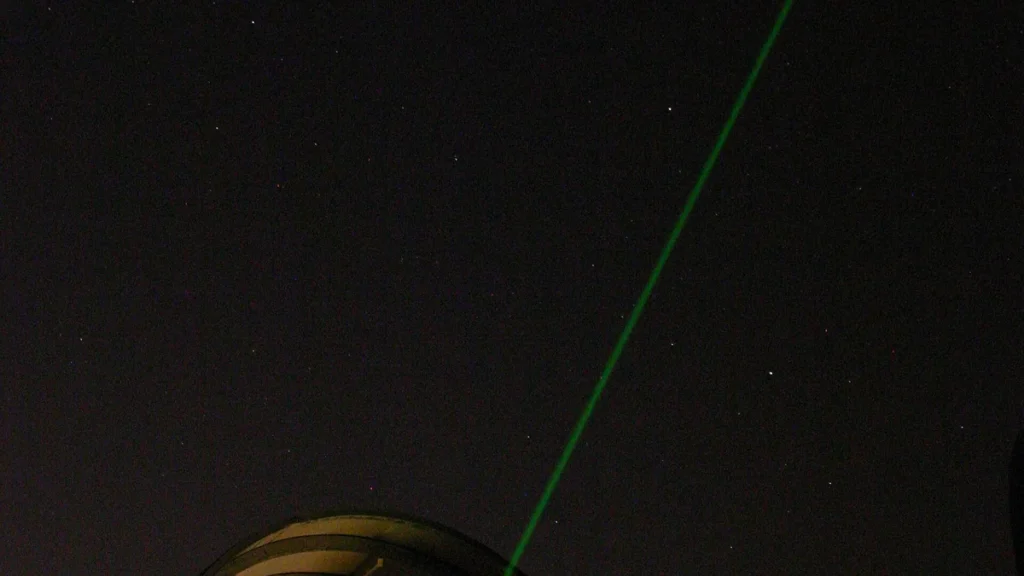
The National and Kapodistrian University of Athens’ ERMIS-3 CubeSat established an optical laser link with a station on Mount Holomontas in Greece, marking the country’s first optical link with a low Earth orbit satellite weeks after the spacecraft’s commissioning.\n\nThe 8U spacecraft lifted off on 30 March 2026 aboard a SpaceX Falcon 9 rocket and deployed into low Earth orbit at 500 kilometres altitude alongside ERMIS-1 and ERMIS-2. The trio forms the ERMIS Hellenic CubeSat Demonstration Mission, the first phase of Greece’s National Microsatellite Programme, which the European Space Agency implements on behalf of the Greek government. The University of Athens said the three CubeSats were successfully deployed following a short flight, marking a milestone in Greek aerospace history.\n\nThe university said the programme draws on the European Recovery Fund under NextGenerationEU and carries a total budget of €200 million, while the ERMIS project itself is valued at approximately €4.9 million. Greece’s Ministry of Digital Governance and Artificial Intelligence and the Hellenic Space Centre also support the effort, alongside the European Union’s Recovery and Resilience Facility. The University of Athens said the programme forms part of Greece’s National Microsatellite Programme and receives backing from ESA and the Hellenic Space Centre.\n\nThe Lithuanian firm Astrolight provided the ATLAS-1 optical terminal on ERMIS-3 and companion ground-based laser reception and beacon equipment for the Holomontas station. According to ESA, Astrolight furnished both the orbital terminal and the receiving gear on the ground, proving its complete system during orbital tests of the ERMIS-3 downlink. Greek City Times said the successful tests point to Astrolight’s technical expertise and its contribution to cooperation between the two universities.\n\nThe first active pass after commissioning brought first optical contact, or first-light, for the spacecraft. Greek City Times reported that engineers completed calibration of both systems by the third pass, allowing autonomous operation on a predetermined schedule.\n\nThe spacecraft and its ground station now set up two optical links daily, running on their own around the clock with capacity margins up to 10 gigabits per second. The ATLAS-1 laser device now handles one gigabit per second, although link-budget calculations point to possible speeds of up to 10 gigabits per second.\n\nEarly results indicate dependable data links in daylight and after dark, beneath partial cloud cover, at low satellite elevation angles, and even when clouds or trees briefly block the optical signal. Signals came in at elevation angles below 10 degrees above the horizon, and after calibration link availability topped 85 percent of the available time. Greek City Times said these performance results point to potential operational and commercial uses for the optical link.\n\nThe mission proved precise pointing, acquisition and tracking, a core objective for ERMIS-3’s high-capacity secure optical link to the ground. Laser links rely on narrow beams to achieve high data rates, yet staying connected is hard because the spacecraft moves at several kilometres per second and both sides need to track each other within a short window. ESA said its technical expertise helped support the successful demonstration of the satellite’s optical link and turn the concept into a pioneering in-orbit resilient demonstration.\n\nSmall cubesats have long posed challenges for optical links since their standardized, compact build limits stability and maneuverability, which makes pointing, acquisition and tracking unstable and difficult to keep. The European Space Agency managed the programme, provided technical supervision and engineering support for ERMIS-3, including environmental testing and optical alignment at ESTEC in the Netherlands.\n\nAstrolight built both the spacecraft’s laser transmitter and the ground receiver at Holomontas, reinforcing cooperation between the National and Kapodistrian University of Athens and Aristotle University of Thessaloniki. The university directs the three-satellite constellation under Greece’s Connectivity Programme and oversees manufacturing and assembly at its new Space Centre on the Psachna campus.
The spacecraft carries a commissioned hyperspectral camera and will seek to show fast transmission of detailed hyperspectral imagery from space, providing an alternative to limited radio-frequency spectrum stretched by multiplying sensors. It also carries a data-processing payload with advanced intellectual-property cores and compression algorithms, along with new pointing controls and autonomous-operations software created by the National and Kapodistrian University of Athens.\n\n
“This achievement demonstrates that Europe can deliver world-class innovation through close cooperation between industry, academia and institutions,” said Frederic Rouesnel, Head of ESA’s Resilience Initiatives Implementation Management Office. “The National Small Satellite Programme is transforming Greece’s investment in space into tangible technological expertise,” said Dimitris Papastergiou.\n\nESA and Greek City Times called the feat a national first for Greece and an internationally significant milestone for nanosatellite laser communications. No link has ever gone from Greece to a low Earth orbit satellite before, and this is among the first stable laser links worldwide between a CubeSat in low Earth orbit and a telescope on the ground.



Join the discussion