Key facts
- A new open-source Python package named exoVetter creates vetting metrics and visualizations for assessing transiting exoplanet signals in high-cadence time-series photometry.
- The paper is titled ExoVetter and a TESS Exoplanet Transit Search of Kepler Stars as Ground Truth and carries arXiv identifier 2610.32949.
- The work limits the demonstration to stars that Kepler also observed, using the more sensitive telescope to establish ground truth for events in the light curves.
- The authors use that ground truth to set baseline thresholds for multiple flux-based vetters and a single centroid-offset vetter when running exoVetter metrics on TESS data.
Researchers led by Matthew M. Dallas introduced exoVetter, an open-source Python package that creates vetting metrics and visualizations for assessing transiting exoplanet signals in high-cadence time-series photometry, in a paper posted to astro-ph.EP and assigned arXiv identifier 2610.32949.
The paper carries the title ExoVetter and a TESS Exoplanet Transit Search of Kepler Stars as Ground Truth. Matthew M. Dallas, Susan E. Mullally, Fergal Mullally, Michelle Kunimoto, Te Han and Timothy D. Brandt introduced the package under the arXiv categories Earth and Planetary Astrophysics, Instrumentation and Methods for Astrophysics, and Solar and Stellar Astrophysics.
The authors limited the demonstration to stars that Kepler also observed, using the more sensitive telescope to establish ground truth for events in the light curves. They then used that ground truth to set baseline thresholds for flux-based vetters and a single centroid-offset vetter when running exoVetter metrics on TESS data.
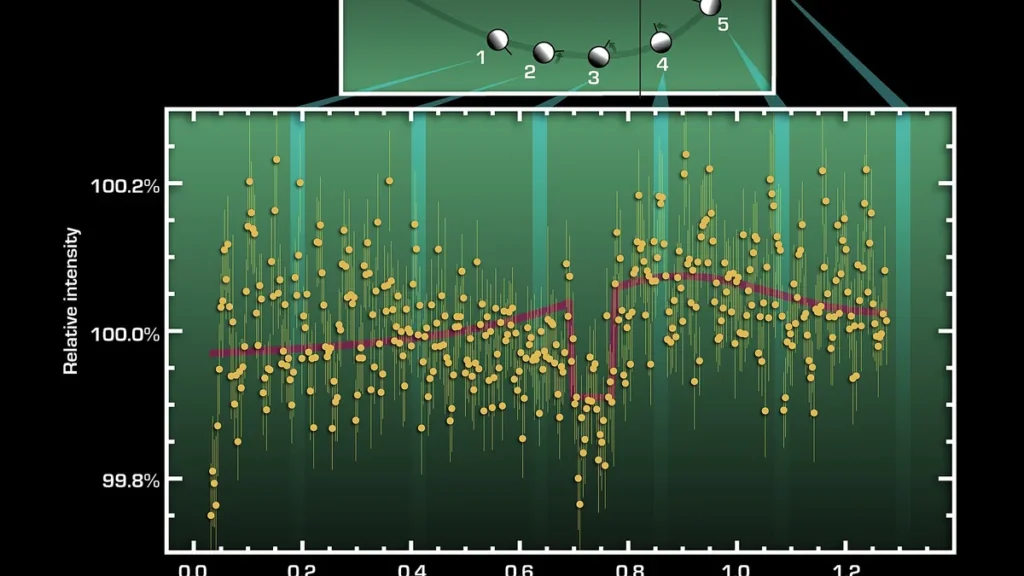
The team demonstrated the package using a box-least squares search of 324,530 Transiting Exoplanet Survey Satellite light curves to separate real transit events from other signals. The demonstration compared the TESS light curves against Kepler observations of the same stars to verify which signals were genuine.
The demonstration suggests a planet catalog built from dim targets fainter than 13.5 Tmag can match the real-event fraction of bright targets brighter than 13.5 Tmag for short-period events in the TESS-Gaia light curves. The comparison covers targets on both sides of the 13.5 Tmag threshold and focuses on short-period events.
The authors describe exoVetter as modular and independent of mission data so it can be expanded and included in transit search pipelines for many science cases and missions. Because the package does not depend on mission-specific data, the researchers say it can fit into various pipelines and be extended for new science cases.
An earlier conference abstract called Exovetter: A Vetting Metrics Framework for Transiting Exoplanets appeared in Bulletin of the AAS, Vol. 56, Issue 2, on Feb. 7, 2024. It listed Matthew Dallas, Susan Mullally, Pey Lian Lim, Fergal Mullally and Michelle Kunimoto as authors and described Exovetter as a Python package that combines exoplanet transit vetting algorithms into a single pip-installable distribution. The abstract appears under a Creative Commons Attribution 4.0 International License as part of the AAS243 meeting abstracts.
That earlier work positioned Exovetter as a continuation of vetting used in the TESS, Kepler and K2 missions. Transit signal vetting has supported those survey missions in creating catalogs of transiting exoplanets by separating true transit signals from false positives driven by stellar variability and noise.
Researchers calculate metrics from photometric and pixel-level time series to separate true transit signals from false positives caused by stellar variability and noise. The package uses astropy units and the lightkurve package as part of its standardized framework. The earlier package builds on Kepler vetting tools but applies a standardized framework to all algorithms using those tools.
The authors say the framework supports extension for future missions, citing the Roman Galactic Bulge Time Domain Survey as an example. Exovetter supports simple visualizations and customizable vetting pipelines for any time series photometry. The earlier work shares the same research lineage as the new paper, sharing lead author Matthew Dallas and co-authors Fergal Mullally and Michelle Kunimoto.
The earlier demonstration built a simple pipeline and vetted a catalog of known planets and false positives discovered with TESS. The authors provided several instructional Jupyter notebooks that explain each vetter and how to use it.
The package is open source and the authors welcome community improvements and new vetter contributions. The GitHub repository at github.com/spacetelescope/exovetter belongs to Space Telescope Science Institute and carries a BSD 3-Clause license. The code builds on the Astropy package template, which is also licensed under the BSD 3-clause license.
Astrobiology Web lists a journal reference in Publications of the Astronomical Society of the Pacific for 2026, giving the reference as Volume 138, Issue 10, id.104504, 13 pp. Cosmos Week calls the paper a preprint awaiting peer review and labels the result as provisional.
Cosmos Week states that the analysis has not yet undergone formal peer review. The outlet presents its commentary as an editorial reading and urges caution until peer review and independent follow-up are complete.
Cosmos Week frames the work within a shift in exoplanet science from simple discovery to comparative characterization, saying individual detections matter most when they add well-constrained data points to broader frameworks rather than standing alone as anecdotes.



Join the discussion