Key facts
- Late at night on November 2 and 3, the moon, Mars, and Jupiter will line up closely above the eastern horizon.
- On November 2, the moon, Mars, and Jupiter will sit within roughly six degrees of each other, about the span of a binocular field.
- Regulus, Leo's brightest star, will appear just below the moon, Mars, and Jupiter on November 2.
- All three can be seen together from Sunday through Tuesday, after which they will separate farther in the sky.
Look for the moon, Jupiter and Mars near Regulus in Leo late on Nov. 2 and 3, National Geographic reports.
Look toward the east-southeast and scan higher in the sky during the overnight hours from Sunday through Tuesday, News 12 advises. Find the moon first and use it as a guide to locate the nearby planets in the dark early morning sky. National Geographic places the close lineup above the eastern horizon late on Nov. 2 and 3, when Regulus, Leo’s brightest star, appears just below the moon, Mars and Jupiter. On that night, the moon, Mars and Jupiter sit within roughly six degrees of each other, about the span of a binocular field.
The moon will be highest on Sunday morning, close to Mars by Monday, and lower and below Jupiter on Tuesday, according to News 12. This shift occurs because the moon rises a little later each night and appears to dance among the planets. After Tuesday, the three separate farther apart in the sky. Expect clear and dry weather that is cold, with Sunday morning the coldest; News 12 advises viewers to grab warm coats on the way out the door.
You do not need a telescope. Jupiter is bright and visible without aid, while Mars appears smaller with an orange glow. News 12 recommends using the moon as a guide to locate the two planets in the dark early morning sky. An hour before sunrise, the crescent moon will be 43 percent illuminated and 60 degrees above the south-southeast horizon, Jeffrey L. Hunt reports, giving these details for the gathering of the moon, Jupiter and Mars near Regulus.
Jeffrey L. Hunt described the scene this way: “The crescent moon, 43% illuminated, is 60° above the south-southeast horizon. Bright Jupiter is 6.1° to the lunar orb’s lower left.” – Jeffrey L. Hunt
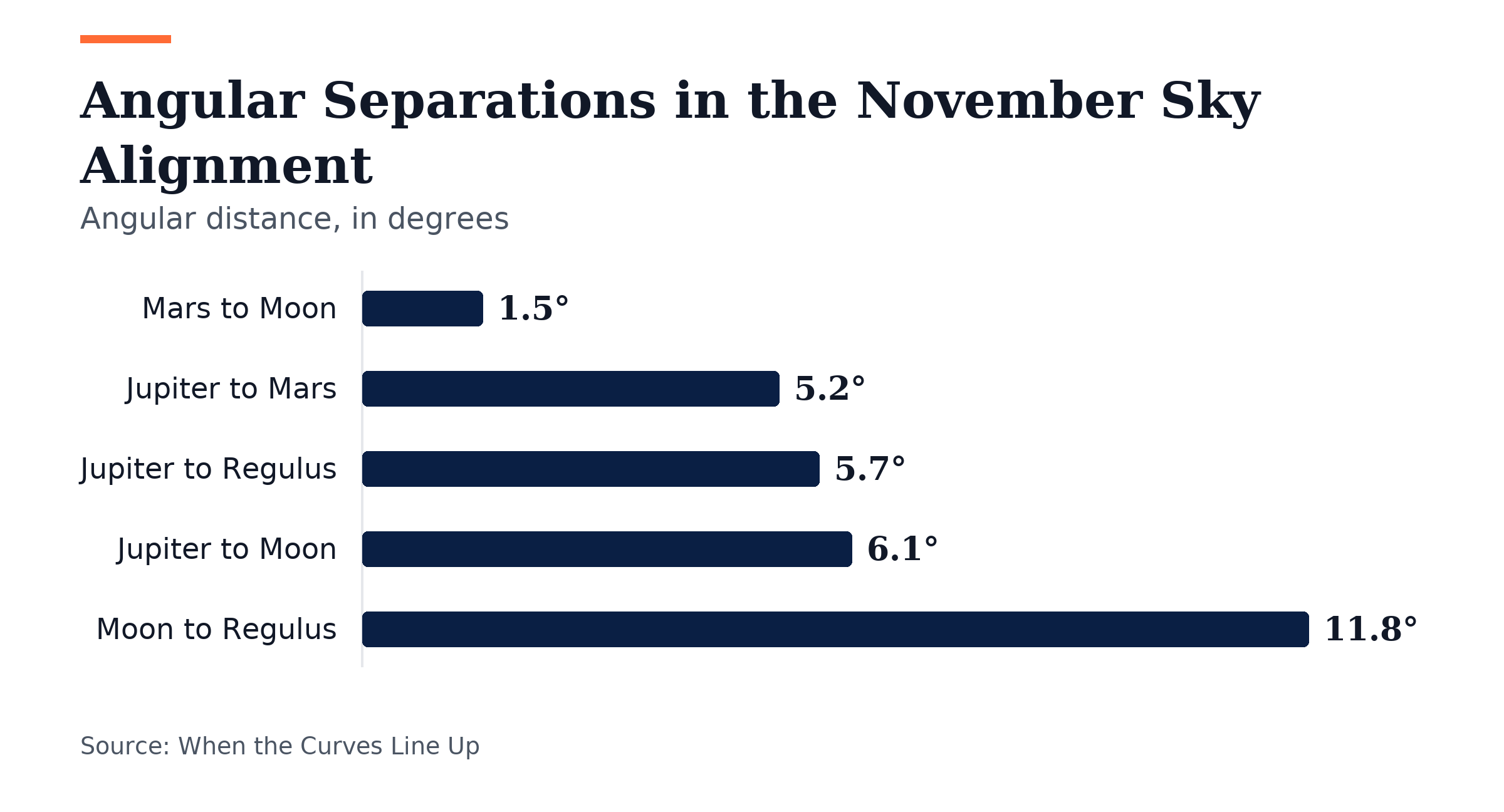
Jupiter lies 6.1 degrees to the lower left of the moon, while Mars sits 1.5 degrees to the lower left of the moon, describing the solar system trio in front of Leo during the gathering. Jupiter also lies 5.7 degrees to Regulus’s upper right and 5.2 degrees to Mars’s lower left, angular separations Hunt lists as part of the geometry of the moon, Jupiter, Mars and Regulus.
The moon-to-Regulus gap measures 11.8 degrees, Jeffrey L. Hunt explains, too wide for the whole group to share one binocular field; Hunt uses this limit to explain why binoculars may show the planets together but exclude Regulus from the same view. West Coast viewers see the moon nearer to the planets at rise time, close enough for a single binocular field, a regional difference Hunt notes compared with the wider separation described elsewhere.
For North American viewers, the tightest four-body grouping happens Nov. 30 inside a 5.2-degree circle, fitting one binocular field, with separations ranging up to 15.2 degrees. Hunt encourages readers to mark their calendars for this later close bunching.
On Oct. 31, Mars moves into Leo, sitting 6 degrees west of Jupiter and 12 degrees west of Regulus, at magnitude +0.9 and 134 million miles, or 12 light-minutes, from Earth. Jupiter crossed from Cancer into Leo the previous month and rises above the east-northeast horizon soon after 2:30 a.m. local daylight time. Joe Rao, an instructor and guest lecturer at New York’s Hayden Planetarium, writes that the best time to view Jupiter in a telescope is as dawn begins to break, when it stands roughly halfway up the eastern sky.
Such groupings happen infrequently. Mars passes Regulus roughly every two years, while Jupiter’s conjunction cycle with the star lasts nearly 12 years. Hunt adds that the moon joins the two planets near Regulus during each lunation, or lunar month, through June 2027. This gathering is part of a rare series of groupings involving Jupiter, Mars, the moon and Regulus in Leo leading up to mid-2027.
The infrequency of such groupings, combined with the planets’ approach to opposition, gives the event its observational appeal.
Jeffrey L. Hunt reported on Oct. 24, 2026, that Jupiter and Mars approach opposition and their respective periods of retrograde while appearing near Regulus. Hunt explained the planetary positions as each body approaches opposition and retrograde motion in front of Leo, with the moon joining them every lunation through June 2027; this ongoing series of lunar visits occurs monthly as the two planets move near Regulus.
Hunt says the next comparable gathering occurs Sept. 29, 2062, when the four bodies fit in a 7.7-degree circle from mid-America, too wide for one binocular field. He presents this date as a future rarity after the current series of groupings.
Hunt stated on Oct. 24, 2026, that Mars passes Jupiter on Sept. 26, 2062, when Mars is not near opposition and continues marching eastward at about 0.5 degrees daily. This orbital movement explains why Mars is far from Jupiter when the moon returns to the region on October 27, 2062, following the September 2062 display.
Hunt reported on Oct. 24, 2026, that Mars reaches opposition on May 14, 2063. The future opposition date provides context for the long-term cycle of Mars positions relative to Jupiter and Regulus across decades.
When the moon returns to the region on Oct. 27, 2062, Mars sits 13 degrees east of Jupiter and nearly 18 degrees east of Regulus. These wider separations occur because Mars continues its eastward march after passing Jupiter in September 2062 without being near opposition.
National Geographic points to another target nearby: the Beehive Cluster, an open star grouping in Cancer. Find it by following the line of dots upward; under dark skies it looks like a smudge, while binoculars or a telescope show roughly 1,000 stars. National Geographic suggests using a stargazing app to help navigate the night sky after finding the cluster.
For U.S. skywatchers planning an outing, sunrise in Chicago is at 6:24 a.m. CDT and sunset at 4:44 p.m. CST, according to the US Naval Observatory’s MICA computer program. An hour before sunrise places the crescent moon high in the south-southeast sky.


Join the discussion