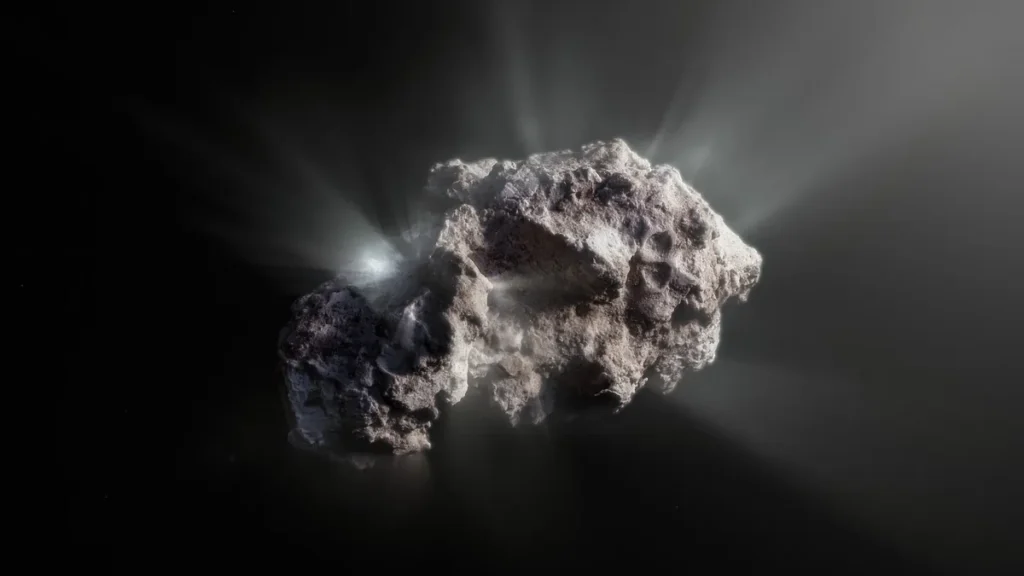
Key facts
- 3I/ATLAS is only the third known interstellar object, following 1I/'Oumuamua and 2I/Borisov.
- The study is posted as arXiv:2610.37540 [astro-ph.EP], version 1, submitted on October 27, 2026 at 16:55:04 UTC.
- The Webb interstellar object program is led by Dr. Martin Cordiner of NASA's Goddard Space Flight Center and the Catholic University of America.
- Radio telescope observations detect high levels of deuterated water in 3I/ATLAS, at a ratio 30 times higher than comets in our solar system and 40 times higher than water in Earth's oceans.
A team using the James Webb Space Telescope’s MIRI instrument gathered low-resolution mid-infrared spectroscopy of interstellar comet 3I/ATLAS after the comet passed perihelion, when it stood 2.21 astronomical units from the Sun. The study was submitted as arXiv:2610.37540 [astro-ph.EP], version 1, on Oct. 27, 2026 at 16:55:04 UTC. Cristina A. Thomas, Michael S. P. Kelley, David E. Harker, Martin A. Cordiner, Davide Farnocchia, Dennis Bodewits, Steven B. Charnley, Maria N. Drozdovskaya, Marco Micheli, Stefanie N. Milam, Cyrielle Opitom, Silvia Protopapa, Nathan X. Roth, and Megan E. Schwamb wrote the paper.
A prominent 10-micron silicate emission feature appears in the spectrum, with a broad, smooth shape unlike those typically seen in comets of our solar system. Researchers fit the data with thermal emission from amorphous carbon, amorphous olivine, and amorphous pyroxene grains. The models strongly favor a pyroxene-dominated, amorphous silicate makeup, while revealing a degeneracy between silicate grain size and the relative amount of silicate and carbon dust.
Among the representative models tested, the best fit finds zero crystalline material (silicates with an ordered atomic structure), and the researchers set an upper limit of 5.3 percent on the silicate crystalline fraction. The group also spots an emission feature near 6.83 microns consistent with aliphatic C-H-bearing material.
Because the silicate composition is overwhelmingly amorphous, it supports earlier work indicating that 3I/ATLAS material underwent little thermal processing and retains information about the conditions under which the interstellar planetesimal formed. That earlier work involved unusual volatile and isotopic measurements in the comet.
A Southwest Research Institute-led team observed 3I/ATLAS with Webb’s Near-Infrared Spectrograph on three occasions from August 2025 through April 2026, capturing the comet before and after its closest approach to the Sun. Dr. Martin Cordiner of NASA’s Goddard Space Flight Center and the Catholic University of America leads the Webb interstellar object program. Dr. Silvia Protopapa of the Southwest Research Institute is lead author of the resulting paper, and Dr. Michael Kelley of the University of Maryland is second author. Cordiner said, “We designed this program to be ready the moment an active interstellar comet was found and to follow it over time.”
Ice grains surrounding 3I/ATLAS measure about a micron or smaller and consist of water ice mixed with dust. Water ice produces an absorption band near 3 microns along with weaker bands near 1.5 and 2.0 microns, though most comets in our solar system display all three bands together. Light-scattering models favor grains about a micron or smaller made of water ice mixed with dust. This combination sets the comet apart from most studied comets in our solar system while matching the spectral signatures of icy worlds orbiting beyond Neptune.
By April 2026, as the comet moved away from the Sun, the data pointed to an added population of ice-rich grains larger than earlier ones but still about a micron across. The researchers compared 3I/ATLAS to Webb spectra of trans-Neptunian objects, finding that the 3-micron water-ice band matches several groups of these distant bodies, particularly those carrying carbon dioxide ice and organic compounds.

The researchers suggest that icy planet-building blocks here and around other stars may share ice in micron-scale grains ranging from pure ice to ice mixed with dust, placing 3I/ATLAS toward the dusty end. Future Webb observations of solar system comets, alongside spectra of new interstellar visitors, will help test whether 3I/ATLAS represents typical icy bodies from other stars or an outlier.
ALMA observations reveal that 3I/ATLAS holds an unusually high amount of methanol compared with hydrogen cyanide, with methanol-to-HCN ratios of about 70 and 120 on two dates in late 2025. Methanol seems to come from both the nucleus and ice particles in the coma, while hydrogen cyanide comes mainly from the nucleus. The scientists focused on methanol and hydrogen cyanide to identify the chemistry carried by the comet, offering a rare chance to study how small icy bodies form in another planetary system. Nathan X. Roth, lead author and American University professor, said, “Observing 3I/ATLAS is like taking a fingerprint from another solar system.”
Radio telescope observations find high levels of deuterated water (heavy water, in which deuterium replaces ordinary hydrogen) in 3I/ATLAS, with a ratio 30 times higher than in solar system comets and 40 times higher than in Earth’s oceans. Solar system comets contain one deuterated water molecule per 10,000 ordinary water molecules, while 3I/ATLAS shows a ratio 30 times higher. The processes that raise deuterated water levels generally need conditions below about 30 Kelvin, or roughly minus 406 degrees Fahrenheit.
Researchers used ALMA in Chile to detect deuterated water but could not directly observe ordinary water, so they applied a mathematical model based on methanol measurements to calculate ordinary water amounts. ALMA observed 3I/ATLAS on November 4, 2025, six days after the comet reached its closest point to the Sun. Nature Astronomy published the heavy-water findings on April 23, 2026, based on radio telescopes at the Atacama Large Millimeter/submillimeter Array in Chile. Luis Salazar Manzano is the lead author of that heavy-water study.
3I/ATLAS is only the third interstellar object known, after 1I/’Oumuamua and 2I/Borisov. 1I/’Oumuamua passed through in 2017 and 2I/Borisov appeared in 2019. Astronomers spotted 3I/ATLAS in July 2025 at roughly three times the distance between Mars and the Sun, and tracking its path showed it came from another star system.




Join the discussion