
Key facts
- Xona's Pulsar system broadcasts L-band signals from Low-Earth Orbit, roughly 20 times closer than GPS, allowing integration into many existing GPS receivers without new hardware.
- Xona raised $250 million in Series D funding on Oct. 22, 2026, with Steve Jurvetson's Future Ventures leading, at a $2.45 billion valuation.
- Xona claims Pulsar offers centimeter-level accuracy and beams up to 100 times stronger than GPS signals, while also resisting jamming and functioning indoors.
- The FCC approved Xona's full satellite network in August, and Xona describes it as the first and only authorization for a private navigation system working next to government-run systems.
Xona Space Systems deployed its first six commercial navigation satellites into orbit on Oct. 20, 2026, launching aboard SpaceX’s Bandwagon-5 rideshare. The launch marked the initial deployment of the company’s Pulsar navigation constellation.
Xona’s Pulsar system broadcasts L-band signals from Low-Earth Orbit, the region of space relatively close to Earth, roughly 20 times closer than GPS, at an altitude of roughly 1,250 miles. The proximity lets many existing GPS receivers use the signal without new hardware.
Xona raised $250 million in Series D funding on Oct. 22, 2026, with Steve Jurvetson’s Future Ventures leading the round at a $2.45 billion valuation. The round followed a $170 million Series C by seven months and brings total funding since 2019 above $570 million. Jurvetson has invested in just three space companies: SpaceX, Planet and Xona.
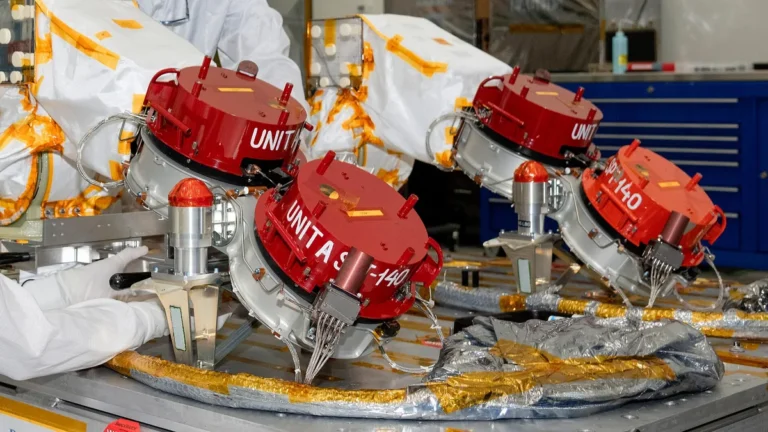
Four satellites manufactured by Aerospacelab will back early beta service across several countries in early 2027. Two spacecraft assembled internally will validate the architecture for scaling the full constellation. Xona was the largest customer on the Bandwagon rideshare. Xona built the two in-house satellites at the Burlingame, California factory to test a design aimed at production of several satellites a week.
Xona’s demonstration satellite, Pulsar-0, launched in mid-2025 on a SpaceX Transporter-14 flight. A company blog post cited in one source describes more than 500 transmissions, while another source puts the total at more than 350 passes over four continents. Manning said current commercial receivers can receive the Pulsar signal without any hardware modifications.
Xona claims Pulsar offers centimeter-level accuracy and beams signals up to 100 times stronger than GPS, while resisting jamming and functioning indoors. One source describes the network as demonstrated to resist jamming and reach indoors. The FCC has not validated the accuracy, security or reliability of these services.
The FCC approved Xona’s full satellite network in August, and Xona describes it as the first and only authorization for a private navigation system working next to government-run systems. The approval covers more than 250 satellites, while a separate description proposes a 258-satellite constellation. The FCC initially authorized 16 spacecraft and requires half the constellation by July 2032 and the full constellation by July 2035.

CEO Brian Manning said U.S. industries integrate Chinese signals alongside GPS for resilience, calling the dependence a vulnerability ingrained in critical infrastructure. He made the point on the GPS Under Attack panel at Silicon Valley Space Week. Manning acknowledged that receiver makers cannot drop those signals and stay competitive globally, but said reliance on Chinese and Russian signals weakens the U.S. position. The comments came as Xona moved its first hardware into orbit.
Manning said military drone builders are removing GPS chips because they distrust the signal, and that bad location is worse than no location because it can cause strikes on one’s own troops. Speaking on the MilSat Symposium panel moderated by Ahsun Murad of Optimal Satcom, he said inertial sensors can counter jamming, but false location is dangerous, and spoofing GPS requires about as much skill as typing the Google. Manning said, “It’s actually worse to have bad location than no location.”
Col. Jon Strizzi said 14 GPS IIIF satellites are on contract, five are in assembly, integration and test, and he expects first deliveries in mid-2027. Strizzi, director of Space Systems Command’s Space Systems Integration Office, gave the Space Force GPS update on the same panel as Manning. Other panelists were Jeff Janicik of Innoflight, Monali Jain of AutonomousLabs.Space and Sumant Sharma of EraDrive. The update covered the military’s GPS IIIF procurement schedule.
Manning told Forbes that Xona began the year with an empty warehouse and now operates a functional satellite factory. “The last several years were about proving that a commercial company could build a fundamentally better navigation system,” Manning said.
According to Xona, vast numbers of devices depend on signals vulnerable to jamming or spoofing, and updating government-operated navigation systems is slow and costly. The company puts the number of affected devices in the billions. One source describes Pulsar as a commercial rival to the U.S. government-operated GPS and says its signals resist jamming and reach indoors.



Join the discussion