Key facts
- The 2020 US Astronomy and Astrophysics Decadal Survey recommended HWO as the top priority for NASA's next flagship astrophysics mission.
- A June 2026 study in the Journal of Astronomical Telescopes, Instruments, and Systems introduced Exploratory Analytic Cases to balance HWO science goals with engineering needs.
- EAC1 is a 6-meter inscribed / 7.2-meter circumscribed off-axis design.
- EAC2 is a 6-meter round off-axis design.
Drawn from NASA centers and JPL, the Systems Engineering Team finished designs for EACs 1 through 3, work introduced in a June 2026 study.
The 2020 US Astronomy and Astrophysics Decadal Survey recommended HWO as the top priority for NASA’s next flagship astrophysics mission. Work on the program has continued for about 10 years. The first confirmed exoplanet around a sun-like star was discovered in 1995.
The observatory will follow Roman as NASA’s next flagship astrophysics mission and become the first space telescope specifically engineered to detect life on another world. The mission aims to photograph at least 25 Earth-like worlds orbiting nearby Sun-like stars within their habitable zones and study their air for chemical signs of life including oxygen and methane.
A credible life detection requires several gases simultaneously, such as oxygen plus methane or ozone plus disequilibrium indicators. Detecting a single gas like oxygen would not be enough to claim a life detection.
Blocking a star’s glare demands extraordinary optics: HWO’s coronagraph must cut starlight by 10 billion, or 10^10, so the faint reflected light from an Earth-like world becomes visible.
No existing coronagraph, on the ground or in space, has ever achieved 10^10 suppression. The Nancy Grace Roman Space Telescope’s Coronagraph Instrument achieves roughly 100 million to 200 million suppression in its best operating mode, between 10^8 and 10^8.3. That makes HWO’s engineering challenge roughly 50 times harder than Roman’s coronagraph has demonstrated. HWO technology maturation literature documents that suppression level.
The telescope’s optical wavefront has to stay within 10 picometers of stability during each control cycle, about 1,000 times steadier than anything JWST has shown. Its 8-metre mirror must hold steady to within an atom’s width.
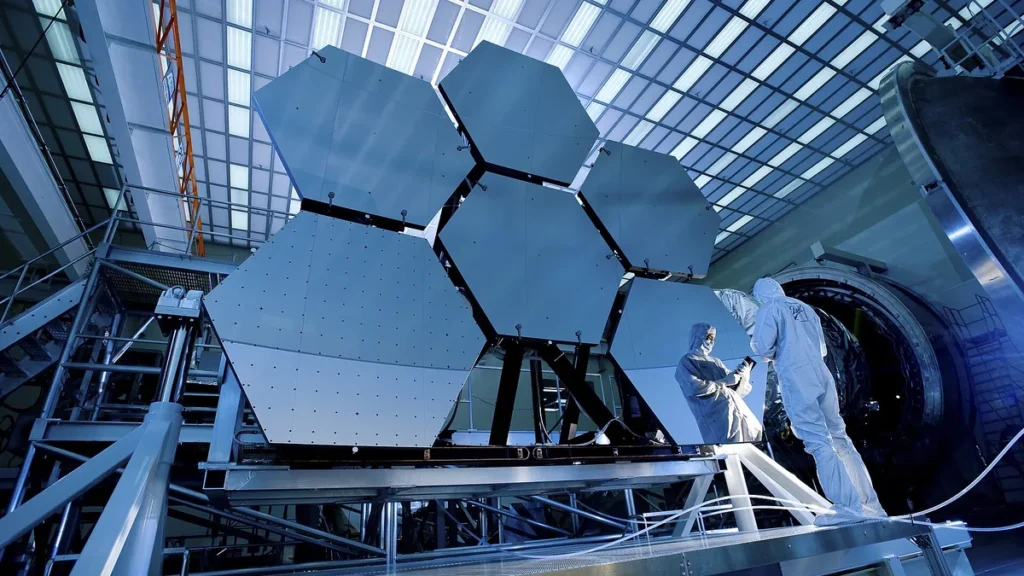
A study published in June 2026 by the Journal of Astronomical Telescopes, Instruments, and Systems presented Exploratory Analytic Cases as a way to weigh HWO science aims against engineering limits. The first concept, EAC-1, uses a 6-meter inscribed / 7.2-meter circumscribed off-axis layout. EAC-2 is a 6-meter round off-axis design. EAC-3 is an 8-meter outer diameter on-axis design.
The team preferred off-axis layouts because they gather more light and provide a bigger collecting area. All three designs include an extendable barrel to protect the primary mirror from micrometeorite impacts. The team has not selected the final design, and the decision awaits the Mission Concept Review.
Temperature properties influence HWO’s light-collecting and telescope operations, especially for the coronagraph instrument that blocks the star’s glare. That instrument enables direct imaging of orbiting exoplanets by blocking out the star’s glare.
The High Resolution Imager serves as HWO’s primary imaging camera and also handles grism spectroscopy, sub-microarcsecond astrometry, fine guidance, wavefront sensing and pupil imaging.
Light gathered across a 3’x2′ field passes through two collimating mirrors before a dichroic splits it into ultraviolet-to-visible and near-infrared channels for simultaneous observing. The ultraviolet-to-visible channel covers 200-900 nm and the near-infrared channel covers 0.9-2.2 um. Minimizing reflective surfaces upstream of the dichroic maximizes throughput and stability while reducing wavefront error.
The camera can expose the full field for at least 10 seconds or switch to smaller windows for readings as fast as 1 kHz. The optical path packages into the required volume without contortion, and one forward interchange mechanism reconfigures both arms.
HRI’s UVIS front-end electronics sit behind the focal plane assembly but outside the cold enclosure. That placement keeps the largest dissipator out of the volume that must reach 178 K.
The UK is leading development of HWO’s High Resolution Imager and Multi-Object Spectrograph, expected to be core instruments on the telescope. UK researchers received £3 million from the UK Space Agency to develop HWO instruments. The funding expands the scale of previous studies.
Professor Martin Barstow of the University of Leicester leads the UK HWO community and works with the UK Space Agency and the wider UK astronomy community on participation plans. Dr Vincent Van Eylen heads an exoplanet group at UCL’s Mullard Space Science Laboratory and leads the UKSA-funded HRI team spanning 7 UK institutes.
STFC supported national workshops held by the UK astronomy community over the past three years to set scientific priorities. Barstow warned that possible funding reductions could hurt Britain’s role in leading a core instrument and limit the science return when operations start in two decades.
NASA’s Goddard Space Flight Center and JPL established the HWO Technology Maturation Project Office in August 2024. The office wants every critical technology to reach Technology Readiness Level 5 by 2029, clearing the way for a Mission Concept Review and Phase A by 2030.
Work is underway on two testbed facilities: the Ultra-Stable Structures Laboratory and Mini-MUST at Goddard, along with Decadal Survey Testbed 2 at JPL inside a large 12-meter vacuum chamber. Goddard received Mini-MUST’s thermal vacuum chamber in July 2025.
NASA handed out three-year fixed-price contracts on January 5, 2026, to seven companies working on HWO technology across the design options: Astroscale U.S., BAE Systems Space and Mission Systems, Busek, L3Harris Technologies, Lockheed Martin, Northrop Grumman and Zecoat. The agency did not disclose the value of individual contracts.
The FY2026 budget request asked for only $3.3 million for HWO technology work, an 81% reduction from earlier funding. Lawmakers put $150 million toward HWO in a minibus spending bill passed January 5, 2026. The administration’s FY2027 budget proposal, released April 3, 2026, would cut HWO funding to $5 million.
The Astro2020 Decadal Survey points to a full-lifecycle development cost of at least $11 billion, while NASA has not published a current official estimate. NASA scientist Giada Arney said, “We just found out that we’re finally going to get to accelerate our mission progress with real funding.”
NASA stood up the HWO Precursor Science Investigations program through ROSES-2025 Amendment 68 on July 27, 2026. Mandatory notices of intent are due September 10, 2026, and full proposals are due October 26, 2026, with all submissions going through dual anonymous peer review.
HWO-PSI seeks proposals on stellar characterization and atmospheric science to fill knowledge gaps before the team locks the telescope’s design. Stellar characterization covers stellar activity, debris disk structure and variability that can mimic or mask planetary signals, while atmospheric science models what instruments would see in spectra of planets like early Earth or present Earth. Proposals can address any science driver, including stellar populations, intergalactic medium or high-energy ultraviolet astrophysics, not only life-detection objectives. This breadth matters because precursor proposals are not limited to life detection and can advance HWO’s scientific readiness across domains.
The SPORES-HWO project released a catalog of stellar properties covering 164 top-priority target stars, while the HWO Target Stars and Systems 2025 list names about 100 bright, nearby Sun-like stars. The HWO25 Conference Proceedings from February 2026 contain roughly 73 documents produced by four science working groups.
HWO follows the Nancy Grace Roman Space Telescope as NASA’s next flagship space telescope, with launch expected in the early 2040s. Roman’s Coronagraph Instrument will launch August 30, 2026, and will serve as a technology demonstration for HWO. HWO will open NASA’s next generation of flagship Great Observatories, building on the legacy of Hubble and Webb. NASA leads the mission while international partners provide major elements.
JWST mainly uses transit spectroscopy, but HWO takes direct images of planets around nearby Sun-like stars regardless of whether they pass in front of their stars. HWO would map the same deep cosmic fields as Hubble and JWST, with broader wavelength coverage extending into the far ultraviolet.
HWO will serve broad astrophysics research as a general-purpose facility, not only as an instrument to detect life. The observatory will target nearby stars within around 30 light-years and serve as a general-purpose facility for astronomers, much like Hubble and JWST.
HWO has a limited number of observing hours, and time spent on the wrong star or signal is lost forever. Watching each target star takes a long time because biosignature detection requires observations across multiple spectral bands at once.



Join the discussion