
Key facts
- The results suggest that tidal heating at Enceladus has remained consistent over time.
- Steady peak heating may support a long-lived subsurface ocean, with consequences for astrobiology and outer solar system habitability.
- Researchers modeled flexural bending of chasmata and dorsae across Enceladus to estimate the ice shell's effective elastic thickness and constrain heat flux changes through time and by region.
- Present-day heat flow measured at Enceladus's South Polar Terrain matches the estimated paleo-heat flow in regions outside that terrain.
Chelsea Eakins, Francis Nimmo and Paul Schenk modeled flexural bending of chasmata and dorsae across Enceladus’s ice shell to reconstruct paleo-heat fluxes across the moon, submitting the work to arXiv as 2610.19242 in Earth and Planetary Astrophysics on Oct. 13, 2026. Eakins and Nimmo work at the University of California, Santa Cruz, while Schenk is at the Lunar and Planetary Institute. The file came to 8,220 KB. Chelsea Eakins submitted the arXiv preprint.
The researchers used flexural deformation of surface features across moon regions to derive shell thickness and past heat flow constraints. They estimated the ice shell’s effective elastic thickness by simulating how chasmata and dorsae respond to shell bending, using the results to constrain heat flux changes through time and by region. The effective elastic thickness describes the shell’s resistance to bending under load. This technique connects surface deformation to the thermal evolution of the ice shell.
The authors said present-day heating on Enceladus is reasonably well characterized, and current plume activity suggests locally high heat flow. The study’s introduction notes that plumes point to high present-day heat flow, that researchers mapped current heating, and that the moon’s earlier thermal evolution remains unclear. That gap motivated the flexural modeling approach.
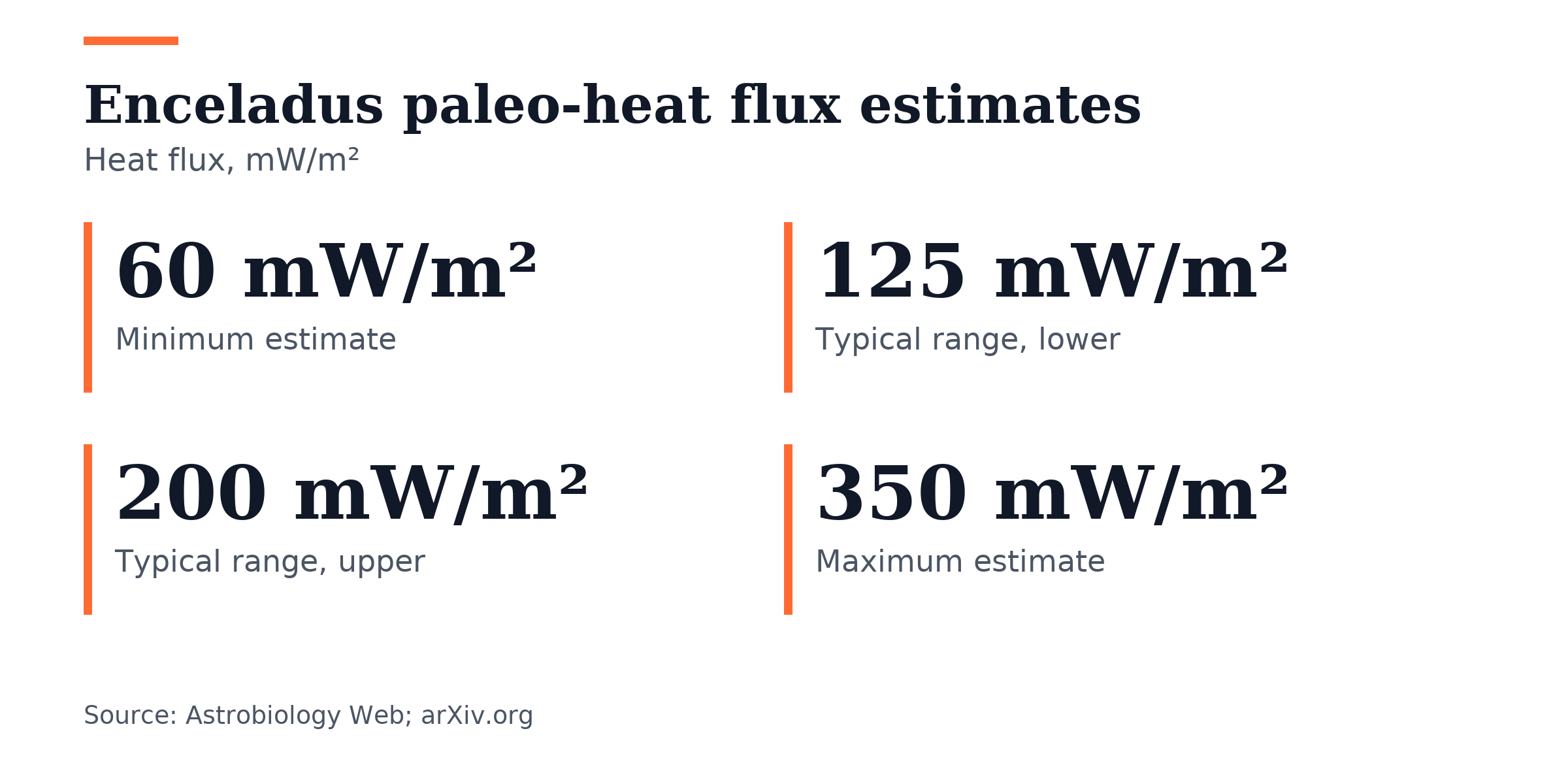
The authors found that paleo-heat fluxes reach 60 to at least 350 milliwatts per square meter, with most values ranging from 125 to 200 milliwatts per square meter. To get those numbers, they simulated how surface features respond to shell bending. Present-day heating is well characterized, but the moon’s thermal history is not well understood, and that gap drove the work.
The authors found that areas beyond the South Polar Terrain saw an earlier heating episode above 100 milliwatts per square meter, after which the shell cooled and thickened. They link that elevated past heat outside the South Polar Terrain to a cycle in which heating came first, followed by cooling and shell thickening, setting those areas apart from the active south pole.
Present-day South Polar Terrain measurements broadly match paleo estimates from other regions. At identical locations, reconstructed paleo values exceed present-day heat flow from shell-thickness maps.
According to the results, tidal heating at Enceladus has stayed consistent over time. From their model outputs, the authors see tidal heating as stable across the moon’s history instead of highly variable.
Steady paleo-heat flow across cratered terrains of different ages backs the resonance-locking idea for tidal dissipation in Saturn and could point to an enduring Enceladus-Dione resonance. The resonance-locking idea proposes that tidal dissipation in Saturn’s system, driven by orbital resonances such as the one between Enceladus and Dione, may explain the moon’s long-term thermal stability. The research ties steady paleo-heat flux from differently aged cratered terrain to tidal dissipation inside Saturn through resonance locking and suggests an enduring resonance with Dione.
Continued peak heating could keep a subsurface ocean beneath Enceladus’s ice alive for a long time, with consequences for astrobiology and outer solar system habitability. The authors tied ongoing peak heating to the chance that liquid water has persisted beneath the ice and flagged the resulting implications for astrobiology.

Join the discussion