Key facts
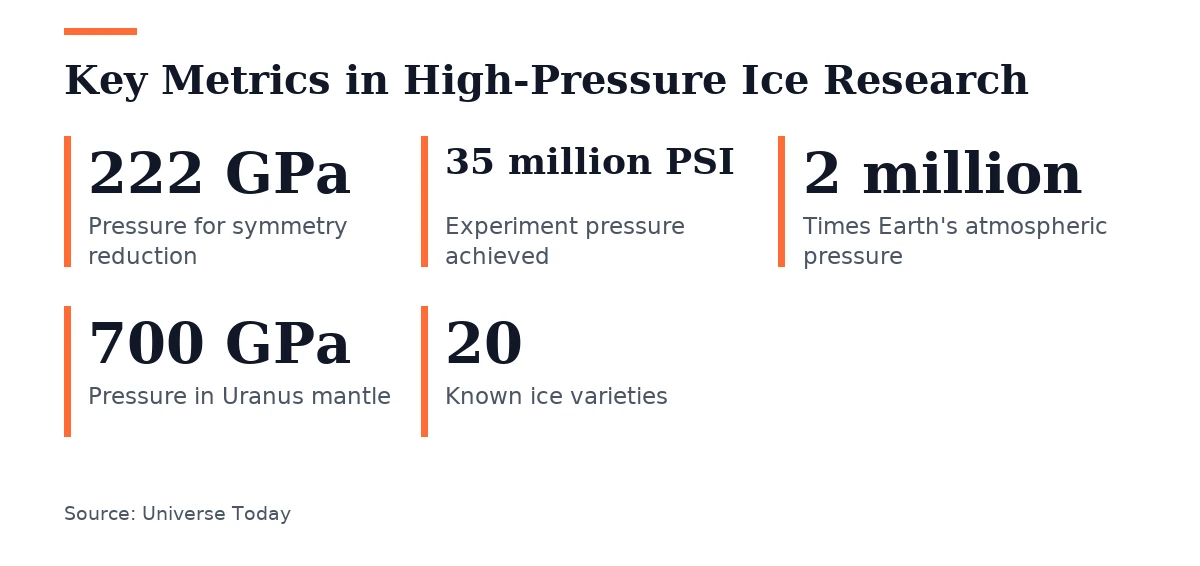
- Researchers report experimental evidence that water ice moves from ice-X to a phase losing cubic symmetry above 222(12) gigapascals.
- Ice-X forms under pressures found in Uranus and Neptune, the Solar System's ice giants.
- In ice-X, oxygen atoms sit exactly halfway between two hydrogen atoms, creating a cubic symmetrical lattice, and water ceases to be molecular.
- The study is titled "Evidence for symmetry-reduction in solid H2O above 222 GPa" and appeared in Communications Chemistry.
Universe Today reported Oct. 21, 2026, that researchers at the University of Nevada Las Vegas have found water ice shifting from ice-X to a phase that loses cubic symmetry above 222(12) gigapascals, pressure found inside Uranus and Neptune.
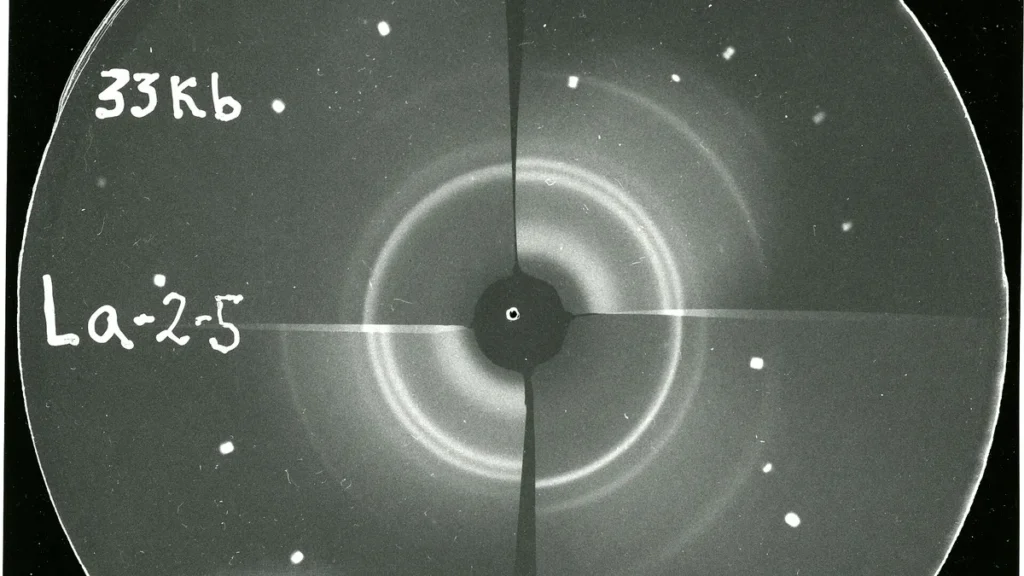
The team placed water into a diamond anvil cell, a device that creates extreme pressures on samples by squeezing them between diamonds. They compressed the water to 35 million PSI, exceeding the threshold needed to form ice-X. That phase occurs in the interiors of Uranus and Neptune. The experiment used spectroscopic tools to watch water as pressure rose past the point where ice-X normally forms.
Using spectroscopy and x-rays, the group examined how hydrogen and oxygen atoms arranged themselves under extreme pressure in the cell. Scientists wanted to know if ice would keep becoming more symmetric at still greater pressure deep inside ice giants. The measurements showed the opposite trend, with symmetry decreasing instead of increasing as pressure climbed. The result contradicts the usual rule that higher pressure means higher symmetry in ice.
Ice-X forms under pressures found in Uranus and Neptune, the Solar System’s ice giants. In that phase, oxygen atoms sit exactly halfway between two hydrogen atoms, creating a cubic symmetrical lattice. Water stays molecular through ice-X. Scientists recognize more than 20 ice varieties, each forming at different pressure and temperature and named by discovery order rather than pressure and temperature sequence.
Ice-X requires pressure not found anywhere on Earth, even in the mantle. Above 222 gigapascals, water ice moved into a structurally more complex form and lost the cubic symmetry of ice-X.
The researchers say the measured equation of state for ice-X and the new phase’s cell parameters match theoretical models, agreeing with predictions about how the solid should behave. The authors state the transition marks a new kind of structural complexity in high-pressure H2O and changes ice-X’s upper stability limit.
The result identifies the pressure at which ice-X stops being stable and where a structurally more complex form of high-pressure water begins. Pressure of 222 gigapascals is more than 2 million times Earth’s atmospheric pressure.
Because ice-X exists at pressures matching those inside Uranus and Neptune, the phase is directly relevant to modeling those planets. Uranus may have an icy-fluid mantle reaching 700 gigapascals, a pressure far above the 222 gigapascals observed in the experiment.
Ashkan Salamat, a physicist based at the University of Nevada Las Vegas who leads the research, said Voyager program data provide information on ice giant compositions and interior pressure and temperature. He said in a press release that water beyond Earth-like conditions behaves more complexly than imagined. The comment came from a press release describing how water behaves under conditions unlike anything on Earth.
He said laboratories can replicate planetary chemistry to test what might happen inside these worlds. “It’s amazing how water can behave under pressure,” Salamat said. The authors write that these experiments show the complexity of compressing water under high pressure.
The study, titled “Evidence for symmetry-reduction in solid H2O above 222 GPa,” appeared in Communications Chemistry. The work emerged from the University of Nevada Las Vegas, where Salamat directs the Nevada Extreme Conditions Lab. Researchers there recreate planetary interior conditions in the laboratory.
The article notes that methane on Mars and phosphine on Venus are examples, though not certain, of chemicals possibly forming through pathways different from Earth’s. Universe Today compares the discovery to those uncertain clues as evidence that other worlds may not follow Earth-based expectations.


Join the discussion