Key facts
- KASA Administrator Taeseog Oh said the agency will actively incorporate on-site feedback from experts and industry leaders into future policies.
- The Korea Aerospace Research Institute released the Guidelines for Private Companies' Use of the Naro Space Center on October 31, 2025, to support private-sector rocket development and launch activities.
- KASA confirmed the October 7, 2026, Nuri launch date during its first launch management committee meeting held on August 27 in Sacheon, South Gyeongsang Province.
- South Korea's stated ambition includes at least one Nuri launch per year starting in 2032 and ultimately four launches every year.
South Korea’s Korea AeroSpace Administration announced on October 26, 2026, that commercial space enterprises may access defense industry mutual aid services and the state-run Naro Space Center in Goheung under a new institutional policy package.
The agency named the defense-industry overhaul its top administrative achievement for 2026. On October 8, 2026, the Defense Acquisition Program Administration and KASA expanded Defense Industry Mutual Aid Association membership to aerospace companies and military support suppliers.
A July 2026 revision to the Defense Industry Development and Support Act now lets commercial space operators use the association’s surety and guarantee services. KASA’s Space Service Development Division partnered with the Defense Acquisition Program Administration to enact the amendments. The changes aim to cut performance bond costs, reduce flight testing liability, and support a domestic space insurance market.
KASA leadership said lowering insurance overhead and expanding spaceport access will anchor commercial space operations in the South Coast Aerospace Industrial Belt. The agency also plans further public-private procurement regulations through 2027 to transfer government-developed space technologies to commercial operators. The October 26 announcement included standardized operational guidelines opening Naro Space Center to private launch operators and reducing dependence on costly overseas spaceports.
KASA unveiled the Naro Space Center Private Sector Utilization Guidelines on June 29, 2026, to improve access to launch infrastructure for South Korean commercial space companies. KASA described the guidelines as an institutional foundation to lower cost burdens for firms that have relied on overseas launch sites or maritime platforms, allowing the full launch vehicle development cycle to occur domestically. KASA’s phased roadmap opens the center to the private sector in the third quarter of 2027, with a second stage in the first quarter of 2031.
Once Stage 2 finishes, an Assembly and Test Facility will enable one-stop launch vehicle assembly and payload testing in a single building at the center in Goheung, South Jeolla Province. The facility would let South Korean private companies handle the entire process from initial testing to final commercial launch.
Until now, South Korean space launch vehicle startups and mid-sized companies have leased expensive overseas launch sites or used maritime launch platforms because the country lacks dedicated private launch infrastructure. Scheduling difficulties at overseas sites and high logistics costs are the biggest pain points for these firms. The center has historically hosted national launch vehicles such as Naro (KSLV-I) and Nuri (KSLV-II), and will open to the private sector starting in 2027 after completion of dedicated commercial facilities.
Private companies must submit launch plans at least four months before the scheduled launch date. They then complete a four-step process involving preliminary consultation, technical safety review and approval, contractual steps including fees and insurance, and launch operations. The guidelines include usage fee discounts based on company size, a mechanism aimed at South Korea’s predominantly small and medium-sized enterprise and startup ecosystem, which has limited financial resources.
Earlier groundwork came on October 31, 2025, when the Korea Aerospace Research Institute released the Guidelines for Private Companies’ Use of the Naro Space Center as a manual to transparently open facilities, equipment, and services to private entities. Korea Aerospace Research Institute President Lee Sangcheol said, “This guideline marks a meaningful first step in sharing the space center assets accumulated by the public sector with private companies.”
At the fourth Aerospace SOS Consultative Meeting on April 29, 2026, at Naro Space Center in Goheung, Jeollanam-do Province, KASA Administrator Taeseog Oh met with companies including INNOSPACE, Perigee Aerospace, and Korea Aerospace Industries. The meeting included a tour of the under-construction commercial launch site and a session to gather policy recommendations from domestic firms preparing for commercial launch services. Participating companies said the lack of domestic land-based launch infrastructure had forced them to seek overseas or sea-based options, and they expressed high expectations for the opening while suggesting simpler administrative procedures and expanded technical support. Oh put it this way: “We will actively incorporate the valuable on-site feedback provided by experts and industry leaders into our future policies,” he said at the meeting.
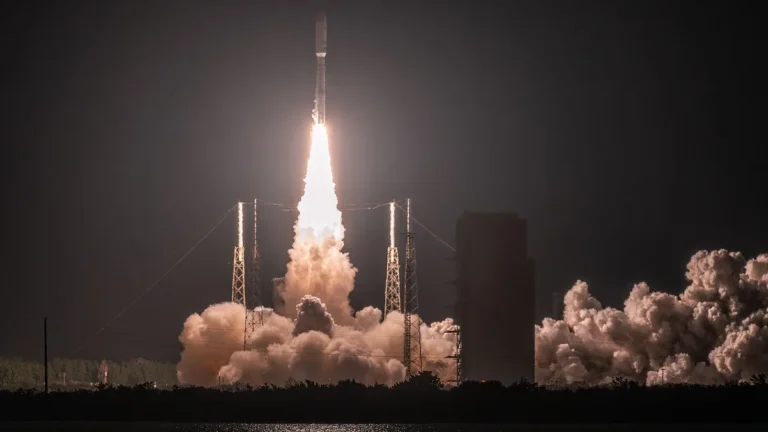
The October 26 policy opening comes alongside South Korea’s move toward private operational command of its national rocket. The homegrown Nuri rocket will lift off from the Naro Space Center on October 7, 2026, carrying 15 satellites into a 500-kilometer sun-synchronous orbit, the largest payload manifest in the program’s five-year history. Hanwha Aerospace will hold end-to-end operational command of the fifth Nuri flight, with full authority over the entire launch process rather than just the assembly lead it held on the fourth flight. KASA confirmed the October 7 date during its first launch management committee meeting on August 27 in Sacheon, South Gyeongsang Province.
The launch window runs from 12:23 p.m. to 1:23 p.m. Korea Standard Time, with a backup window from October 8 through October 14. The date is the third scheduled attempt for the fifth flight, after slips from June 2026 to August and then again because of underperforming thrusters on some nanosatellite payloads.
Nuri is a 47.2-meter three-stage launch vehicle that flew in November 2025. Its first stage clusters four KRE-075 engines generating about 75 tonnes each for a combined 300 tonnes; the second stage uses one vacuum KRE-075 and the third uses a KRE-007. Both engine types run on LOX and Jet A-1, and the all-domestic propulsion distinguishes Nuri from its predecessor, Naro-1, which used a Russian-built first stage.
The 15-satellite manifest includes five NEONSAT spacecraft and 10 CubeSats, and the five NEONSAT cluster satellites collectively weigh approximately 500 kilograms at launch. They are South Korea’s first group of mass-produced Earth observation satellites. The KAIST SaTReC NEONSAT program built them using commercial off-the-shelf components. The program represents a ₩231.4 billion, or about $169 million USD, investment begun in 2020 with an eight-year completion target.
KASA placed the mission in a 500-kilometer sun-synchronous orbit, lower than the 600- to 800-kilometer orbits used in earlier Nuri flights, to provide a morning illumination window while maintaining 1-meter resolution. The 10 CubeSats include one to verify domestically developed components, two from a competitive CubeSat program, and seven from an open public call. Total payload fits within Nuri’s rated capacity of about 1.9 tonnes to 700-kilometer sun-synchronous orbit and 2.2 tonnes to 500-kilometer sun-synchronous orbit.
South Korea deliberately distributes the space industrial ecosystem rather than consolidating under a single prime contractor. South Korea’s ambition includes at least one Nuri launch per year starting in 2032 and ultimately four launches every year, a cadence that requires a commercially managed operation because a government research institute cannot sustain operational decision authority for every flight. Flight 5 authority transfer establishes that baseline, with KSLV-III planned for first flight in the early 2030s. South Korea ratified the K-LEO national broadband plan in July 2026 to deploy a national low-Earth orbit communications network by 2035.
K-LEO, described domestically as a Korean-style Starlink, has three scenarios ranging from 128 to 512 satellites with investment estimated between ₩3.9 trillion and ₩14.2 trillion, or about $2.8 billion to $10.4 billion USD. The Hanwha Group has committed approximately ₩55 trillion, or about $40 billion USD, to aerospace and artificial intelligence through 2040, building toward a vertically integrated capability covering launch vehicles, satellites, and orbital data processing.

Join the discussion