Key facts
- The modeling connects little red dot observations with theory to identify pathways to stellar collisions in dense clusters and supermassive black hole formation.
- Before large spiral galaxies like the Milky Way existed, stars in dense early-universe clusters collided and formed black holes around which galaxies later formed.
- Early-universe stellar collisions happened either at very rapid speeds that destroyed the stars or more slowly so they merged into one.
- Williams noted the Milky Way's center offers a nearby example with a massive black hole sitting inside a dense nuclear star cluster.
UCLA researchers reported Oct. 26, 2026, that James Webb Space Telescope observations of extraordinarily compact early-universe stellar systems point to stellar collisions once far more common than now.
A UCLA-led study posted on the arXiv preprint server found that early-universe stellar systems were dense, with stars frequently hitting each other. The collisions could destroy stars at rapid speed or merge them more slowly.
The paper is titled “A cosmological framework for stellar collisions at high redshift in proto-globular clusters, nuclear star clusters, and Little Red Dots” by Claire E. Williams et al. Phys.org lists the study on arXiv with DOI 10.48550/arxiv.2603.26872, while Mirage News says AAS Journals published it.
UCLA astrophysicist Smadar Naoz co-authored the research connecting dense star clusters to black-hole seeds.
The model states that repeated mergers could create one extraordinarily massive star that might collapse into a black hole. This offers a path to explain how black-hole seeds formed early enough to become the black holes already seen in the early cosmos.
Collisions happened either at rapid speeds that destroyed the stars or more slowly so they merged into one. Before large spiral galaxies like the Milky Way existed, stars in dense early-universe clusters collided and formed black holes around which galaxies later formed.
Williams said dense star clusters naturally give birth to massive black-hole seeds in the model, and that same setting can supply stars and gas shaping later black-hole growth. She noted the Milky Way’s center offers a nearby example with a massive black hole sitting inside a dense nuclear star cluster.
The model states that after a black hole forms, its gravity speeds up nearby stars, so collisions near the black hole destroy the stars instead of merging them and releasing gas nearby.
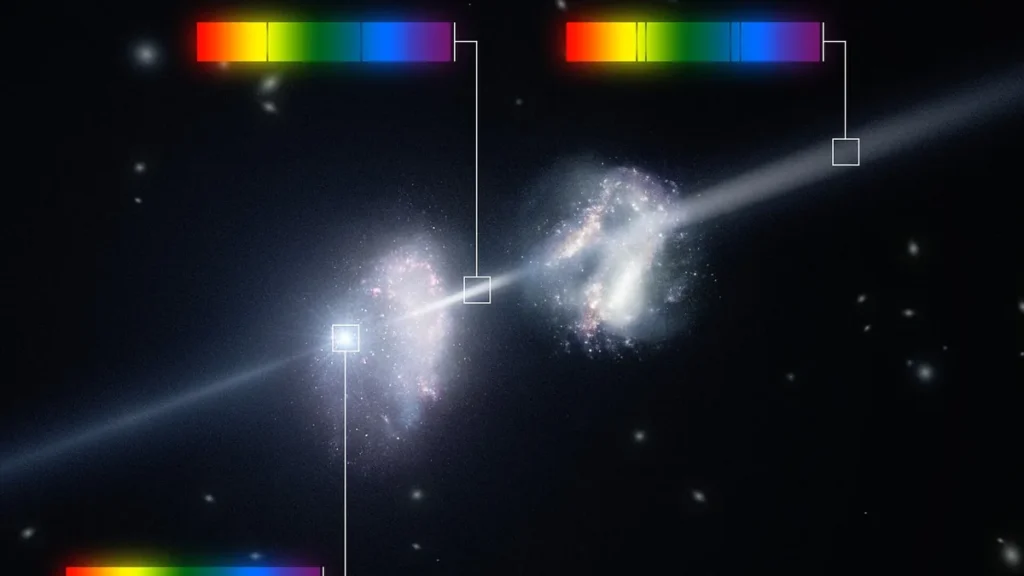
Astronomers expected supermassive black holes to grow gradually, but JWST observations show they formed quickly after the Big Bang. The quick appearance of black holes in the young cosmos has puzzled researchers because gradual growth was the prevailing expectation.
The research is not the first to propose stellar collisions as the mechanism behind supermassive black hole formation. Scientists have debated how enormous black holes appeared so early, and earlier studies have also suggested collisions among stars could contribute. These black holes are elusive, bigger than stellar remnants but smaller than the supermassive black holes at galaxy centers, and observers almost never detect them.
Astronomers describe little red dots as compact early-universe objects that appear as red dots and are thought to hold a rapidly growing black hole at their center. According to the simulations, little red dots might be dense groupings of stars where collisions happen, producing a large star that could later turn into a black hole. Smadar Naoz called little red dots a hot topic and said the research connects perspectives on them.
The modeling connects little red dot observations with theory to identify pathways to stellar collisions in dense clusters and supermassive black hole formation.
Our research connects several of those perspectives together and may help us see more of the elephant.
Smadar Naoz, Phys.org


Join the discussion