Key facts
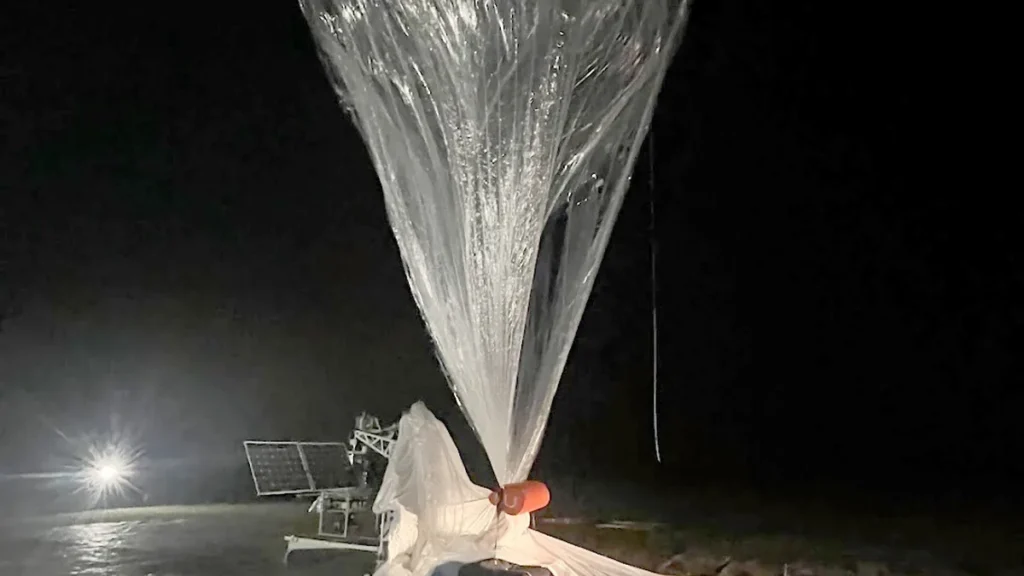
- The August 12 balloon flew for just over two hours, reached a maximum altitude of 102,000 feet (31 kilometers), and landed in a soybean field near Wanamingo, Minnesota.
- Data from the August 12 flight showed an aerosol concentration spike between 6 and 8 miles (9 and 13 kilometers), indicating the team caught the older, more dispersed Widemouth 2 wildfire plume.
- The August 12 smoke came from the Widemouth 2 wildfire in Utah, which produced a pyrocumulonimbus on August 2, 2026.
- NASA’s INSPYRE aircraft collected aerosol data between 39,000 and 44,000 feet (12 and 13 kilometers) when it sampled the Widemouth 2 plume the day after its August 2, 2026 pyrocumulonimbus.
University of Minnesota students launched stratospheric balloons from Minnesota on July 17 and August 12, 2026, to sample wildfire smoke plumes for NASA’s INSPYRE campaign. Sources: NASA Science
The flights came from the University of Minnesota stratospheric ballooning team known as the Smokestack team, advised by James Flaten, a contract professor and associate director of NASA’s Minnesota Space Grant Consortium. NASA Langley researcher Jean-Paul Vernier recruited the group in spring 2025 for the INSPYRE campaign’s Balloon Network for Stratospheric Aerosol Observations project, a multi-year nationwide effort. Vernier contacted Flaten, and five undergraduates met Vernier on campus in August 2025 to begin preparing for on-call smoke missions. Sources: NASA Science
The team’s first test flight took place on August 27, 2025, with Vernier assisting in person and five undergraduate students participating. Students launched, tracked, chased, and recovered the balloon while staffing a ground station and retrieving transmitted sensor data. Afterward, the team ran independent flights and data analysis ahead of the summer 2026 smoke season. Sources: NASA Science
Each balloon carried an iMet radiosonde and a Vaisala radiosonde that gather GPS and basic weather data and send it to ground stations by telemetry radio. The payload also included a Profiling Optical Particle Counter, or POPC, which sits in the payload box on the balloon stack and measures aerosol concentrations. The POPC can track dust, pollution, volcanic plumes, and wildfire smoke, and it provided the readings that confirmed smoke interception on both the July and August flights. A student-built PICOLO flight computer collected additional sensor data, complementing the radiosondes and POPC.
Sources: NASA Science
Jean-Paul Vernier and Rubel Das, a mechanical engineer from NIA and NASA Langley, forecast a pyrocumulonimbus smoke plume (pyroCb) above southern Minnesota on July 15, 2026. Geostationary satellite images confirmed the plume’s path, and Vernier said he saw a red sun during a dog walk in Virginia that day, indicating smoke was in the air along the predicted route. Das helped determine when and where to launch balloons to intercept plumes from Canada, the western United States, or Siberia as they cross Minnesota. Sources: NASA Science
The first official flight started with a 1 a.m. alarm after the group calibrated and packed gear on Thursday afternoon and loaded two rental vans. Rubel Das applied Langley Trajectory Model simulations to provide the team with a tight launch window for the July 17 flight because the forecast plume was moving across southern Minnesota’s border and would disappear by about 7 a.m. on Friday, July 17, 2026. Because night launches carry extra regulations, the team waited until 5:10 a.m. to release the balloon from a Walmart parking lot in Austin, Minnesota. Sources: NASA Science
Lani and Ellie remained at the launch site to operate the ground station and watch radiosonde packets, while Isaiah, Varsha, and James pursued the balloon after a quick breakfast. Crew members released the balloon at 5:10 a.m., and its recovery siren beeped during the flight. The balloon landed in a cornfield just over the Minnesota border in northern Iowa at 7:20 a.m. on July 17, 2026. Isaiah and Varsha traced an audio siren through wet corn stalks to recover the gear.
Sources: NASA Science
The team would not know whether it intercepted the wildfire smoke plume until returning to the lab and extracting data from the POPC. Anticipation filled the drive back to the Twin Cities, though exhaustion from the early wake-up call softened the mood. After the flight, lab work revealed elevated aerosol counts and concentrations between 5 and 6 miles (8 and 10 kilometers), confirming the balloon had reached the smoke plume. The readings aligned with the altitude range the team had forecast for the smoke.
Sources: NASA Science
Isaiah took the raw POPC and iMet data and processed it through a parser script created by Jean-Paul Vernier that merged iMet altitude readings with POPC aerosol counts and concentrations. Vernier later described seeing smoke from Virginia as the plume moved along the predicted path toward Minnesota. “I woke early, and I could see a red sun in front of me while taking my dog for a walk,” Vernier said. Virginia lay on the path before the plume looped around toward southern Minnesota, and the sighting supported the decision to proceed with the overnight launch.
Sources: NASA Science
The team launched a second smoke-sampling balloon on August 12, 2026, at 12:20 p.m. local time from Glencoe Silver Lake Public School. The crew flew without their professor and fixed a problem with the flight computer before assembling the balloon stack. At 12:20 p.m., the stack was airborne with the POPC running and both radiosondes sending data. Sources: NASA Science
The August 12 balloon flew for just over two hours, reached an altitude of 102,000 feet (31 kilometers), and followed a southeastern trajectory right into the smoke plume. It landed in a soybean field near Wanamingo, Minnesota, and recovery was straightforward because the site sat near a road. Forecasters expected the Widemouth 2 smoke plume to spread across the entire southern half of Minnesota during the morning and afternoon of August 12, 2026. Sources: NASA Science
Results from the August 12 flight revealed an aerosol concentration spike between 6 and 8 miles (9 and 13 kilometers), showing the team had caught the older, more dispersed Widemouth 2 wildfire plume. Aerosol levels were far below those from the first flight, suggesting the plume had aged over time. The smoke originated from the Widemouth 2 wildfire in Utah, which produced a pyroCb on August 2, 2026. Verifying the plume’s origin will require more work.
Sources: NASA Science
The INSPYRE aircraft gathered aerosol readings between 39,000 and 44,000 feet (12 and 13 kilometers) while flying through the Widemouth 2 plume on the day following its August 2, 2026 pyrocumulonimbus. The aircraft entered the smoke plume shortly after the pyroCb developed. The student balloon team flew into the same plume more than a week later to track how it changed over time, and the crew also valued sampling the same plume that INSPYRE researchers had intercepted using their fixed-wing NCAR GV aircraft. Sources: NASA Science
INSPYRE depends mainly on fixed-wing aircraft for sampling, but stratospheric balloons can fly far above traditional aircraft at a fraction of the cost. INSPYRE researchers created the Minnesota subteam to help gather data quickly through stratospheric balloon flights. The July 17, 2026 flight also worked as a test flight that prepared the team for higher-impact missions coordinating operations and comparing data with projects including INSPYRE. Sources: NASA Science
The pyroCb smoke plumes the team targets often come from Canada or the western United States, though some originate farther away, such as Siberia. Rubel Das began supporting the team in spring 2026 by forecasting smoke movement so launches could intercept plumes passing over Minnesota. With the 2026 wildfire season ending, the team will refine its process for next year and stay flight-ready through practice flights and global pyroCb monitoring. Sources: NASA Science
The team posted, analyzed, and shared information gathered during the 2026 wildfire season with researchers studying pyroCbs to aid study of a smoke plume’s impact on the planet. With the season ending, the team plans to update its process for next year, remain flight-ready with practice flights and equipment checks, and monitor pyroCb developments worldwide. The authors say the effort adds to the small but growing knowledge of pyroCbs while helping INSPYRE researchers with fast balloon data collection. Sources: NASA Science
Jean-Paul Vernier has set up BalNeO stations at universities in Bauru, Brazil; Reims, France; and Hyderabad, India. The University of Minnesota Twin Cities student ballooning team runs smaller-scale experiments using latex weather balloons. The Smokestack team’s writers trace ballooning back to the 1780s Montgolfier brothers of France and say modern uses include meteorology and science experiments such as temperature and pressure testing, atmospheric sampling, chemistry work, and radio telemetry testing. Sources: NASA Science

Join the discussion