Key facts
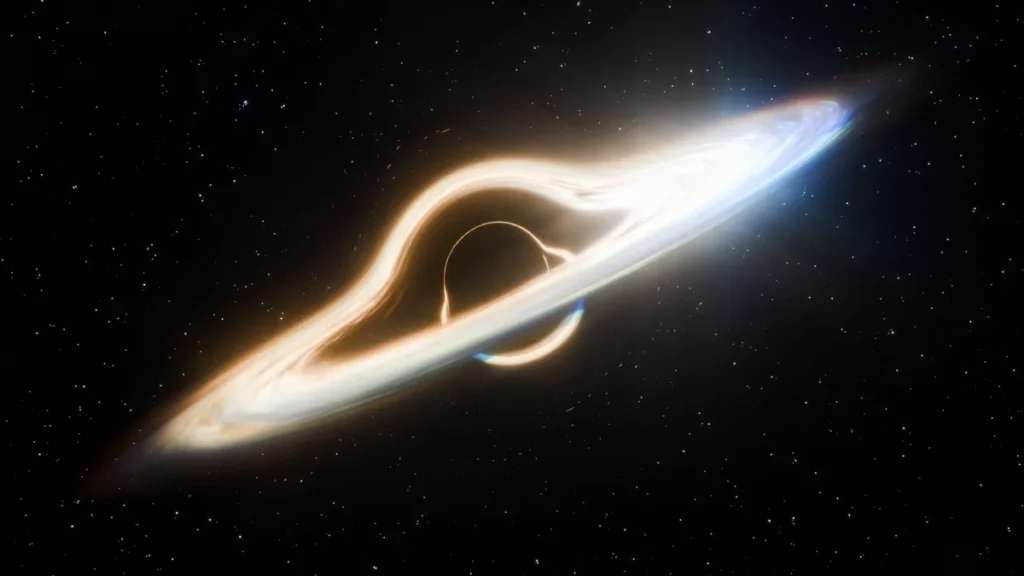
- A pair of black holes near the galaxy's center sits just 620 light-years apart in projection, while a third black hole lies about 5,500 light-years from that center.
- The two central black holes are expected to merge within several hundred million years, potentially forming an even more massive black hole.
- All three black holes in J0148-4214 are actively accreting material, unlike the more quiescent supermassive black hole at the center of the Milky Way and other nearby galaxies.
- Hannah Übler, research group leader at the Max Planck Institute for Extraterrestrial Physics, led the international team and is lead author of the J0148-4214 black-hole study.
Researchers working under the Max Planck Institute for Extraterrestrial Physics identified three actively consuming black holes in galaxy J0148-4214, at a distance of more than 12.5 billion light-years, in research published Aug. 12, 2026. Hannah Übler, a research group leader at the institute, described the find as a first for the distant universe, and the team called it the first evidence of three active black holes in one galaxy in the distant universe. The work appeared in Astronomy & Astrophysics under DOI 10.1051/0004-6361/202557419. ScienceDaily released it Oct. 25, 2026 based on materials from the institute in Garching.
Galaxy J0148-4214 sits more than 12.5 billion light-years away, meaning its light took 12.5 billion years to reach Earth. Observers see the galaxy as it existed about 1.2 billion years after the Big Bang. The team recorded a redshift of z=5.02. The expansion of the universe stretches light into longer, redder wavelengths so the galaxy appears to be moving away, an effect measured as redshift, and the team used that measurement to calculate the distance and place the galaxy in the universe’s infancy.
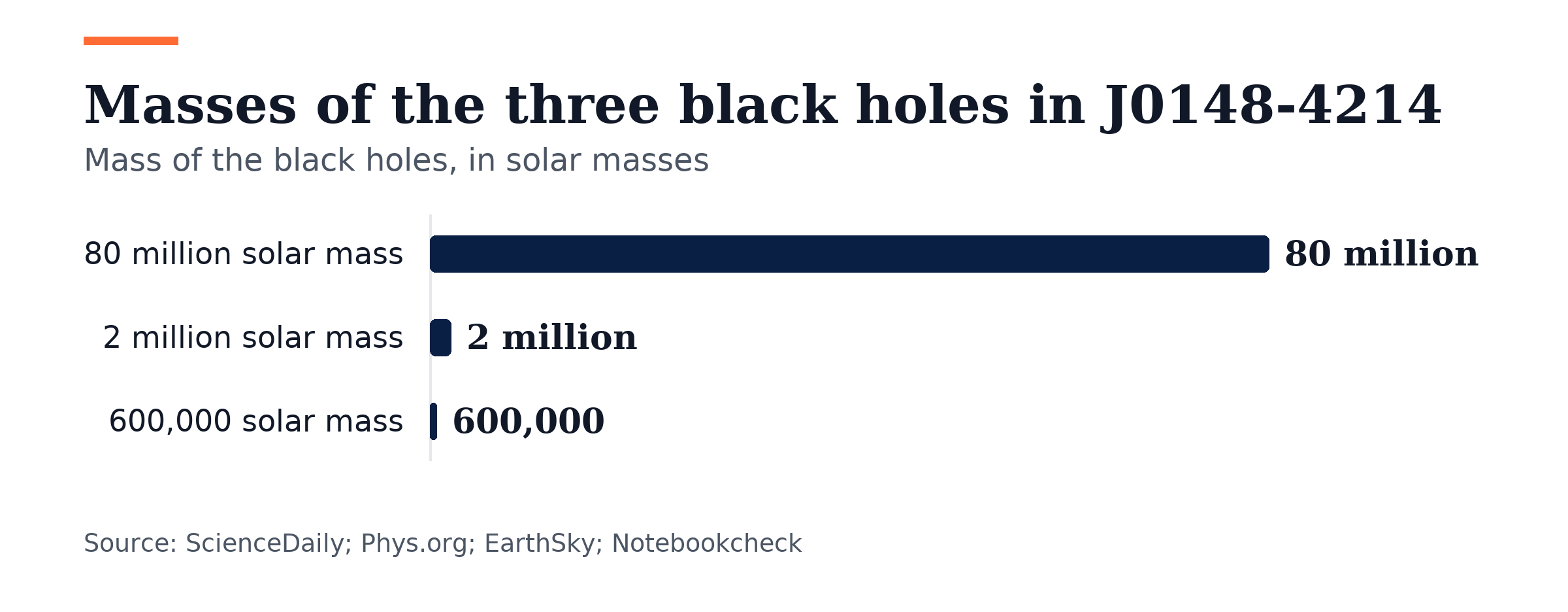
Two black holes near the galaxy’s center sit just 620 light-years apart in projection, while another sits roughly 5,500 light-years from that center. The trio weighs roughly 80 million, 600,000, and 2 million solar masses. The objects differ dramatically in size. Size does not determine activity, so the biggest object is not the most active, and the 600,000-solar-mass hole consumes matter more quickly than the 80-million-solar-mass hole, while the close pairing supports the idea that early galaxy collisions brought central black holes together before they merged.
All three black holes are actively feeding on material from surrounding accretion disks. The 600,000-solar-mass hole exceeds the Eddington limit, the theoretical ceiling on how quickly a black hole can gain mass through accretion. Such rapid growth may help explain how some black holes became enormous soon after the Big Bang even though little time had passed.
The team relied on the James Webb Space Telescope’s NIRSpec instrument operating in integral field spectroscopy mode, combined with spectro-astrometry, to read hydrogen emission signatures. Integral field spectroscopy mode on the Near Infrared Spectrograph studies light and spectral signatures across sections of a galaxy, pulling apart signals that would otherwise appear to originate from a single black hole. This mode is important for studying black holes in distant galaxies. Without detailed spatial information from NIRSpec-IFS, researchers probably would have found just one of the three active black holes.
The method measures shifts in line emission across the galaxy and follows small changes in spectral-emission positions, identifying both black holes even though telescopes cannot resolve them as separate points of light. Gas near a black hole moves at extreme speeds, leaving recognizable patterns in the light spectrum. Powerful gravity near a black hole pushes hydrogen gas to high speeds. The center of J0148-4214 displays a complex hydrogen-emission pattern that two closely spaced black holes explain better than a single source, and spectro-astrometry tracked subtle position shifts in the emissions to locate both.
The two black holes in the center should merge within several hundred million years and could form an even more massive black hole. Roberto Maiolino, a University of Cambridge professor and study co-author, described the results as extremely exciting. He said merging black holes may be an additional, fast route for rapid black-hole growth in the early universe, adding, “They suggest that black hole merging may be an additional, fast route for their rapid growth in the early universe.”
The third black hole sits roughly 5,500 light-years from the center and may be a remnant of an earlier merger kicked outward by uneven gravitational-wave emission. A recoil kick occurs when merging black holes release gravitational waves unevenly, driving the remnant in the opposite direction. Or the object might be moving inward to eventually interact with the other two, and astronomers say it could someday merge with the central pair. The distant third object may have a different history, such as when it was ejected from the center or fell slowly inward.
The galaxy holds about 1.3 billion suns in stellar mass, and the black holes account for a significant fraction of that total, according to co-author Giovanni Mazzolari of the Max Planck Institute for Extraterrestrial Physics. The JWST observations let the team estimate masses, accretion rates, and stellar mass together. The large share of mass held by black holes shows how dominant these objects were in this early system.
Giovanni Mazzolari, a researcher at the Max Planck Institute for Extraterrestrial Physics, is the study’s second author. Hannah Übler, a research group leader at the institute, led the international team and serves as lead author of the J0148-4214 black-hole study. The paper BlackTHUNDER: Evidence of three massive black holes in a z ∼ 5 galaxy appeared in Astronomy & Astrophysics on Aug. 12, 2026.
The results suggest that many distant galaxies may contain several growing black holes that remain undiscovered. Finding more of these systems could help trace merger history and explain how the largest black holes formed so early.
All three black holes in J0148-4214 actively accrete material, unlike the quieter supermassive black hole at the center of the Milky Way and other nearby galaxies. EarthSky said these active early-universe black holes can help explain how the universe took its present form. The fast feeding of the roughly 600,000-solar-mass black hole may offer clues to how some black holes became extraordinarily massive in the short time available in the early universe.
Join the discussion