Key facts
- PESTO published a robotics technology needs report in March 2024 recommending robotics technology investments for future planetary science missions.
- The report covers surface, subsurface, and aerial planetary robotics while leaving some related fields to separate dedicated efforts.
- The report organizes its recommendations into three themes: traveling farther and sampling more, deploying small science robots, and reaching extreme terrain and deep subsurface layers.
- Traveling farther and sampling more is supported by recommendations R1 through R6.
In March 2024, PESTO published a robotics technology needs report calling for robotics technology investments to support future planetary science missions.
PESTO was created by the Planetary Science Division to recommend, manage, and coordinate non-mission-specific, non-nuclear planetary technology investments and maximize infusion into missions. The office oversees a comprehensive Planetary Science Technology Development strategy. It also hosts an alternating-year in-person Technology Showcase connecting technology developers, scientists, and mission managers as part of its broader effort to coordinate technology investments across NASA and infuse capabilities into missions.
The report was prepared for Dr. Erica Montbach, who manages the NASA Planetary Science Exploration Technology Office, under contract 80NM0018D0004. Dr. Vandi Verma served as study lead, and Dr. Jeffery L. Hall served as program manager at JPL.
The study team brought together 25 participants from 18 institutions across the country. They included robotics subject matter experts and planetary scientists from NASA, industry, and academia. The report says the panel brought together a range of perspectives, expertise, and career levels. The team held virtual meetings and a two-day workshop in person before synthesizing findings in later discussions with scientists.
The report covers surface, subsurface, and aerial planetary robotics while leaving some related fields to separate dedicated efforts. The study team left out In Space Assembly and Manufacturing, Guidance Navigation and Control, In-Situ Resource Utilization, and robotics for human exploration. It also excluded missions already in NASA Phase A development or beyond, including Mars Sample Return and Dragonfly, because the study looked at missions not yet in formal development so its technology recommendations could aim at future concepts rather than programs already locked into engineering plans. The study is limited to embodied systems, meaning hardware that can physically act in other worlds, and it excludes pure software domains such as autonomy, AI, and data science.
Three themes structure the report’s recommendations: traveling farther and sampling more, deploying small science robots, and reaching extreme terrain and deep subsurface layers. The first theme ties to the Endurance-A decadal mission concept, the second to small-class Discovery and SIMPLEx programs, and the third to caves, ocean worlds, and missions farther from the Sun. Endurance-A is a long-range rover under the Lunar Discovery and Exploration Program, set to gather 100 kg of samples at the South Pole Aiken site for astronaut collection near the pole.
Recommendations R1 through R6 support the theme of traveling farther and sampling more, covering perception, navigation, autonomous sampling, balloons, and drilling for long-range rover missions on the Moon and Mars. Recommendation R1 calls for perception software and algorithms built to handle difficult lighting conditions, supporting surface navigation in places such as polar regions or permanently shadowed craters. Recommendation R2 calls for perception and illumination hardware along with component systems to complement that software. Recommendation R3 calls for surface navigation systems enabling long-range driving during both day and night, and R4 calls for autonomous instrument positioning and autonomous sample collection, handling, and verification.
Recommendation R5 calls for long-range balloons that can operate at variable altitudes as an aerial mobility option for planetary bodies where balloons can provide broad coverage at different altitudes. Recommendation R6 calls for drilling systems capable of reaching depths of 2m or more in rock and ice to access pristine subsurface samples on the Moon, Mars, and ocean worlds. The report says Endurance-A could top its baseline by traveling farther, robotically placing instruments, and collecting samples autonomously with dedicated technology investment.
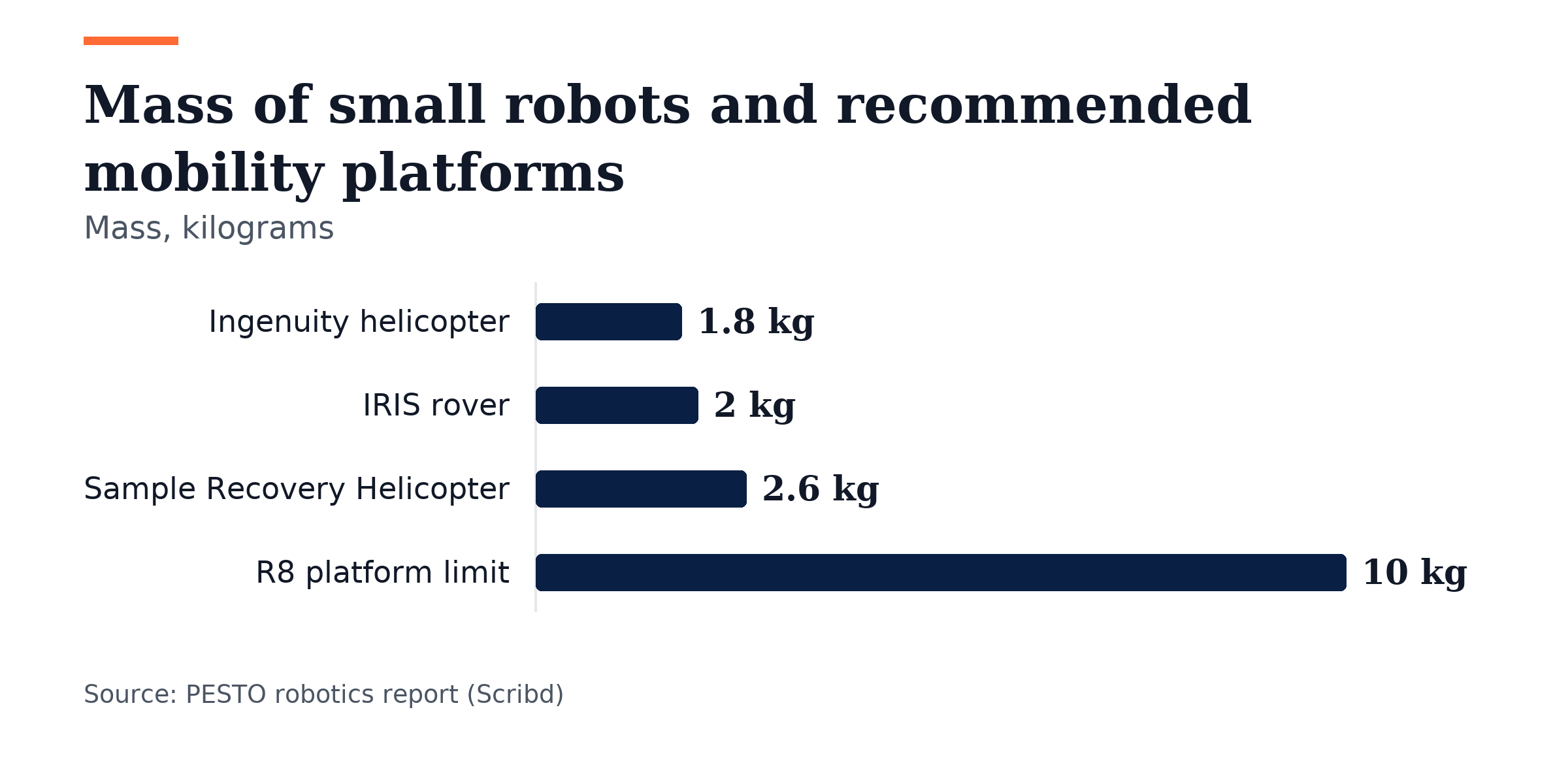
Recommendations R8 and R10 support small science robots. These cover small mobility platforms under 10 kilograms and extreme-environment components such as actuators, batteries, and wheels. Recommendation R8 calls for a mobility platform under 10 kg for scouting and targeted science, and the report points to Ingenuity, a flight technology demonstration that weighs just 1.8 kilograms, as an example relevant to small robots. Recommendation R10 calls for extreme-environment components including cold- and heat-tolerant actuators, rechargeable batteries, and long-life wheels and mobility parts that must operate with low mass and power while delivering high performance in harsh conditions.
The report describes a 2 kg IRIS rover built as a CLPS payload and a 2.6 kg Sample Recovery Helicopter platform with a 120gm arm and gripper able to move 100gm payloads. These examples illustrate the scale of small robots the study envisions for scouting, sample recovery, and targeted science on small missions. The report says OSIRIS-REx data showed Bennu’s surface is covered in boulders instead of the smooth, sandy terrain predicted by Earth- and space-based telescope observations. It shows how unexplored planetary surfaces can differ from expectations, which motivates small mobile robots that can reach multiple locations and lower mission risk.
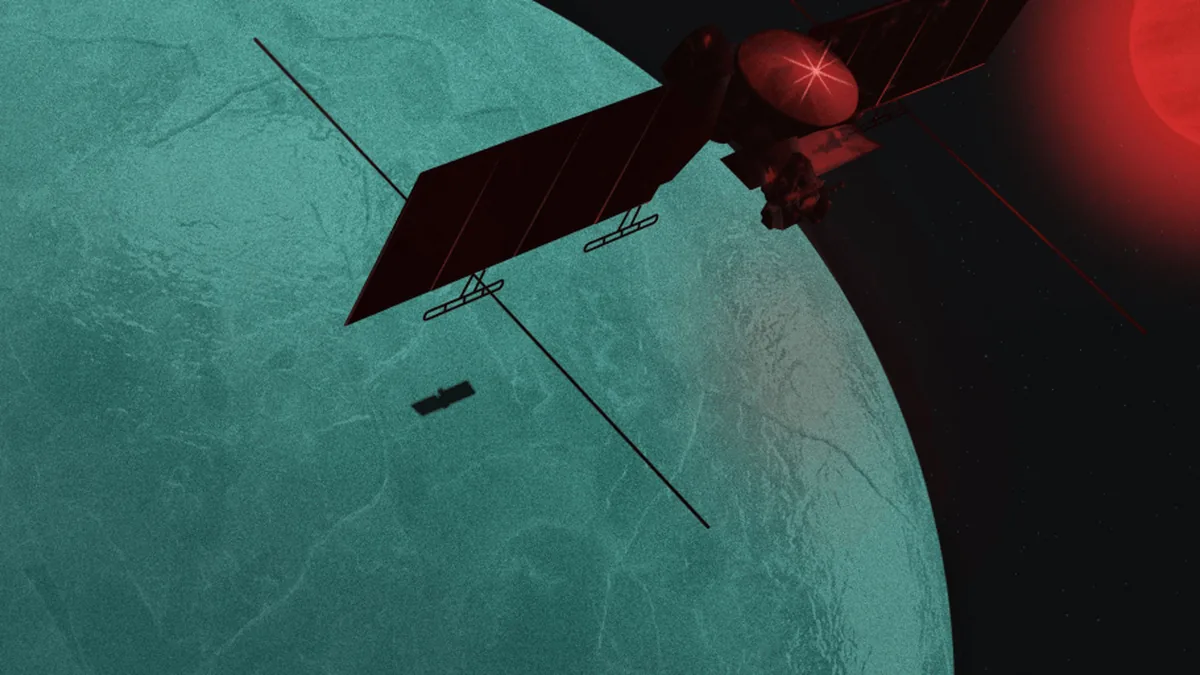
Recommendations R6 through R7 and R9 support reaching extreme terrain and deep subsurface layers. These include deep drilling, deep ice probes for ocean worlds, and mobile access systems for steep and irregular terrain. Recommendation R7 calls for deep ice probes to reach subsurface reservoirs on ocean worlds, including liquid layers beneath ice shells on bodies such as Europa and Enceladus. Recommendation R9 calls for a mobile access system able to traverse steep and irregular terrain to reach crater rims, central peaks, pits, caves, and scarps on the Moon and Mars.
The 2023 Decadal Survey Origins, Worlds, and Life ranked Europa Clipper, Mars Sample Return, Uranus Orbiter and Probe, and Enceladus Orbilander as flagship missions. Other flagship concepts studied but not prioritized include Europa Lander, Neptune Triton Odyssey, Venus Flagship, and Mercury Lander, and they could resurface in future decadal studies. After Mars Sample Return, the decadal survey prioritized Mars Life Explorer under the Mars Exploration Program. It is a stationary lander for ice drilling and robotic-arm work.
The decadal survey does not name specific missions below New Frontiers class, though it identifies science questions that smaller missions could answer. Robotics technology in the report applies to Discovery, SIMPLEx-class, and smaller missions. The decadal survey recommends continued cadence of smaller PI-led missions and science payloads to the Moon via PRISM and CLPS programs, and the study team factored these programs into its technology priorities. The report suggests that demonstrating flight maturity of small robots through CLPS payloads could reduce risks for missions to unexplored surfaces and change lander science return.
The report names several supporting technology areas: high-performance computing, power, simulation, testing, operations, fault handling, autonomous resource and health management, and autonomous science observations. These areas are recognized as necessary for the success of planetary robotic missions but fall outside the study’s embodied robotics scope. The report notes that other studies have covered those software domains, so this one centers on hardware that can physically manipulate or move in planetary environments.
The report says specific engineering implementations may shift as budgets change, new technologies emerge, and science priorities evolve with new data and mission selections. Due to this uncertainty, the study treats specific mission studies as a general framework instead of fixed requirements for technology infusion. The report says robotics on Earth need investment to adapt to space environments and mission needs, and funding is limited. The study seeks to survey state-of-the-art robotics and high-priority science questions to pinpoint where targeted investments could yield significant impact despite infrequent mission opportunities.
The report says that adding robotics to Moon and Mars science missions could make future long-range missions to Enceladus and Europa possible. That links near-term lunar and Mars technology development to outer solar system flagship concepts prioritized by the decadal survey. PESTO started the study specifically to shape this upcoming strategic technology plan for planetary science, and the robotics recommendations will feed into the new Planetary Science Directorate strategic technology plan that the 2023 Decadal Survey recommended.


Join the discussion