Key facts
- According to the report, demand from investors is being propelled by Defense Department buying patterns that favor numerous low Earth orbit platforms over bespoke defense satellites.
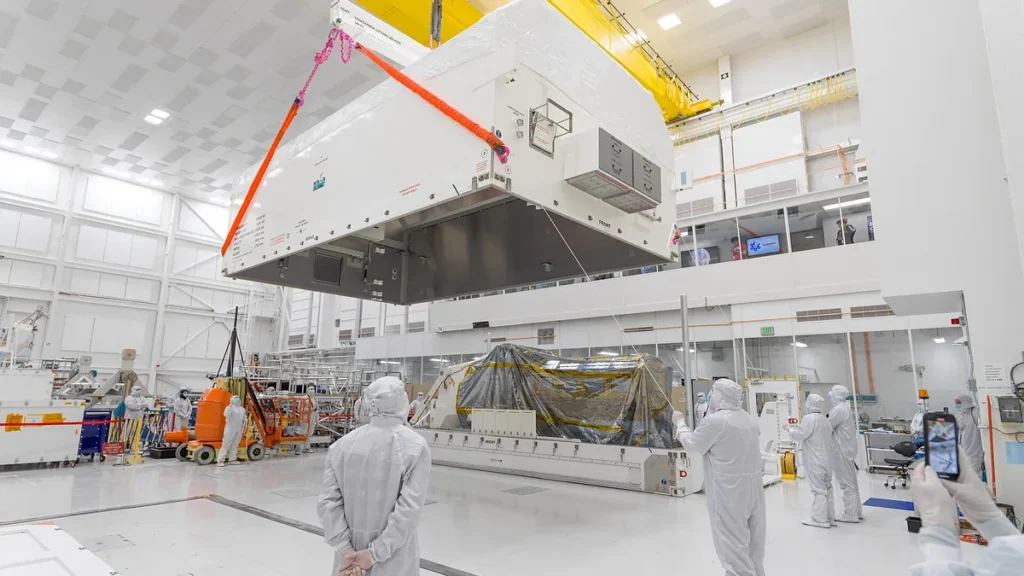
- The company's Factory One manufacturing complex is based in Los Angeles.
- Factory One is set up to assemble roughly 200 standardized platforms each year.
- Proceeds from the pending round would expand vertical integration along the Aries and Nova production lines through in-house parts work, avionics checks, and propulsion assembly aimed at shortening supplier lead times.
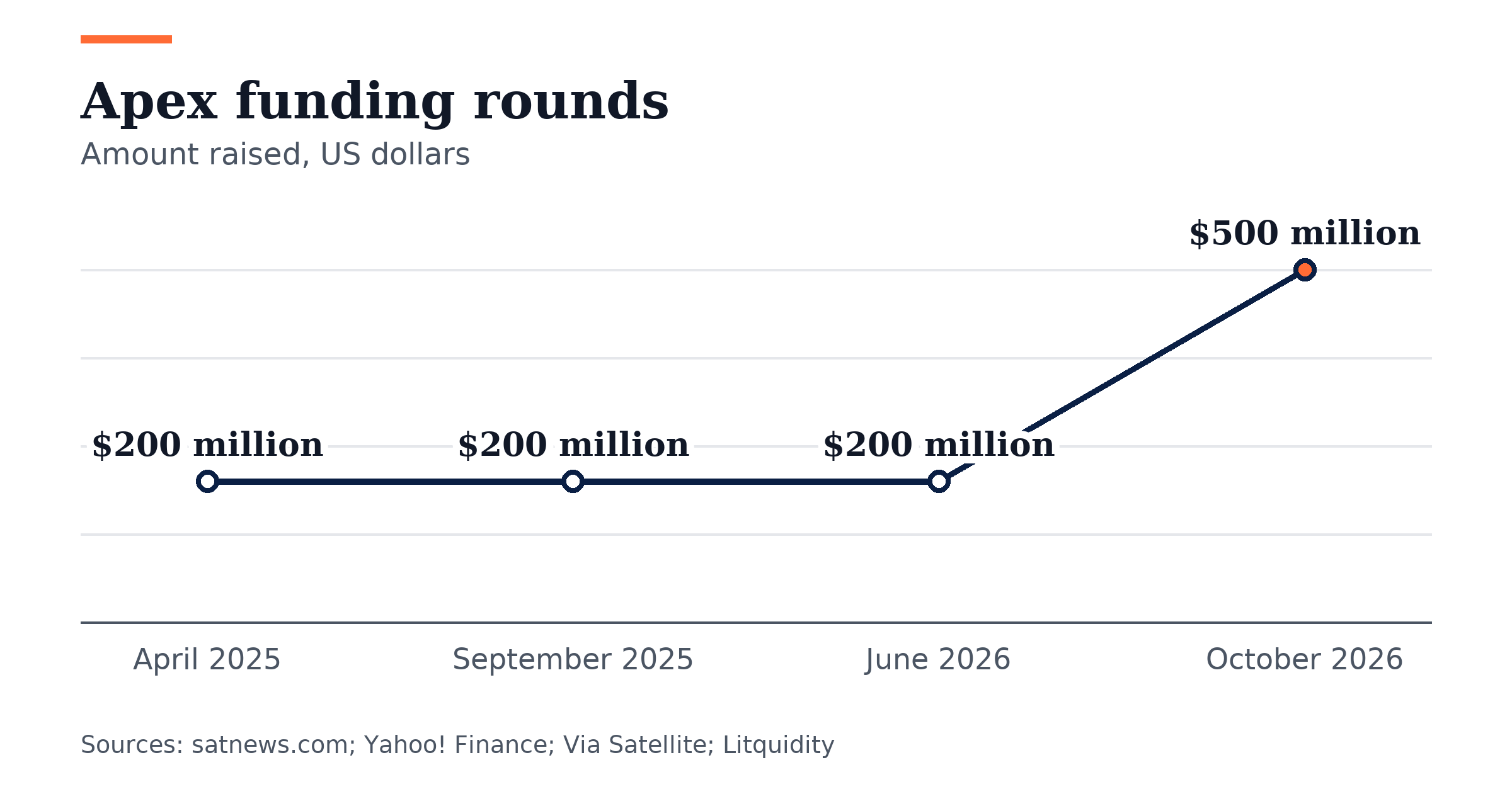
On Oct. 22, 2026, Apex opened discussions to raise roughly $500 million at a valuation near $4 billion, according to Bloomberg reporting cited in recent coverage. Washington Harbour Partners is positioned to lead the round, with current investors Andreessen Horowitz and XYZ Venture Capital taking part to accelerate large-scale orbital bus production for commercial and national security satellite customers.
The company raised $200 million at a $2.3 billion valuation during June 2026. Those October talks arrive roughly four months after that earlier round.
The company’s productized satellite buses aim to remove multiyear custom engineering timelines for government and commercial programs, and its standardized platforms shorten the time needed to build and deploy satellites compared with custom spacecraft. It produces its Aries small satellite platform and the larger Nova bus at Factory One, a manufacturing complex in Los Angeles set up to assemble roughly 200 standardized platforms each year. Nova’s design supports intricate defense sensor loads and space-based interceptor magazines, while Aries serves as the flagship small satellite platform. Apex wants to run bus production like an automated industrial process, delivering ready-made platforms in volume to defense contractors and commercial customers.
The Aries bus supports low Earth orbit and geostationary orbit missions with a payload up to 150 kilograms, and Apex flew a spacecraft of its own design on the platform in March 2024. Nova supports payloads up to 500 kilograms and will fly for the first time in 2026 as an Apex test vehicle. The company is developing an even larger platform called Comet, and both Nova and Comet serve low Earth orbit missions.
During April 2025, Apex secured $200 million to increase production and address strong demand for configurable spacecraft platforms as it pursued future Golden Dome missile defense shield contracts. Point72 Ventures led the April 2025 round, with 8VC serving as co-lead alongside Andreessen Horowitz and newcomers Washington Harbour Partners and StepStone Group. Total funding surpassed $300 million after the round, counting back to the company’s 2022 founding. Apex set aside much of the April 2025 capital to buy inventory components and construct dozens of speculative satellite buses.
Investors put another $200 million into Apex in September 2025 through a Series D round that valued the company at more than $1 billion. The money aimed to speed up production and vertical integration. The funding aimed to bolster the company’s balance sheet and finance acquisitions related to vertical integration, talent and suppliers.
The Los Angeles facility spans 50,000 square feet and has an assembly rate of up to 12 satellite buses per month. A $200 million Series C round four months before September 2025 led Apex to plan monthly production of 18 spacecraft buses, up from 12, to support vertical integration. After the Series C, the company leased a 55,000 square-foot site beside its current building to build more subsystems and components in-house.
The pending round’s proceeds would deepen vertical integration along the Aries and Nova lines through internal parts work, avionics testing and propulsion assembly, with the goal of cutting supplier lead times. This vertical push aims to widen localized component work and lower dependence on outside suppliers. Apex’s research list includes solar panels, reaction wheels, flight computers and avionics under the vertical integration umbrella. In late August 2025, Apex bought Hall-effect thruster technology from Phase Four, a startup that makes in-space electric propulsion.
Under the U.S. Golden Dome homeland missile shield, Northrop Grumman partnered with Apex to supply orbital buses for space-based interceptors with delivery targeted for 2027. Apex has already completed a commercially led missile interceptor demonstration in orbit, a step that preceded the Northrop Grumman alignment for Golden Dome space-based interceptors. Proceeds from the round would fund Southern California facility expansion to raise yearly delivery speed ahead of Golden Dome flight tests in 2027.
Apex does not yet hold Golden Dome contracts, though industry is preparing for significant Pentagon funding linked to a Trump administration priority. Ian Cinnamon, the company’s chief executive officer, told Reuters that Apex is orienting itself to serve as the backbone platform provider for Golden Dome and related capabilities.
Defense Department buying patterns that favor numerous low Earth orbit platforms over bespoke defense satellites are propelling investor demand. According to Ian Cinnamon, demand rose fivefold during the previous 9 to 10 months. Cinnamon also pointed to the Trump administration’s Golden Dome missile defense shield and large commercial and government opportunities as demand drivers.
Apex serves defense contractors, government bodies and commercial satellite operators. Apex is delivering Aries vehicles and is in talks on remote-sensing and government deals that cover missile-tracking, warning and fire-control pathfinders.
Ian Cinnamon described the company’s early stance on outside capital. “And the honest truth of it was, at first, we didn’t want to take the money, so we said no,” he said in remarks tied to the September 2025 funding round.
Cinnamon also explained the speed advantage of the company’s approach. “so if you need one, it doesn’t take years, it takes days or weeks,” he said in connection with the April 2025 funding.



Join the discussion