
Key facts
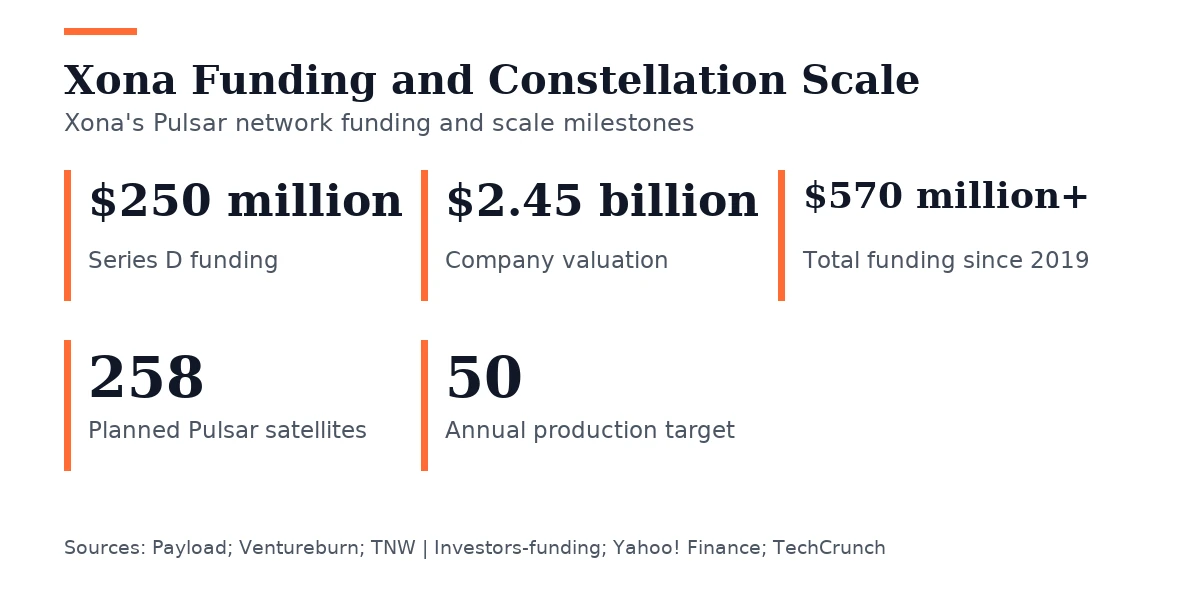
- Xona secured $250 million in Series D equity financing led by Future Ventures, with backing from unnamed new and current backers.
- Four newly launched spacecraft are meant to enable initial beta navigation coverage in several countries beginning in early 2027.
- Xona's eventual constellation is expected to include roughly 258 satellites for the Pulsar network in low Earth orbit.
- Pulsar offers centimeter-level positioning precision, jamming and spoofing resistance, indoor reception, and signal strength up to 100 times greater than legacy GPS.
Future Ventures led a $250 million Series D equity financing for Xona on Oct. 22, 2026.
The financing values Xona at $2.45 billion and lifts total funding since its 2019 founding past $570 million. The Series D follows a $170 million Series C completed seven months earlier, with Future Ventures contributing $78.5 million to the latest round, a figure TNW reported from Forbes. Manning told Forbes the company had not planned to raise again so soon but did so after a surge in demand.
Days before the announcement, Xona flew six Pulsar satellites on SpaceX’s Bandwagon-5 rideshare in October 2026, its largest launch to date. Aerospacelab helped build four of the spacecraft as modified Pulsar-0 models. The other two are Pulsar Test Satellites created entirely by Xona in-house.
The October flight begins Pulsar’s full commercial constellation rollout. The company expects its eventual Pulsar network in low Earth orbit to include roughly 258 satellites. Xona is targeting production capacity of 50 satellites annually by the end of 2027.
The Federal Communications Commission authorized Xona to broadcast L-band signals (a portion of the radio spectrum used for navigation and communications) in August 2026, marking the first approval for a commercial GPS constellation of its kind. Xona is the only FCC-authorized private navigation constellation cleared to operate alongside nation-state systems from the United States, Europe, China and Russia.
Xona says Pulsar delivers centimeter-level positioning precision, jamming and spoofing resistance, indoor reception, and signal strength up to 100 times greater than legacy GPS. Pulsar provides centimeter-level precision, while GPS delivers meter-level precision. Xona engineered the system for L-band spectrum used by more than six billion GNSS-enabled devices worldwide, broadcasting a proprietary signal adjacent to GPS to integrate into existing receivers without a new hardware ecosystem. The company created an architecture that lets its satellites keep time without costly atomic clocks by relying on proximity to Earth and ground-based sources of truth.
Spoofing protection comes from a dynamic cryptographic watermark. Pulsar signals work with existing navigation hardware through software and firmware updates. Xona demonstrated that Pulsar can provide a stronger signal without interfering with navigation and aviation services in the band. The company worked with the FCC, U.S. agencies, aviation stakeholders and international governments on coexistence.
Pulsar-0, the demonstration satellite, entered orbit in June 2025. It has completed more than 350 transmission passes over four continents. The company has logged more than 500 transmissions since the 2025 launch and demonstrated accuracy better than two centimeters. Existing commercial receivers can pick up the signal without hardware changes.
The CEO said government customer interest has risen because of jamming and spoofing vulnerabilities. He cited Strait of Hormuz interference that disrupted navigation for more than 2,000 ships. “coming on the heels of increased jamming and spoofing vulnerability seen from places like the Strait of Hormuz,” Manning said in an email to Payload. Xona says many devices rely on navigation signals that are susceptible to jamming and spoofing. The company also says upgrading government-run networks is slow and expensive.
Five engineers who met in Stanford University’s aerospace engineering graduate program started the company in 2019. Tyler Reid now serves as chief technology officer, and he worked on self-driving cars at Ford before viewing Pulsar as essential for autonomous vehicles. “My knee jerk was like, this is dumb,” Manning said. Before the Series D, Xona had raised just over $300 million in venture funding since its founding, including $20 million from the U.S. Space Force.
Xona opened a new satellite manufacturing site in Burlingame, California, in April 2026. The company appointed Waymo veteran Patrick Cadariu as chief operating officer in October 2026 to oversee production expansion. Manning said full Pulsar production will proceed at several satellites per week.
Canada provided $15 million CDN, roughly $10.7 million, shortly before the Series D announcement to help Xona expand operations in Montreal, Quebec. Steve Jurvetson sits on SpaceX’s board and was an early investor in Xona. During his career, he has backed just three space companies: SpaceX, Planet and Xona. Future Ventures, which he co-founded, led the Series D round.
Xona says Pulsar can deploy faster than traditional navigation systems and at a fraction of the cost.
The company plans to offer an initial timing service to commercial customers in 2027. Four satellites from the October launch will enable initial beta navigation coverage in several countries beginning in early 2027. Xona can begin real-customer beta tests of Pulsar once its satellites pass over the mid-latitudes about eight times each day.
The company aims to provide full service across the United States, Europe, Japan and South Korea by 2028. In 2027, Xona plans to test Pulsar compatibility with equipment from the U.S. Army, Navy and Air Force. Ian Gough, who leads TimeBeat, says the initial Pulsar pilot will allow his engineers to verify and correct timing for the company’s devices around the world.
In comments to Payload, Manning said Xona is experiencing strong commercial demand from autonomous vehicles, robotics, aviation and critical infrastructure. Manning told TechCrunch that GPS is free as a service but not as hardware, pointing to billions of devices sold each year and a large market seeking better performance.
Xona faces hurdles including production scaling, fleet deployment, reliability proof in varied conditions and customer adoption through device integration. Ventureburn said customers will need to integrate Pulsar-compatible firmware into their devices for commercial adoption.


Join the discussion