
Key facts
- The Lazuli Space Telescope, a privately developed observatory, will be the first private space telescope dedicated to exoplanet atmospheric characterization, with a launch planned by 2029.
- Researchers have identified 27 giant exoplanets as the initial target list for Lazuli’s ExtraSolar Coronagraph (ESC), focusing on reflected starlight observations to study mature exoplanet atmospheres.
- The Lazuli Space Telescope’s ESC will enable observations of exoplanet atmospheres using reflected starlight, bypassing age-related dimming issues that affect thermal emission methods.
- Lazuli’s ESC will complement observations from NASA’s Nancy Grace Roman Space Telescope and the Extremely Large Telescope’s METIS instrument, enhancing comprehensive atmospheric characterization.
Researchers chose 27 giant exoplanets as initial targets for the Lazuli Space Telescope’s ExtraSolar Coronagraph, and the privately funded observatory plans to launch in a lunar-resonant orbit. Universe Today, Chiprook, arxiv.org, Interesting Engineering, ArXivSignals, spacetoday.net
The target list was described in an arXiv paper, with targets chosen to ensure optimal coronagraph performance and efficient use of observing time. Universe Today, Chiprook, arxiv.org, Interesting Engineering, ArXivSignals, spacetoday.net
The observatory will be the first private space telescope dedicated to exoplanet atmospheric characterization. Universe Today, Chiprook, arxiv.org, Interesting Engineering, ArXivSignals, spacetoday.net
Lazuli’s ExtraSolar Coronagraph blocks a star’s glare to isolate the faint light reflected by nearby planets. Using reflected starlight lets the observatory study mature exoplanet atmospheres while avoiding the age-related dimming that weakens thermal emission methods for older worlds. The method also supports observations at closer separations than infrared telescopes can manage, enabling comprehensive atmospheric characterization of mature systems. This is especially useful for mature planets, whose dim thermal emission makes infrared methods less effective for atmospheric study. Universe Today, arxiv.org, ArXivSignals
The 27 targets include well-known worlds such as 55 Cancri d, and β Pic b, chosen for their distinct orbital traits and scientific value. Researchers Logan Pearce and Ewan Douglas curated the list, favoring worlds with well-documented orbits and bright host stars. They applied a brightness cutoff of Gaia G magnitude 8 and weighed orbital parameters, geometric albedo, and stellar light to improve detection odds, drawing on the Exoplanet Archive. The researchers prioritized targets whose orbits and host-star properties made them ideal for the coronagraph’s reflected-light observations. Universe Today, Chiprook, arxiv.org
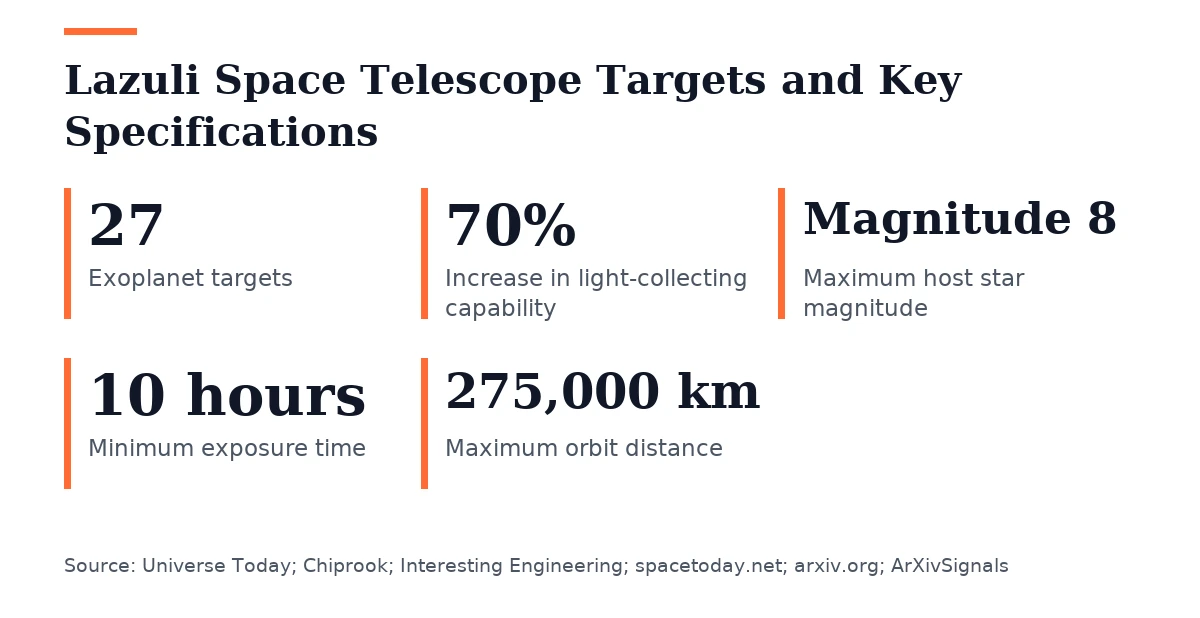
The planets span a range of ages and temperatures, expanding direct imaging beyond previously studied systems. Detecting reflected light demands exposure times of 10 to hundreds of hours because of the high contrasts involved. Well-constrained orbital priors are critical to improving the odds of detection within those long observing windows, especially given the faint reflected light involved. Efficient target selection remains central to the campaign, helping the team make the most of every available observing hour. Universe Today, arxiv.org
Lazuli’s observations will work alongside NASA’s Nancy Grace Roman Space Telescope and the METIS instrument on the Extremely Large Telescope. The pairing supports broader atmospheric characterization, including work relevant to potential biosignatures. Synergies between Lazuli and other platforms will provide a broader understanding of exoplanet atmospheres and planetary evolution. Lazuli’s observing program thus fits alongside agency facilities rather than replacing them, offering a complementary path for atmospheric study. Universe Today, arxiv.org, ArXivSignals
Lazuli’s 3-meter mirror is larger than the 2.4-meter mirror on Hubble, increasing light collection by 70%. The observatory carries a wide-field optical imager, an integral field spectrograph, and the ExtraSolar Coronagraph for versatile science. These instruments enable observations of exoplanet atmospheres, supernovae, and other key astronomical research areas, tailoring the observatory to diverse science goals. The larger aperture positions Lazuli as a competitive asset in exoplanet science, enabling observations previously limited to larger agency missions. Universe Today, Chiprook, Interesting Engineering, spacetoday.net
The lunar-resonant orbit will carry Lazuli up to 275,000 km from Earth, providing stability for long-duration observations and reducing interference from Earth’s atmosphere and gravitational perturbations. Lazuli is part of the Schmidt Observatory System, a philanthropic initiative funded by Eric and Wendy Schmidt. The system also operates three ground-based observatories alongside the space telescope. The initiative aims to advance astronomy through private investment while complementing government efforts in space science. Interesting Engineering, spacetoday.net
Backers are targeting a launch at a fraction of the cost of NASA flagship missions, with rapid deployment and cost efficiency central to the design. Pete Klupar said, “We’re going to do it in three years, and we’re going to do it for a ridiculously low price.” The project is designed to complement government efforts while demonstrating the feasibility of private-sector contributions to space science. It also aims to show that non-government observatories can advance research despite budget constraints and space congestion. Universe Today, Chiprook, arxiv.org, Interesting Engineering, spacetoday.net
Lazuli enters exoplanet atmospheric characterization as a privately developed observatory. Its reflected-starlight focus is especially suited to mature planets, whose thermal emission fades with age and grows harder to measure over time. By studying planets across a range of ages and temperatures, Lazuli broadens the scope of direct imaging for planetary science. Universe Today, arxiv.org, Interesting Engineering





Join the discussion