Key facts
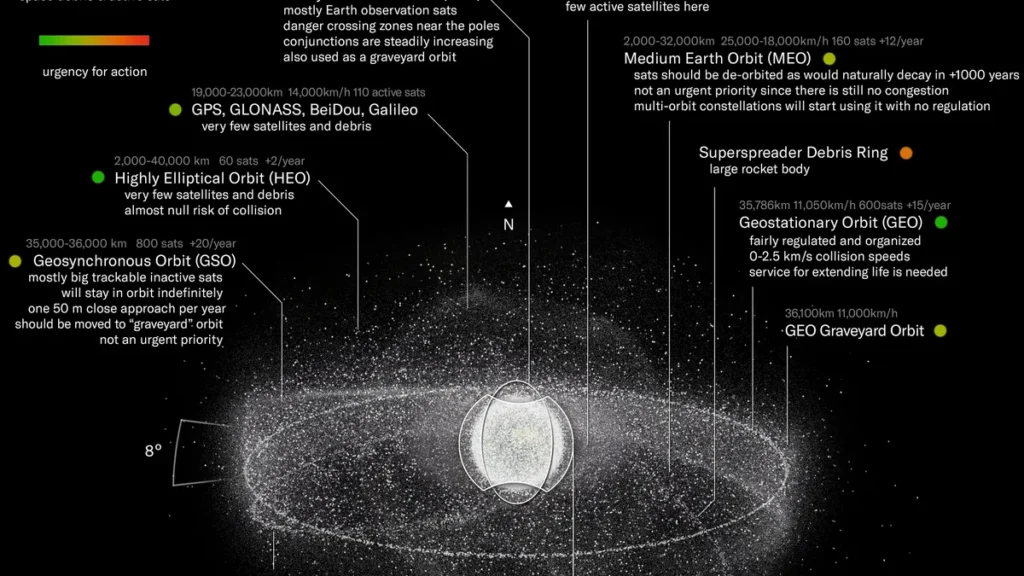
- The European Space Agency reports about 19,440 satellites on orbit in low Earth orbit.
- The article says most of Wijayatunga's work applies to both debris and spacecraft.
- The study focuses on a damaged spacecraft that can no longer communicate, so the servicer must approach without any help from the target.
- Wijayatunga created CORTEX, short for Convex Optimization for Rendezvous Trajectory Execution, a lab-demonstrated framework for designing and guiding close-range rendezvous trajectories.
Minduli Wijayatunga, a new aerospace engineering faculty member at the University of Illinois Urbana-Champaign, described CORTEX, an autonomous framework for close-range spacecraft rendezvous, in a 2026 Acta Astronautica paper reporting laboratory hardware tests of the system. The framework guides a servicer to a disabled target that cannot communicate or maneuver on its own.
CORTEX, short for Convex Optimization for Rendezvous Trajectory Execution, is a lab-demonstrated framework for designing and guiding close-range rendezvous trajectories. Wijayatunga created it in response to the question of how spacecraft make decisions when thrusters fail or perturbations push them off course. Wijayatunga says CORTEX times the rendezvous for an optimal sunlight window to see the target, complete close-proximity operations, and depart, while accounting for eclipses.
She contrasts CORTEX with her Ph.D. work on trajectory design and guidance using convex optimization for transfer phases, where eclipses limit thrust but not safety enough to require replanning or holding position. Wijayatunga says she wanted to bring that same idea into CORTEX and expand it by considering sunlight windows so operations do not have to occur in darkness. The replanning versus abort architecture and accounting for sunlight windows so operations avoid darkness are novel in CORTEX, she says.
To stress-test hardware experiments, researchers manually pushed the servicer to represent a perturbation, turned off thrusters during supposed-on periods, and artificially increased state and thrust errors to simulate situations like solar storms. Wijayatunga explains that CORTEX chooses between replanning a new path to the target or aborting, retreating to a passively safe orbit, and trying again.
If a spacecraft deviates significantly from its nominal trajectory, CORTEX replans and reapproaches unless a severe keep-out zone violation occurs, in which case it retreats to a passively safe orbit. Wijayatunga describes CORTEX as an algorithm to recover from the unexpected. Wijayatunga says CORTEX was very robust to instances where thrusters were supposed to be used but could not be for whatever reason. “And CORTEX was very robust to that.”
Wijayatunga says that in some hardware tests, a servicer violating the approach corridor leaves the keep-out zone and moves back to a safe position, while in others it recovers and continues its mission. The servicer makes the choice to miss the target and regroup for another approach autonomously.
The European Space Agency reports about 19,440 satellites on orbit in low Earth orbit. The agency says 3,540 of the roughly 19,440 satellites are nonfunctioning or not emitting a signal to warn other spacecraft of their location. Wijayatunga says there are over 8,000 metric tons (8,800 tons) of debris, and none of it is cooperative because the objects cannot thrust or send a signal. The article presents the figures as part of a growing low Earth orbit problem.
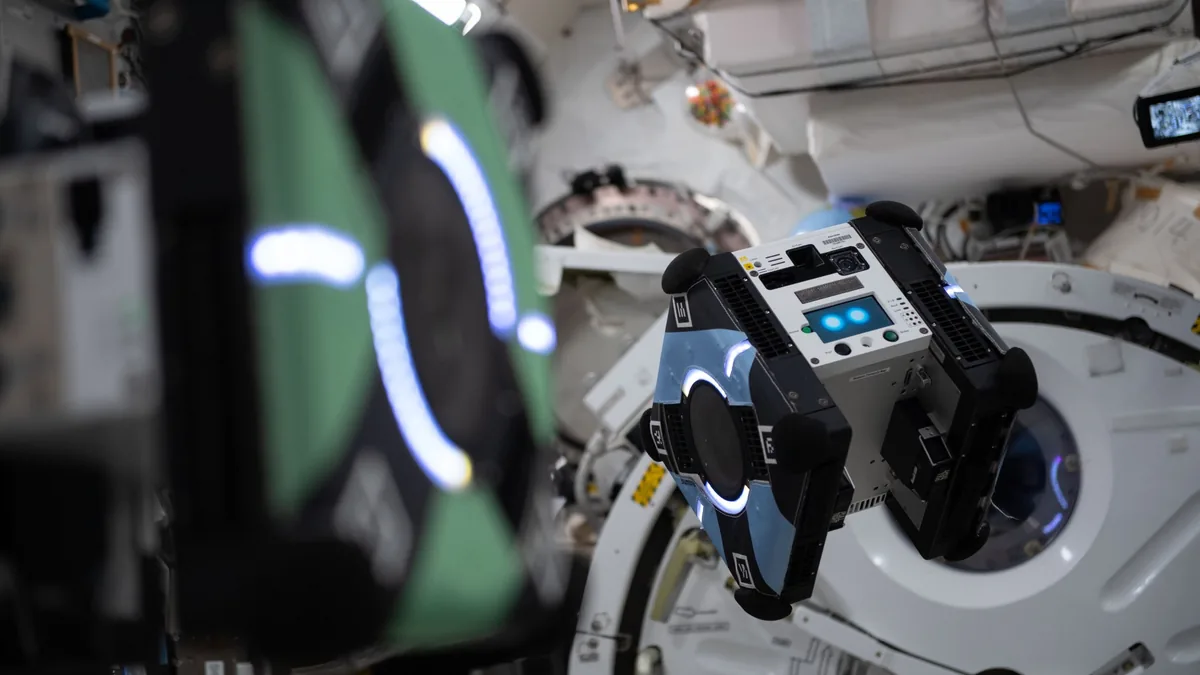
Servicing these satellites in orbit will become more necessary as additional spacecraft are launched, according to the article. Wijayatunga says autonomous repairs are needed due to communication delays between a repair spacecraft and Earth and the limited windows when communication can occur. She says spacecraft must track trajectories of uncooperative objects autonomously and make go/no-go decisions without waiting for the ground, posing thruster failure or high-order orbital perturbations as instances requiring such decisions. The study focuses on a damaged spacecraft that can no longer communicate, so the servicer must approach without any help from the target.
Wijayatunga says projects have grown out of this work, extending autonomy to earlier rendezvous phases. One final project in her class uses reinforcement learning to replan the phase right before the close rendezvous. Wijayatunga defines far rendezvous as seeing the target at a range from 30 kilometers (19 miles) down to three kilometers (1.9 miles).
Wijayatunga says no one has yet tried autonomous servicing on a target that will not cooperate. She says the ADRAS-J mission already proved in space that a close-range approach to an uncooperative object can work, supporting her statement that the approach is not theoretical despite no autonomous servicing on an uncooperative target yet.
Minduli C. Wijayatunga et al. published CORTEX in Acta Astronautica in 2026 under DOI 10.1016/j.actaastro.2026.08.041, describing a convex-based framework tested on hardware to design and guide rendezvous trajectories at close range. The article reports that most of Wijayatunga’s work applies to both debris and spacecraft.

Join the discussion