Key facts
- RTE.ie reports that 2026 will include 13 full moons.
- RTE.ie lists the Beaver Moon on 24 November 2026 as a supermoon.
- RTE.ie lists the Cold Moon on 24 December 2026 as a supermoon.
- RTE.ie counts three supermoons in 2026: the Wolf Moon, Beaver Moon, and Cold Moon.
RTE.ie says the Beaver Moon reaches full phase on 24 November 2026 as a supermoon.
RTE.ie reports that 2026 will include 13 full moons. Its list runs from the Wolf Moon on 3 January to the Cold Moon on 24 December and also includes a Blue Moon on 31 May 2026.
A second full moon in a month happens roughly every two and a half years, the outlet says. The reason is that the 29.5-day lunar cycle sometimes falls short of a calendar year. That timing can put two full moons in a single month.
RTE.ie counts three supermoons in 2026. The Wolf Moon on 3 January and the Cold Moon on 24 December join the Beaver Moon on that list.
RTE.ie says full-moon names originated from Native Americans who used lunar phases as time-keeping. Many tribes assign 12 or 13 full moons a year, and tribal name counts differ slightly. The outlet illustrates the names with the Wolf Moon, Snow Moon, Worm Moon, Pink Moon, Flower Moon, and Strawberry Moon.
RTE.ie says the Beaver Moon name likely referred to trapping beavers for their warm pelts in winter. In the same naming section, the outlet says the Cold Moon alludes to the drop in temperature.
RTE.ie, citing NASA, says the moon goes through eight lunar phases in a cycle of about 29.5 days. The outlet describes how rotation and orbit create day and night across the lunar surface. It also says Earth observers always see the same face of the moon, called the lunar nearside.
RTE.ie says the full moon phase is as close as we come to seeing the sun illuminate the entire day side of the moon. The outlet presents this as part of its explanation of lunar phases after the new moon through the waning crescent. It directs readers to NASA’s daily moon guide for more information at the end of that explainer.
Astronomy Magazine’s sky column for Monday, October 26, 2026, times October’s Full Moon, the Hunter’s Moon, at 12:12 A.M. EDT. The same column notes Dione crossing Saturn on October 25. It also gives sunrise, sunset, moonrise, and moonset times for 40° N 90° W.
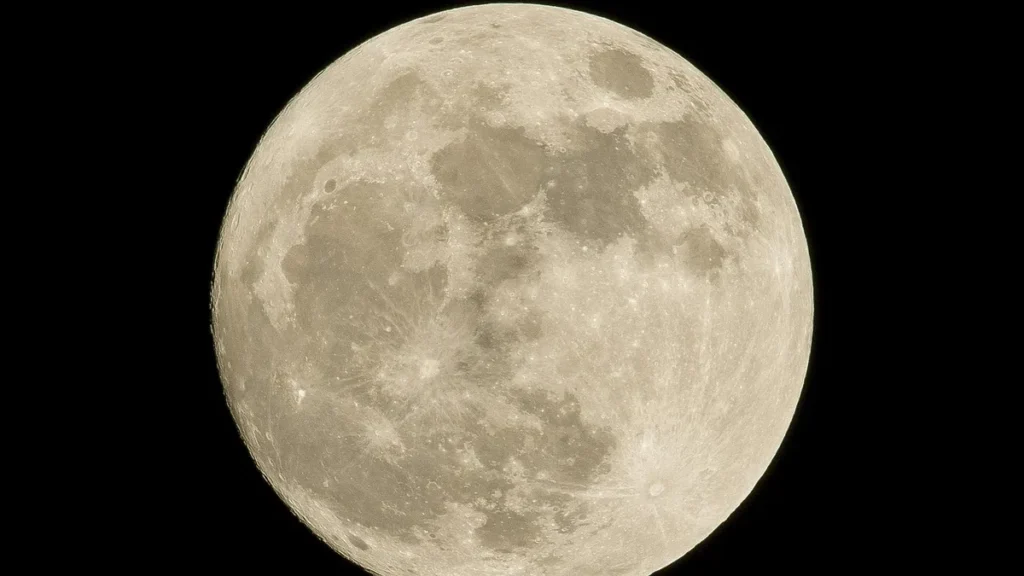
Astronomy Magazine says that at Full phase the Sun appears directly overhead from the lunar nearside, making it lunar noon with the shortest shadows and a less three-dimensional landscape. The magazine calls Full Moon observing challenging because the terrain lacks depth when shadows are minimal.
Astronomy Magazine suggests using a Moon filter, or sunglasses put on just before stepping to the eyepiece, to cut telescope glare at Full Moon. The magazine’s Full Moon observing tips also recommend higher magnification to reduce the amount of bright light entering the eye. Higher magnification reveals less of the lunar surface in a single field of view.
Astronomy Magazine says Full Moon reveals rays of impact ejecta, especially Tycho crater’s well-defined ray system in the lunar south, with some rays stretching hundreds of miles. The magazine presents Tycho’s rays as an observing target during Full Moon when many other features are not at their best. It lists Copernicus, Proclus, Aristarchus, Stevinus, and Byrgius as craters with stunning rays to seek out at Full Moon.
Join the discussion