
Key facts
- Craft Prospect, a Glasgow-based space engineering company, advanced space-based quantum key distribution technologies and held discussions across the UK, Europe, Japan and the United States on 21 October 2026.
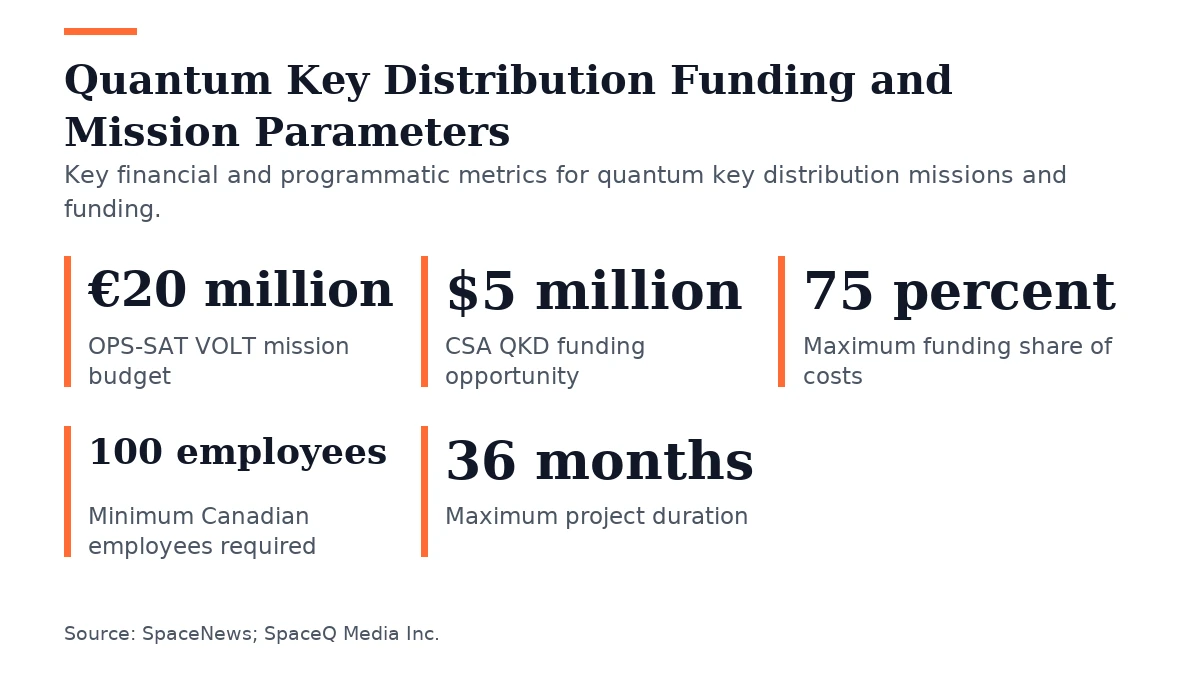
- Senior Quantum Engineer Andrew Kelly presented at the 9th Annual ScyLight Conference in Tenerife on quantum and optical CubeSat payloads for the €20 million OPS-SAT VOLT mission in 2026.
- At Newton Q 2026, Andrew Kelly presented 'From Optical Table to Orbit: Quantum Technology for Industry and Space', covering engineering challenges of converting quantum research into deployable, space-qualified products.
- Newton Q 2026 discussions highlighted growing industry interest in quantum communications, cybersecurity, photonics and infrastructure for future quantum networks.
Craft Prospect, a Glasgow-based space engineering company, advanced quantum key distribution and held discussions across the UK, Europe, Japan and the United States on Oct. 21, 2026.
The company is building a Quantum Key Distribution Space Network Emulator designed to demonstrate, integrate and test quantum key distribution technologies before deployment, helping industry, researchers and mission teams reduce risk and speed up development. Craft Prospect says the events showed steady demand for facilities where organizations can move beyond theory and run quantum trials in practical settings. The work supports secure communication architectures and de-risks future missions as quantum technologies move from research to deployment.
Craft Prospect staff carried the message to a series of 2026 conferences. Senior Quantum Engineer Andrew Kelly spoke at the 9th Annual ScyLight Conference in Tenerife about quantum and optical CubeSat payloads for the €20 million OPS-SAT VOLT mission. At Newton Q 2026, Kelly presented on the engineering challenges of converting quantum research into deployable, space-qualified products, and discussions there highlighted industry interest in quantum communications, cybersecurity, photonics and infrastructure for future quantum networks.
In August 2026 at SmallSat 2026 in Salt Lake City, Head of Engineering Kevin Quillien presented work on The Quantum CubeSat, while Head of Commercial Hina Khan and AI Lead Lucy Donnell showcased OPS-SAT VOLT progress with partner Bright Ascension. The July 2026 SPACETIDE 2026 event in Tokyo featured Steve Greenland discussing UK-Japan collaboration, space security and technologies for secure and resilient space infrastructure. At ESA’s Quantum Technology Workshop in July 2026, Quantum Technology Lead Natalie Pearson and Sales Engineer Rory Ireland engaged European space sector organizations on emerging technologies and collaboration.
Attendees at the events showed significant interest in orbit missions able to demonstrate secure communications, optical networking, autonomy and quantum-enabled technologies. Craft Prospect says organizations want to leave theory behind and begin testing quantum technologies in practical settings. The company adds that facilities supporting rapid experimentation and validation are growing more important as secure communications and quantum networking gain momentum. A recurring theme was the convergence of quantum technologies and space systems, with optical communications, quantum-secure networking, quantum key distribution and autonomous platforms maturing as enablers of Smart Secure Space.
While Craft Prospect pursues demonstration hardware, the Canadian Space Agency is funding a transatlantic effort. The agency posted a $5 million funding opportunity on June 4, 2026 for a secure transatlantic quantum communications network using quantum key distribution, with applications due by July 15, 2026. The program follows a June 2025 joint commitment by the Prime Ministers of Canada and the United Kingdom to build a next-generation quantum key distribution communications network.
Quantum key distribution produces encryption codes described as virtually unbreakable. The winning company must coordinate with a UK counterpart to demonstrate encrypted communication between end users in both nations and share secure quantum keys via satellite between at least two ground stations. The demonstration builds on the Canadian Space Agency’s Quantum Encryption and Science Satellite mission. The agency expects the mission to launch later in 2026 to test quantum encryption in space.
The Canadian Space Agency will award a single non-repayable contribution of up to $5 million covering up to 75 percent of eligible costs, with projects running between 24 and 36 months starting in September 2026. Eligible organizations must be for-profit, established and operating in Canada, with more than 100 employees and over $5 million in annual revenue for the past three years. The winning company must assemble a consortium integrating at least three distinct Canadian technologies from three non-academic organizations, and funding targets projects at Technology Readiness Level 6 or lower, focusing on prototypes tested in relevant environments.
Research at the University of Waterloo Institute for Quantum Computing frames quantum key distribution as a way to build communication systems that are fundamentally secure against interception. Waterloo researchers describe the technology as functioning like a digital wax seal that breaks under eavesdropping or tampering, revealing an intruder through the laws of physics. Teams there test protocols from ground-based fiber optics to satellite links in space to build a framework for national and international quantum networks, listing satellite quantum links and photonic quantum repeaters among their research applications.
On the ground, quantum key distribution has already moved beyond small-scale point-to-point connections into more complex network infrastructures. A London quantum-secure trial involves BT and Toshiba, with HSBC as the initial bank connection and multiple linked sites for sensitive data transmission, while BT and Toshiba plan to expand the network with Equinix to establish the UK’s first quantum key distribution-based quantum-secure connection between data centers. A French service from Orange Business and Toshiba offers commercial quantum safe networking in Paris using quantum key distribution and post-quantum cryptography over existing fiber infrastructure.

Robust interoperable standards are essential for scaling deployment, with Europe’s ETSI and its Industry Specification Group for QKD defining architecture, physical layer requirements, software interfaces and network management protocols. Europe is at the forefront of standards and certification, with standards bodies, academia and industry defining frameworks covering cryptographic performance, side-channel attack resilience, fault tolerance and life cycle security. Standardized interfaces for key management, authentication and control will let quantum key distribution expand into multinode networks on current telecom infrastructure, and components and protocols require certification. Hybrid security models pair quantum key distribution with quantum-resistant algorithms, making standards important for integrating these systems.


Join the discussion