
Key facts
- Astronomers working with the NSF-DOE Vera C. Rubin Observatory have identified a possible new dwarf planet beyond Pluto, provisionally called 2026 ED138.
- Dr. Mario Jurić and colleagues estimate ED138 measures between 600 and 1,500 kilometers across, using its brightness, distance and presumed reflectivity.
- Confirmation would add ED138 to Pluto, Ceres, Eris, Haumea and Makemake as the International Astronomical Union's sixth dwarf planet.
- Follow-up infrared observations are required to determine ED138's true size and whether it meets International Astronomical Union dwarf planet criteria.
The NSF-DOE Vera C. Rubin Observatory in Chile has helped astronomers spot a possible new dwarf planet beyond Pluto, provisionally called 2026 ED138, while the telescope was still being commissioned.
ED138 now circles the Sun at roughly 46 astronomical units, beyond Pluto’s average of 40 astronomical units, and takes about 281 years to complete one orbit. Its path tilts roughly 24.5 degrees against the ecliptic, placing it among trans-Neptunian objects that orbit beyond Neptune. Scientists classify it as a trans-Neptunian object because it circles the Sun at an average distance greater than Neptune’s orbit.
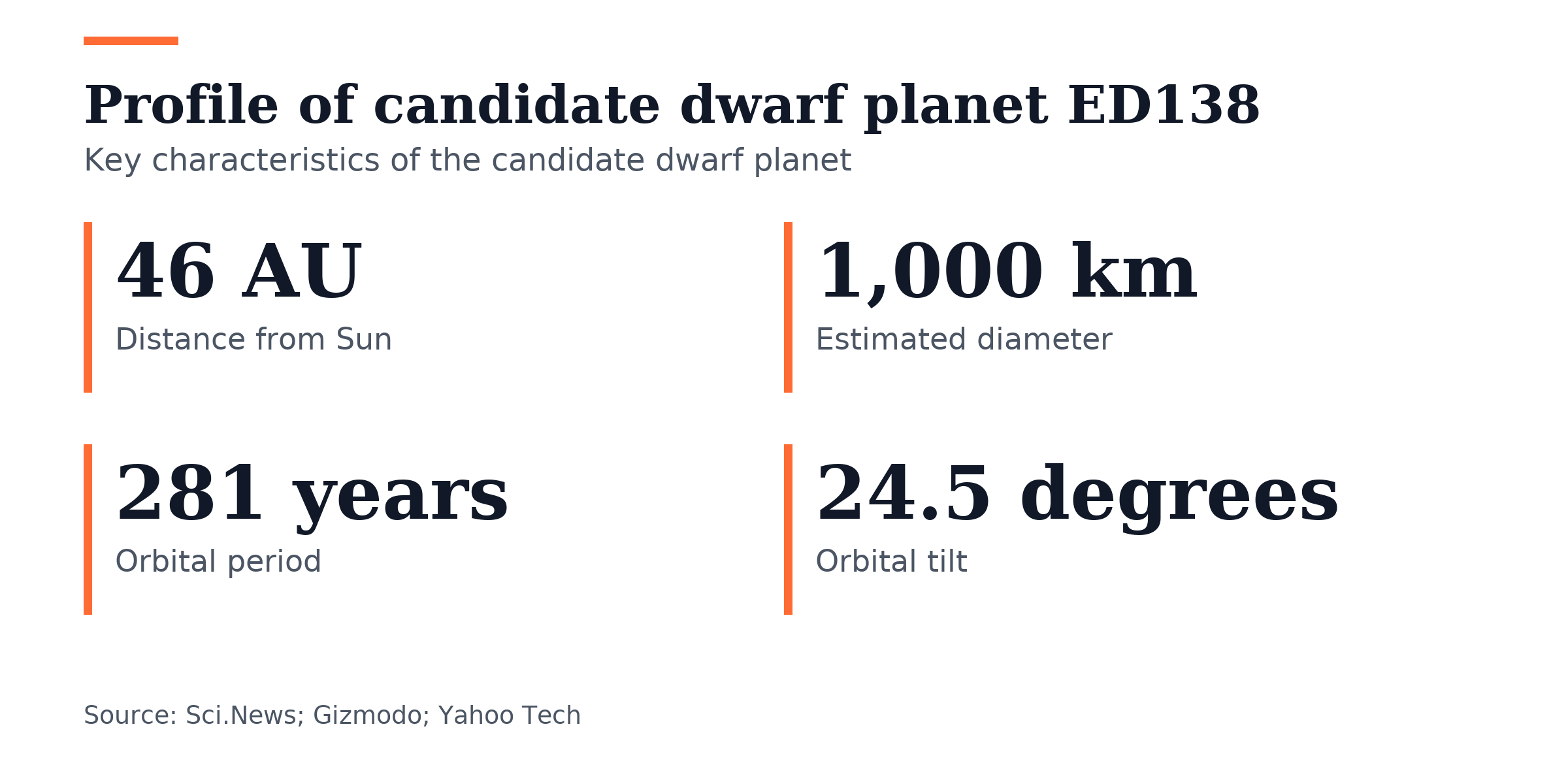
Mario Jurić and his colleagues put ED138’s diameter between 600 and 1,500 kilometers, based on its brightness, distance and assumed reflectivity. Jurić has also estimated the object is roughly 1,000 kilometers, or 621 miles, across, and said finding an object this big happens maybe once in a generation. The size range remains uncertain because it depends on assumed reflectivity.
ED138 remained out of sight because it sits in a part of the sky crowded with millions of stars near the Milky Way’s plane and required repeated observations to reveal its motion. Its steeply tilted path kept it outside the sky regions most surveys routinely covered, because many traditional surveys concentrated coverage near the ecliptic. ED138 hid from view not because it was especially faint but because it sat among millions of background stars near the Milky Way’s plane, and only repeat observations could show it was moving.
Repeated scans of the southern sky by Rubin and software that detects faint moving objects made the detection possible. Rubin began its decade-long sky survey in late June, aiming to view the full southern hemisphere every three days. Rubin returns to each point in the sky roughly 800 times over a decade, providing deep, time-rich views to uncover subtle events and catch moving objects.
Rubin operates the largest digital camera ever constructed for astronomical imaging, a 3200-megapixel instrument that takes a detailed picture roughly every 40 seconds. Every night Rubin gathers about 10 terabytes of data and issues as many as seven million alerts of changes in the night sky. Alerts go to alert brokers, automated systems that sort and classify changes so scientists can respond quickly.
Rubin’s design pairs enormous light-gathering power with fast movement across the sky and a wide field of view. Rubin is the most powerful Solar System discovery machine ever built, snapping about a thousand images each night and compiling a detailed census of millions of asteroids and comets.
Rubin Observatory gets joint funding from the National Science Foundation and the Department of Energy’s Office of Science. Rubin Observatory is a joint program of NSF NOIRLab and DOE’s SLAC National Accelerator Laboratory, with the two organizations operating it together and NOIRLab run by AURA.
Holman first spotted ED138 by running Rubin observations through search software he helped build to link billions of moving detections to a single object. Jurić turned up 20 more Rubin observations of ED138 reaching back to March, while images from other surveys go back to 2016. Rubin gathered observations of ED138 from March 4 through July 11, 2026, using software built by Holman and Kevin Napier. Jurić and Holman unveiled the ED138 discovery at a press conference held on a Tuesday.

Matthew Holman said his first reaction was excited disbelief, and because such objects are rare he immediately checked whether he or the software had made an error. “Rubin is giving us an unprecedented capacity to explore the sky through a combination of speed, depth, and precision,” said Dr. Mario Jurić. “Finding an object this big, roughly 1,000 kilometers [621 miles] across, is something that happens maybe once in a generation,” Jurić said.
Mario Jurić said that after Rubin spots a new object, researchers can look back months, and sometimes even decades, finding it in images where nobody knew to look. He said the capability improves how precisely scientists can work out orbits and deepens understanding of the outer Solar System by using old images. More than a decade of observations let Jurić and his colleagues study ED138’s orbit in detail.
If confirmed, ED138 would join Pluto, Ceres, Eris, Haumea and Makemake as the International Astronomical Union’s sixth dwarf planet, although the IAU currently recognizes five. The IAU definition says a dwarf planet must orbit the Sun, be massive enough to be nearly round, and not have cleared its orbital neighborhood. An icy body at ED138’s estimated size would assume a round shape under its own gravity, required for dwarf planet status. Formal dwarf-planet status for ED138 depends on open questions about its size, shape, and composition.
Infrared follow-up observations are needed to pin down ED138’s true size and whether it qualifies as a dwarf planet under International Astronomical Union rules. Pinning down ED138’s size and shape will take infrared measurements, thermal modeling, occultation observations, and light-curve analysis, all relying on follow-up work from other observatories. Other observatories can now observe ED138 to learn more about what it is. No detailed physical measurements exist yet, so the classification is still open.
Trans-Neptunian objects are among the best-preserved bodies in the solar system, largely unchanged since formation, and researchers study them to learn how the solar system developed. Over ten years Rubin will repeatedly image the entire southern sky, reaching objects that earlier surveys missed. This year Rubin reported more than 11,000 new asteroids, with 33 near-Earth objects and 380 trans-Neptunian objects among them.
The International Astronomical Union’s Minor Planet Center gave ED138 its provisional designation. MPEC 2026-U85 by M. Jurić and colleagues documents the discovery of 2026 ED138. Students, teachers and the public can explore the solar system through Orbitviewer, an interactive web-based app that features this discovery.
ED138 does not prove theories about unseen massive planets, but it shows a world like known dwarf planets was circling unseen because of a gap in observations. “Rubin Observatory’s superpower is the ability to clearly capture movement and change,” said Edward Ajhar.
The Legacy Survey of Space and Time began after the Rubin First Look event in June 2025, final commissioning work, an operational readiness review, and the start of the alert stream. The choice to start LSST came after system optimization and an operational review covering technical readiness, data system performance, and scientific validation.






Join the discussion