Key facts
- NASA has opened media accreditation to cover prelaunch and launch activities for Northrop Grumman CRS-25, a station resupply mission to the International Space Station. U.S. media may apply.
- U.S. citizens must submit accreditation applications by 11:59 p.m. EST on Thursday, Nov. 12, to cover the prelaunch and launch activities.
- The mission is Northrop Grumman's 25th spacecraft constructed to carry station supplies under the agency's resupply contract.
- The Cygnus spacecraft will remain attached to the International Space Station until May 2027.
NASA opened media accreditation on Nov. 2, 2026, for Northrop Grumman CRS-25, a station resupply mission targeted to lift off no earlier than Nov. 29, 2026, from Space Launch Complex 40 at Cape Canaveral Space Force Station in Florida.
Accreditation is open to U.S. media covering prelaunch and launch activities, and applicants must file requests online through a submission process that the notice does not link to a web address. U.S. citizens must submit their applications by 11:59 p.m. EST on Thursday, Nov. 12, 2026, because the cutoff applies only to U.S. citizens requesting credentials. All requests must go through the online system before the deadline passes. NASA states that credentialing is open to U.S. media and that applications go through an online submission process.
Media who receive credentials will get a confirmation email once approved. NASA says its media accreditation policy is online, and the release directs interested media to the policy without reproducing it in the notice. The Kennedy Space Center mailbox ksc-media-accreditat@mail.nasa.gov handles accreditation questions and special logistical support requests, separate from general newsroom inquiries; other CRS-25 questions go to the Kennedy Space Center newsroom at 321-867-2468.
NASA identifies the flight as NASA’s Northrop Grumman Commercial Resupply Services 25, also called NASA’s Northrop Grumman CRS-25. Commercial Resupply Services is the agency’s cargo delivery contract for station resupply. The notice uses both the formal contract name and the shorthand CRS-25 when announcing that media accreditation is open for the November station resupply flight.
Commercial Resupply Services is NASA’s program for purchasing cargo delivery to the station from U.S. companies. The agency contracts with private firms to fly supplies and experiments to the orbiting laboratory. Northrop Grumman’s CRS-25 flight is part of this program.
The mission is Northrop Grumman’s 25th spacecraft constructed to carry station supplies under the agency’s resupply contract. NASA describes the flight as part of a repeated series of commercial deliveries. Northrop Grumman built the vehicle to carry cargo to the station. The company’s 25th resupply vehicle marks a point in the ongoing cargo program.
NASA targets liftoff of the Cygnus XL spacecraft, a cargo vehicle, on a SpaceX Falcon 9 rocket for no earlier than 10:49 a.m. EST on Sunday, Nov. 29, 2026. The launch site is Space Launch Complex 40 at Cape Canaveral Space Force Station in Florida. NASA set the liftoff window from Florida’s Space Coast, using a no-earlier-than target that can shift later. The target date falls in November 2026.
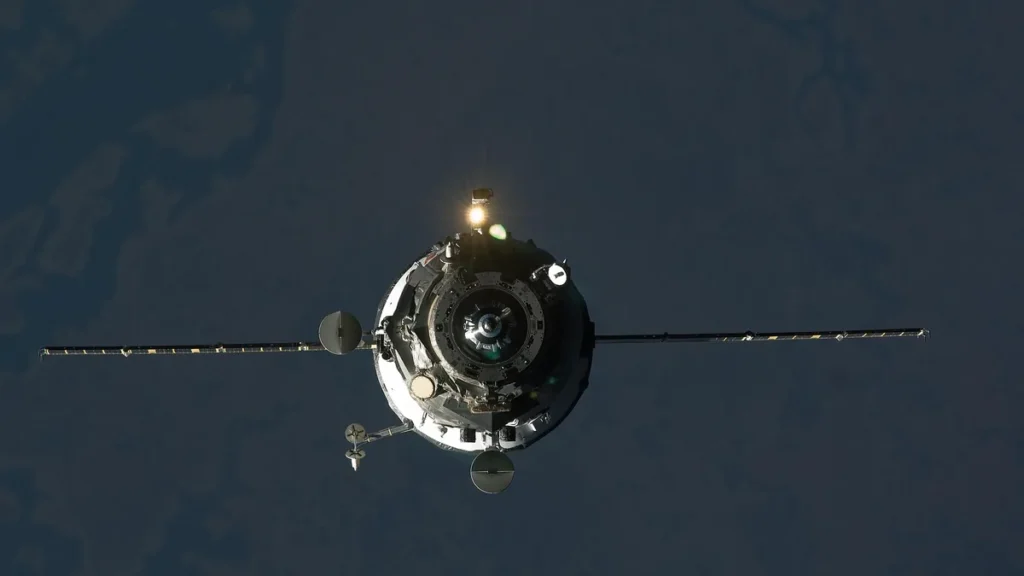
Cygnus XL is a cargo spacecraft designed to carry supplies to the station. Northrop Grumman built the vehicle under the agency’s resupply contract. The spacecraft will launch atop a SpaceX Falcon 9 rocket.
Station astronauts will use the Canadarm2 robotic arm, the station’s robotic arm, to capture Cygnus after launch. The crew will install the spacecraft at the Earth-facing port of the Unity module for cargo unloading. The station’s robotic arm performs capture, and the Earth-facing Unity port is the designated berthing location where the crew unloads cargo. The crew will unload supplies after berthing the spacecraft.
The Cygnus spacecraft will remain attached to the International Space Station until May 2027. It stays docked for several months to support cargo transfer operations before its planned departure in the spring of 2027. The spacecraft remains at the station through the cargo transfer period. NASA notes the timeline supports cargo transfer operations before departure.
Besides food, supplies, and crew gear, Cygnus will carry new science experiments to the orbital laboratory. The manifest combines crew provisions with research hardware, reflecting the dual logistics and science role of each resupply flight. NASA says the cargo includes provisions for the crew alongside equipment for research. The spacecraft carries both daily necessities and new investigations.
The International Space Station serves as an orbital laboratory for research. NASA conducts investigations aboard the station across scientific fields. The station supports continuous human presence in space.

The spacecraft will fly equipment to produce DNA-inspired particles in orbit that could improve treatment delivery for cancer and osteoarthritis. NASA describes this as one of the new experiments aboard the resupply spacecraft alongside food, supplies, and crew equipment. The experiment is part of the science hardware flying on CRS-25. NASA includes the equipment in the cargo manifest for the resupply mission.
One investigation aims to help guide cancer treatments by predicting if a patient’s cancer will spread elsewhere in the body. NASA lists this among the new science investigations flying on the CRS-25 mission. The study is one of the research projects packed into the cargo.
The cargo includes human muscle cells and medications to test therapies for muscle loss tied to spaceflight and aging on Earth. NASA says this experiment addresses muscle loss both in orbit and for terrestrial aging. The research uses cells and medications to test potential therapies.
The spacecraft will also fly a compact radiation sensor intended to improve crew safety on future missions. NASA lists the sensor as part of the cargo beyond crew provisions and equipment. The device aims to improve crew safety on future missions. It joins other science hardware bound for the station.
Each station resupply mission delivers investigations in biology and biotechnology, Earth and space science, physical sciences, and technology development and demonstrations. NASA describes these as the standard research categories flown on U.S. commercial cargo flights to the station. The agency applies these categories to U.S. commercial cargo flights.
Cargo resupply by U.S. companies ensures a national capability to deliver scientific research to the International Space Station. NASA says this capability increases the agency’s ability to conduct new investigations aboard the orbiting laboratory. U.S. companies provide the cargo delivery service under the agency’s resupply contract. NASA ties the national capability to new research opportunities on the station.
Continuous human presence aboard the International Space Station has now lasted 26 years. NASA uses this history to describe the station as a testbed for long-duration spaceflight and commercial low Earth orbit opportunities. The agency cites the long record when discussing the station’s role.
Low Earth orbit is the region of space close to Earth where the station flies. NASA uses the station to expand commercial opportunities in this orbit. The agency also relies on the station as a testbed for long-duration spaceflight challenges.
NASA calls the International Space Station an important testbed for understanding long-duration spaceflight challenges and expanding commercial opportunities in low Earth orbit. The release connects station research to NASA’s broader exploration strategy. The agency links station work to its wider exploration plans.
NASA says it is prioritizing deep space lunar missions under Artemis and Moon Base programs while commercial firms handle human transport and destinations in low Earth orbit. The release frames station resupply as part of a transition where NASA shifts toward Mars mission preparation. The strategy shifts NASA toward deep space lunar missions.





Join the discussion