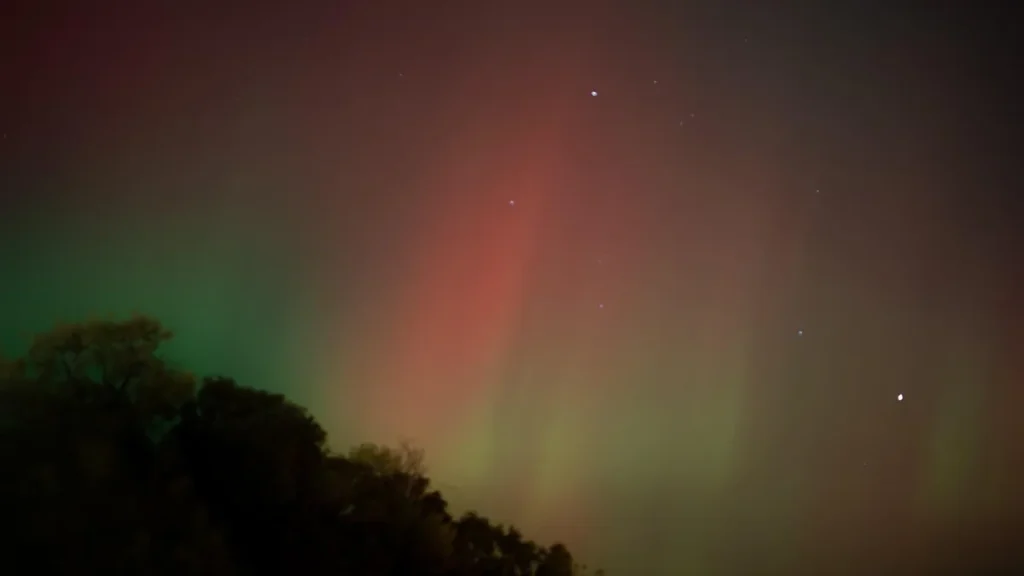
Researchers coordinated by Yasuhito Narita of the Technical University of Braunschweig studied photographs taken over southern Lower Saxony on the night of May 10, 2024, and said the bright rays linking red and green auroras indicate one shared physical process behind both colors.
Those photographs came from a magnetic storm that reached Earth on the night of May 10, 2024. It was the second most intense magnetic storm recorded since 1958. Websites had forecast auroras even for southern Lower Saxony, so researchers from the Technical University of Braunschweig, the Fraunhofer Institute for Surface Engineering and Thin Films IST, the University of Göttingen, and the Max Planck Institute for Solar System Research went outdoors to watch and photograph the display.
Sami K. Solanki, director of the Max Planck Institute for Solar System Research and a passionate photographer, had seen many auroras at higher latitudes but considered them a rarity above Göttingen. He wanted to photograph the display and was not originally interested in using the pictures for science. He recalled his nighttime excursion after seeing predictions of auroras for southern Lower Saxony during the storm. Philipp Schulz, Ingo von Borstel, and Klaus Reinsch shared the same experience.
Their images proved unusual. They showed a reddish glow above green auroras near the surface, with bright rays running downward from red to green. Bruce T. Tsurutani, a former scientist at NASA’s Jet Propulsion Laboratory and first author of the study, said no scientific paper had previously reported rays that continuously link red auroras above to green auroras below.
Tsurutani and colleagues published the results in Annales Geophysicae in 2026. The paper’s title describes high-resolution photographs of red-green auroras over Germany during the main phase of the May 10–11, 2024 superstorm, with DOI 10.5194/angeo-44-1201-2026. It documents photographs taken over Germany during the main phase of the May 10–11, 2024 superstorm.
Yasuhito Narita of the Technical University of Braunschweig coordinated the international team of researchers. The team compared the images with data on the solar wind and disturbances in Earth’s magnetic field.
Narita’s team matched the photographs against solar-wind measurements and magnetic-field disturbance data. Solar wind is the stream of charged particles flowing from the Sun. The resulting analysis indicates red auroras can be produced by electrons streaming down from the Sun just as green auroras are. The researchers also found that high-energy electrons likely triggered both the red and green auroras almost simultaneously during the May 10, 2024 storm.
Green auroras occur during typical nights in polar regions. Fast electrons from Earth’s magnetosphere race along magnetic field lines and advance within the atmosphere to altitudes of 130 to 85 kilometers. There they set off collisions that cause oxygen atoms to glow green.
Red auroras occur during intense magnetic storms at middle latitudes. They typically appear at altitudes ranging from 800 to 200 kilometers. Their formation mechanism has remained untested because satellites typically do not pass through red aurora space.
Researchers have proposed many different ideas for how red auroras form, but the absence of satellite crossings through red aurora space means the theories remain untested.
Narita said the images indicate that one shared physical process creates both red and green auroral light. Tsurutani said the rays have helped researchers understand where the red glow comes from.
The Sun follows an 11-year cycle of calmer and more active phases. During its active peak, the star releases fast solar wind plasmas with embedded magnetic fields in massive eruptions. When they hit Earth’s magnetosphere, the region of space dominated by the planet’s magnetic field, they cause magnetic reconnection. That process transfers solar wind energy to the magnetosphere and leads to auroras, sometimes even at midlatitudes.
Since 2024, aurora displays have appeared several more times over southern Lower Saxony. Solar activity is now entering a declining phase, though unusually intense eruptions can still occur. The displays over Germany during the May 10–11, 2024 superstorm showed colors and patterns that had hardly been documented before.
You can tell red and green auroras apart by where they sit in the sky. Green auroras glow lower, between 85 and 130 kilometers above the surface. Red auroras glow higher, between 200 and 800 kilometers, and often appear as a reddish glow above green curtains during intense storms.
On May 10, 2024, the photographs showed bright rays running downward from the red glow to the green auroras below. Tsurutani said researchers had not previously documented rays that run continuously from red auroras above to green auroras below. Narita said the rays point to a shared physical process behind both colors.
The Braunschweig team is asking members of the public to share photographs of future aurorae. Scientifically meaningful pictures need a relatively short exposure time of no more than six seconds to capture the telltale rays. Narita said anyone who takes photos of the aurora with a smartphone or camera can contribute to the study.
The researchers provided contact emails for the citizen science effort: theoretische-physik@tu-braunschweig.de for Yasuhito Narita at the Technical University of Braunschweig and Bruce.Tsurutani@gmail.com for Bruce Tsurutani. Besides capturing telltale rays, there are many other scientifically important features of red auroras that citizen scientists can help study.
The team is counting on the public’s help to document future auroral displays as solar activity declines. Researchers at the Technical University of Braunschweig are asking the public to share photographs of future aurorae because solar activity, though declining, can still produce unusually intense eruptions.
The institutes involved in the study span several countries. They include the Indian Institute of Geomagnetism in India, the University of Science and Technology of China in China, the Technical University of Braunschweig and the Max Planck Institute for Solar System Research in Germany, the British Antarctic Survey in the United Kingdom, Georg-August University of Göttingen in Germany, and the Fraunhofer Institute for Surface Engineering and Thin Films in Germany.
These institutions contributed to the international analysis of amateur photographs from the May 10, 2024 solar storm over Germany. The researchers compared the photographs with solar-wind measurements and records of magnetic-field disturbances from the storm. Narita coordinated the team that carried out that comparison. The analysis drew on pictures taken by researchers who had gone outside specifically to watch the event.


Join the discussion