Key facts
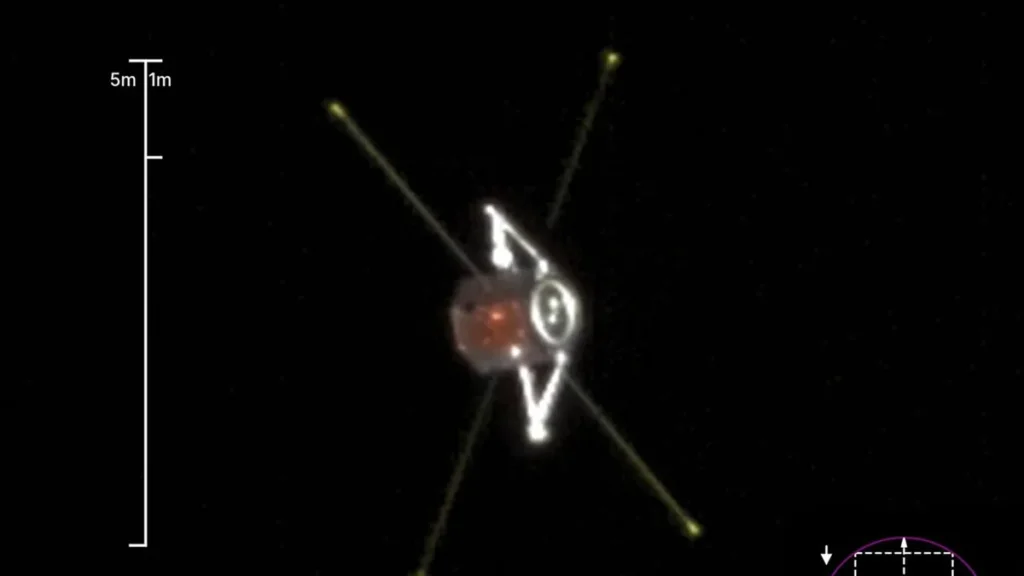
- NASA’s TRACERS mission, launched on July 23, 2025, uses twin satellites to study magnetic reconnection in Earth’s polar cusps, where solar wind particles funnel into the upper atmosphere.
- Magnetic reconnection at Earth’s magnetopause transfers solar-wind energy into the magnetosphere, driving geomagnetic storms that disrupt power grids, communications, and astronaut safety.
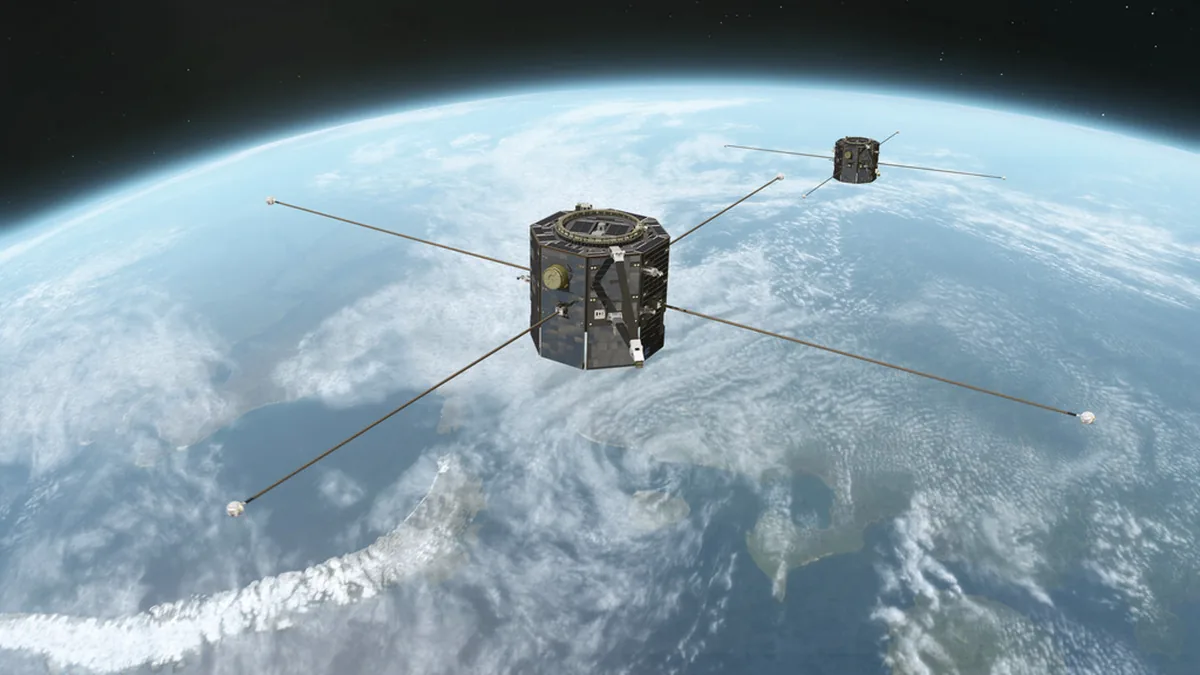
- The TRACERS mission’s twin satellites operate in a Sun-synchronous orbit, passing through Earth’s polar cusps to study magnetic reconnection events.
- TRACERS’ first-year data show magnetic reconnection is primarily a spatial process, meaning its location moves rather than changing over time.
NASA’s TRACERS mission published its first results on magnetic reconnection, an energy transfer between the Sun’s magnetic field and Earth’s magnetosphere, on Oct. 29, 2026, using twin satellites to study the process in Earth’s polar cusps, funnel-shaped regions where solar wind particles enter the upper atmosphere.
Magnetic reconnection at Earth’s magnetopause transfers solar-wind energy into the magnetosphere, driving geomagnetic storms that disrupt power grids, communications and astronaut safety. Understanding the process is critical for improving space weather forecasting and protecting critical infrastructure.
Launched July 23, 2025, TRACERS flies twin satellites in a Sun-synchronous orbit at 590 kilometers altitude with a 96.68-minute period, giving the spacecraft multiple polar cusp crossings each day. The design lets the pair pass repeatedly through the southern cusp and compare measurements between the two spacecraft to observe rapid changes. By comparison, the Cluster mission orbits with a 54-hour period, limiting how often it can catch fast-moving events.
The mission’s first-year data show that magnetic reconnection is primarily a spatial process, meaning the reconnection site moves rather than evolving over time. The result, published in the Journal of Geophysical Research, comes from the Analyzer for Cusp Ions instruments aboard both satellites, which track particle behavior during reconnection events.
During a geomagnetic storm on Sept. 30, 2025, TRACERS recorded 21 ion dispersion events and matched reconnection rates of 0.1 to 1.5 millivolts per meter to the Cross Polar Cap Potential measured by SuperDARN. The study used TRACERS-2 data exclusively, applying an automated algorithm to identify dispersion events and calculate rates from ion-energy cutoffs, with results validated against manual reviews. The correlation produced an r² of 0.62 for the storm’s onset and main phase.
TRACERS’ Analyzer for Cusp Ions measures ions across 47 energy channels with 312 millisecond time resolution and full pitch-angle distributions, improving on DMSP’s one-second resolution. The companion Analyzer for Cusp Electrons operates with 50 millisecond resolution across 49 energy channels between 20 and 13,500 electron volts; during the studied intervals it ran in a mode covering 40 to 10,000 electron volts.
To calculate the rate, TRACERS identifies ion dispersion events in the cusp and derives the value from the lower energy cutoff of dispersed ions and the spacecraft’s velocity, adjusted for magnetic field strength. Uncertainties arise from modeling transit paths and spacecraft velocity. The team applies the Maximum Magnetic Shear model, which blends magnetosheath magnetic field calculations with the T96 magnetospheric model to pinpoint the reconnection x-line. The method traces to Lockwood and Smith (1992), with enhancements from da Silva et al. (2025).
The TRACERS rate estimates of 0.1 to 1.5 millivolts per meter line up with earlier in-situ measurements from the Polar mission but sit slightly below rates derived from DMSP data. The mission’s higher time resolution, 312 milliseconds versus DMSP’s one second, enables more precise reconnection rate calculations. TRACERS builds on MMS and THEMIS, which examined reconnection at other magnetospheric locations including the dayside magnetopause, while TRACERS concentrates on the polar cusps. Higher time resolution and more frequent revisits let TRACERS capture rapid changes that high-altitude missions miss.
TRACERS also observed a geomagnetic storm on Jan. 19, 2026. The mission collected data from both TRACERS-1 and TRACERS-2, though coverage was unequal after operations switched to the southern cusp.
The correlation between reconnection rate and Cross Polar Cap Potential weakens during a storm’s recovery phase. It disappears entirely when recovery-phase dispersion events are included, indicating that reconnection dynamics differ between the main phase and recovery.
NASA approved a prime mission extension keeping TRACERS operational through spring 2027, after a launch setback forced the team to re-establish contact with one satellite and restore routine data collection. The satellites now routinely observe the southern cusp multiple times daily.
The mission is led by David Miles of the University of Iowa, with support from Southwest Research Institute, UCLA and UC Berkeley, and is managed by NASA’s Heliophysics Explorers Program Office. Stephen Fuselier, TRACERS deputy principal investigator and instrument lead at Southwest Research Institute, said on Oct. 29, 2026 that analyzing the data gave a clearer view of solar wind particle behavior and its link to reconnection events, calling this first step important for understanding broader magnetic field interactions.
David Miles, the principal investigator at the University of Iowa, said publishing the findings is deeply meaningful to the team, praised its collaboration and resolve, and expressed excitement for future measurements. Future measurements are planned to confirm the results.

Join the discussion