Key facts
- Wiens wrote that the emission comes from delayed atomic shifts in chromium atoms located in a corundum mineral structure, and SuperCam confirmed the source by timing the transitions through resulting photons.
- Wiens wrote that corundum forms through metamorphic and pegmatitic processes and would not be expected on Mars because the planet lacks plate tectonics.
- Wiens said the corundum results were published in Geophysical Research Letters by a research team led by Ann Ollila earlier in 2026.
- Wiens wrote that because the rover is located in very old terrain near Jezero crater's rim, the team expects signs of localized metamorphism caused by impact heating.
NASA’s Perseverance rover found strong, narrow luminescence peaks at 692.7 and 694.1 nanometers in a light-colored Martian rock near Jezero crater’s rim, SuperCam principal investigator Roger C. Wiens of Purdue University wrote in a NASA Science blog post dated Nov. 4, 2026. The peaks trace delayed atomic shifts in chromium atoms inside corundum, the mineral family that includes ruby.
SuperCam produced the signal as a side benefit of its Raman spectroscopy, which measures delayed atomic transitions through photons, Wiens wrote. The narrow peaks contrast with the broad wavelength range of most luminescence, including ordinary commercial lighting. Wiens wrote that the finding surprised the SuperCam team two years earlier.
Chromium-bearing corundum in gemstone form is ruby, Wiens wrote, and SuperCam confirmed the source by timing the atomic transitions through the resulting photons. Wiens said Ann Ollila’s team published the corundum results in Geophysical Research Letters earlier in 2026. Before launch, the team placed a ruby in the laser beam’s path and saw the room pulse a brilliant red, which Wiens called extremely bright.
Wiens wrote that PIXL and SuperCam can detect all kinds of elements, and that SHERLOC, SuperCam and PIXL identify minerals using x-ray fluorescence, Raman and infrared spectroscopies. Time-resolved luminescence, the technique behind the signal, comes as a side benefit of SuperCam’s Raman spectroscopy work.
Wiens wrote that corundum comes from metamorphic and pegmatitic processes, a combination Mars should not see given its lack of plate tectonics. Large strikes from meteors and asteroids can create localized metamorphism through long-term heating, so the team expects signs of impact heating in the very old terrain near Jezero crater’s rim where Perseverance operates.
Wiens called it the first mission terrain of its kind. The team once used time-resolved luminescence only rarely, but lately they have trained it on light-toned rocks frequently, hunting for more evidence of impact effects.
Perseverance has also turned up tiny corundum crystals inside pebbles called Hampden River, Coffee Cove and Smiths Harbour, outside the rim of Jezero Crater, according to EarthSky’s reporting on research led by Ann Ollila. Each grain spans about 0.008 inches, or 0.2 millimeters, and the rover identified them using SuperCam’s two lasers.
Ann Ollila of Los Alamos National Laboratory led the research team and shared its work at the Lunar and Planetary Science Conference in Texas on March 16, 2026, EarthSky reported. On Earth, corundum is called ruby or sapphire depending on its trace metals, and tectonic activity usually drives its formation there.
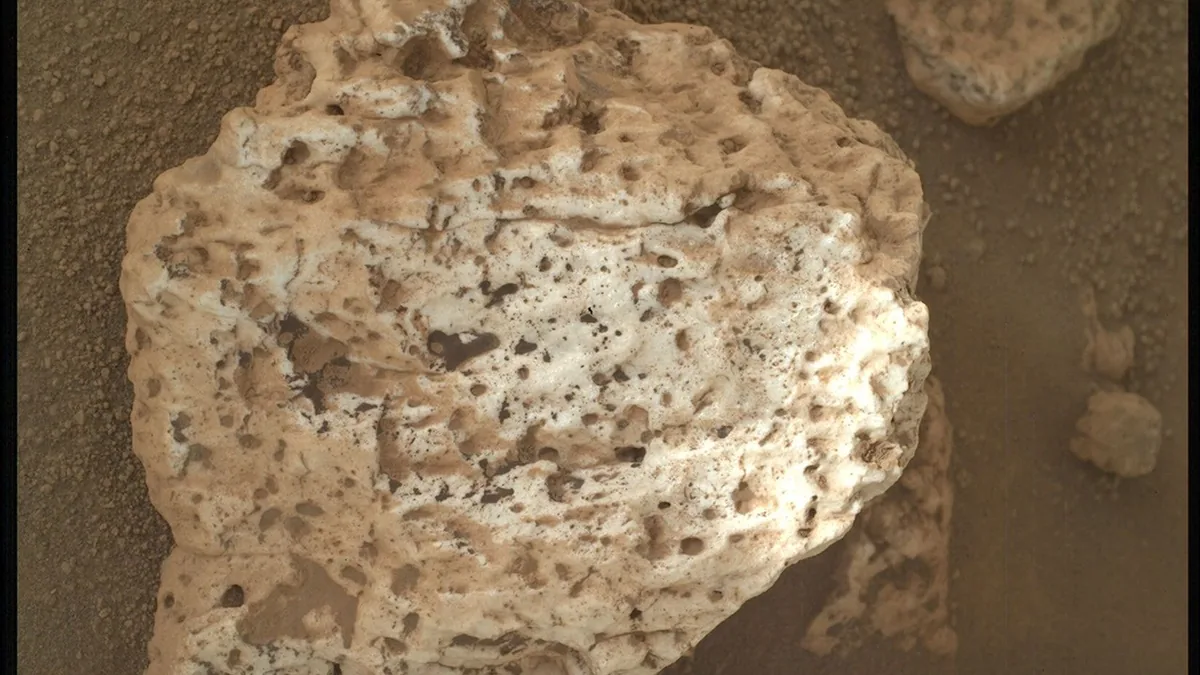
Researchers pointed to meteorite impacts as the cause, since Mars never had plate tectonics and its remaining tectonic activity probably cannot explain the gems, EarthSky reported. Allan Treiman of the Lunar and Planetary Institute in Texas called the discovery shocking and said he was very surprised. Ollila said she would love to pick up a Martian grain and analyze it to see whether it looks red, though everything visible is just a white pebble. She has said corundum on Earth usually needs a silica-poor, aluminum-rich setting tied to tectonism.
Those clues fit into a wider portrait of Jezero’s volcanic and watery past. A Rice University-led study published Sept. 18, 2025, showed that PIXL bombards Martian rocks with X-rays to reveal their chemistry, producing geochemical measurements more detailed than any ever gathered on another planet.
Researchers identified two dozen mineral types in Jezero Crater using PIXL data and Rice University’s MIST algorithm, according to the study led by Rice graduate student Eleanor Moreland. Those 24 species record three fluid-interaction types in Jezero Crater, Moreland said, including a move from hot, acidic fluids toward neutral and alkaline conditions as time passed.
The first suite includes greenalite, hisingerite and ferroaluminoceladonite, pointing to localized high-temperature acidic fluids in the oldest crater-floor rocks. The second reflects moderate neutral fluids across a wider area, and the third represents low-temperature alkaline fluids that are considered quite habitable.
Kirsten Siebach, a co-author and Rice University assistant professor, said hot, acidic conditions would be hardest for life but would not rule out habitability, because life endures in Yellowstone’s acidic pools. She is an assistant professor in the Earth, environmental and planetary sciences department at Rice University.
Wiens wrote that the tiny crystals are helping researchers better understand Mars’ past, though no collectable rubies have turned up yet. The rover is studying very old terrain along Jezero crater’s rim, ground no mission has explored before.




Join the discussion