Key facts
- Perseverance collected a new rock sample nicknamed "Singita," ending a gap of more than a year without a sample collection.
- The rock that yielded "Singita" likely formed deep in the Martian crust and was excavated by at least one, possibly multiple, large impact events.
- The team selected a less-worn coring bit to improve the chances of collecting a sample from the hard rock.
- NASA's Perseverance rover drilled the "Singita" sample on Oct. 24, 2026, according to The Planetary Society.
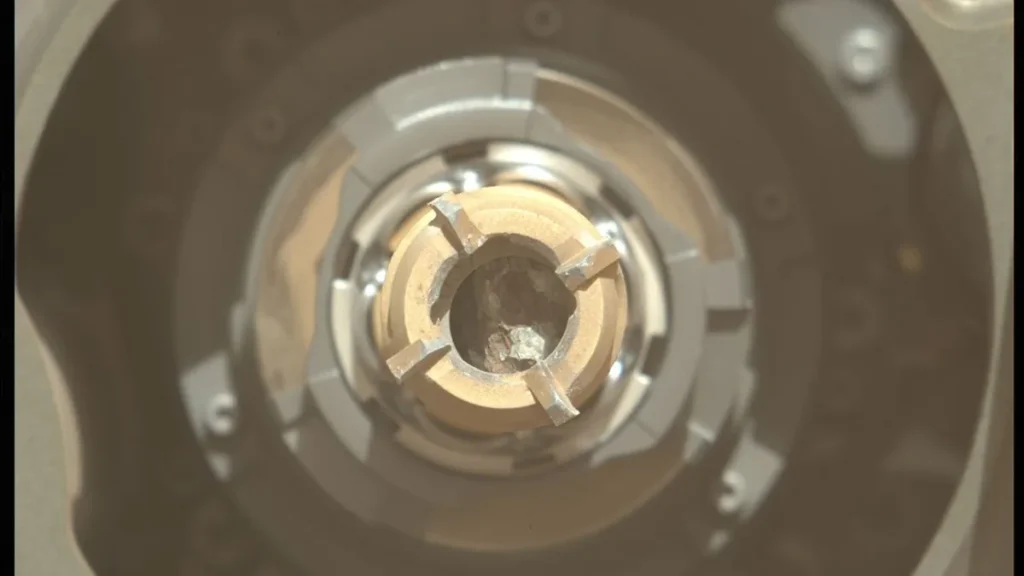
Perseverance’s team collected a new rock sample nicknamed Singita on Oct. 24, 2026, in Mars’s Lac de Charmes region outside Jezero crater’s rim, ending a gap of more than a year without sample collection, according to NASA’s blog and The Planetary Society.
Singita comes from a gabbro, an igneous rock made mainly of calcium-rich plagioclase feldspar and pyroxene crystals. NASA’s blog says the team wanted to add a gabbro to Perseverance’s sample collection and identified light-toned rocks with a matching composition in the new workspace, where the rover drove after Badger Peak proved too hard to core. The rock likely formed deep in the Martian crust, and at least one large impact event—possibly more—excavated it, a history that NASA’s blog links to the rock’s crustal texture. Katie Stack Morgan, who serves as Perseverance’s project scientist, said the rock was likely buried about one kilometer, or 0.6 miles, deep before an impact threw it to the surface at some point in its history, making it a deep-crustal sample brought to the surface by impact.
Perseverance originally landed in Jezero five years ago, according to The Planetary Society. The crater formed from a giant impact about 3.9 billion years ago, give or take. Researchers did not expect rocks older than the crater inside it because Jezero formed from that giant impact.
Katie Stack Morgan said Singita could rank among the oldest rocks exposed on Mars’s surface. She made the remark at the American Astronomical Society’s Division of Planetary Sciences conference. Singita is the first crystalline igneous rock sample collected by the rover beyond Jezero crater. Scientists cannot determine Singita’s precise age unless they return the sample to Earth because dating a Martian rock in place carries uncertainty.
The Planetary Society says Singita lies outside the rim in Lac de Charmes and is likely at least as old as Jezero, beyond the crater formed by that ancient impact. The source rock might be a fragment from the Isidis Basin impact, one of Mars’s largest impact basins, or could be older than that basin.
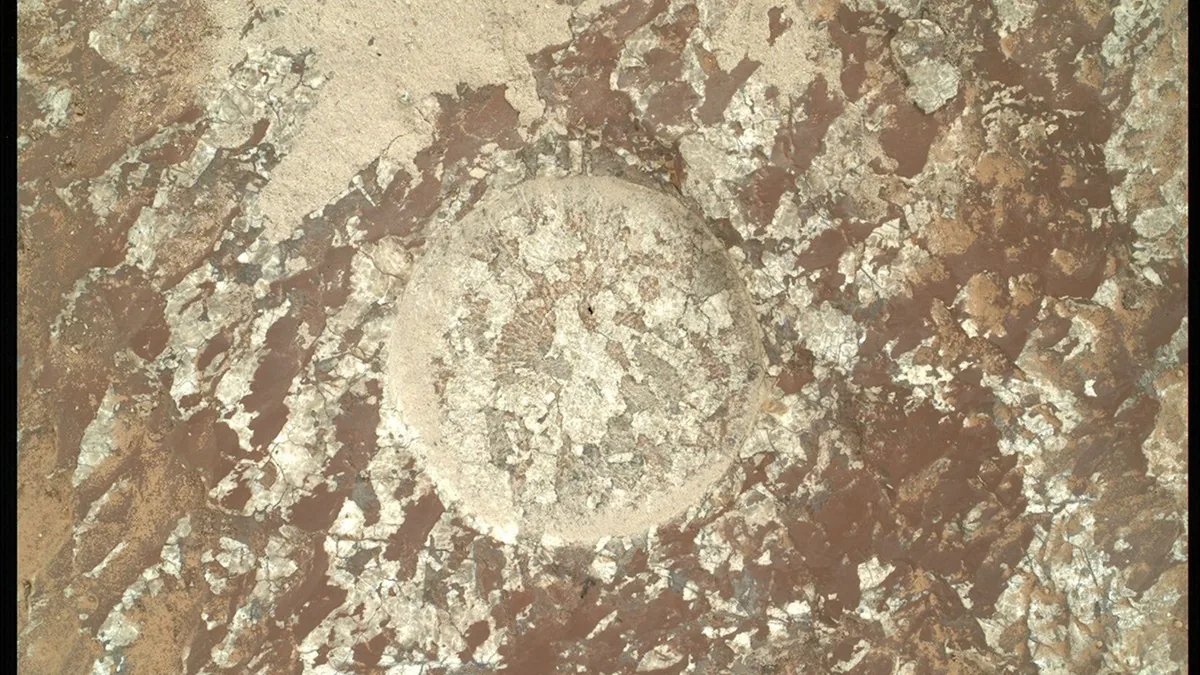
The team singled out Pumbe because it closely resembles Badger Peak, an earlier target with a hardness too high to core, and the resemblance was intentional rather than accidental, according to the NASA blog post written by Tasha Coelho, a student collaborator at Arizona State University working with Mastcam-Z and dated Nov. 1, 2026. After Badger Peak proved too hard to core, the rover drove roughly 100 meters, or 330 feet, to another patch of light-toned rocks in a new workspace. Visual and chemical observations confirmed the new workspace rocks had a composition similar to Badger Peak. The team selected a nearby rock with a flatter surface positioned so the drill stabilizers could press against it, one of the prudent decisions meant to improve sample-collection odds.
According to The Planetary Society, the rover’s first core-drilling attempt at Singita failed because the rock’s hardness stopped the drill, halting the initial sampling effort. The team then switched to a different, less-used coring bit to improve the chances of collecting a sample from the hard rock, a change NASA’s blog describes as coming after hardness caused drilling problems during the first attempt. NASA’s blog says sample acquisition followed abrasion of Pumbe, and the drill penetrated roughly 3.1 centimeters, or 1.2 inches, into the rock before collection began, a depth NASA’s blog describes as a display of the rover’s namesake quality. NASA’s blog says Perseverance completed its 66th successful abrasion with the Pumbe target and remains capable of more abrasions.
NASA’s most recent mission status report describes Perseverance as healthy and stable on Mars, with spacecraft status listed as nominal, and the rover continues to operate. NASA’s blog says the rover remains capable of continued fruitful exploration, with many more abrasions to come. Katie Stack Morgan said the rover will remain in this area to try collecting two additional samples, one from a different, younger crystalline igneous rock. The Planetary Society says this plan follows from the potential scientific importance of Singita.




Join the discussion