
Key facts
- Each side of the Great Square spans roughly 15 degrees, making the whole box about half again as wide as a clenched fist held at arm's length because a fist covers around 10 degrees of sky.
- EarthSky reports that the Great Square of Pegasus sits tilted over the eastern horizon in mid-October to resemble a baseball diamond, arriving with baseball's playoffs and the World Series.
- Astronomy Magazine also presents the Great Square as a celestial baseball diamond, using the 2022 World Series between the Philadelphia Phillies and the Houston Astros as its observing hook.
- EarthSky notes that over time the tilted diamond will turn and square itself out, so the baseball-diamond appearance is temporary within the season.
EarthSky reported Oct. 21 that the Great Square of Pegasus sits tilted over the eastern horizon in mid-October, resembling a baseball diamond as baseball’s playoffs and the World Series arrive.
The tilted diamond is temporary and will gradually turn back into a square over the season, EarthSky says. EarthSky assigns Algenib to the area behind home plate, puts Markab at first base, places the red giant Scheat at second base, and stations Alpheratz at the hot corner. Astronomy Magazine, using the 2022 World Series between the Philadelphia Phillies and the Houston Astros as its hook, places Scheat at home plate on the northwest corner. It puts Alpheratz at first base, Algenib on second base, and Markab on third base.
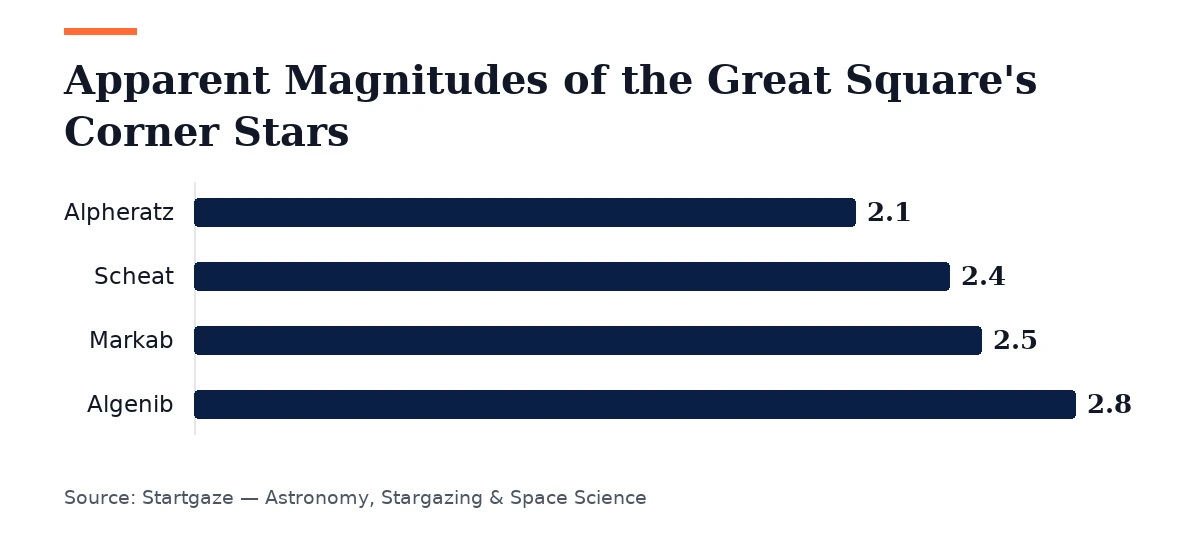
Startgaze lists the corners as second-magnitude stars, with Alpheratz at 2.1, Scheat at about 2.4, Markab at 2.5, and Algenib at 2.8. StarGlobe lists more precise corner magnitudes: Alpheratz at +2.06, Scheat at +2.42, Markab at +2.49, and Algenib at +2.84. That makes Alpheratz the brightest and Algenib the faintest.
StarGlobe puts Markab at the southwestern corner, Scheat at the northwestern corner, Algenib at the southeastern corner, and Alpheratz at the northeastern corner. It describes Markab as a hot blue-white star about 133 light-years from Earth and Scheat as a red giant whose orange tint is visible through binoculars, ranging between magnitudes +2.31 and +2.74. Startgaze says Scheat varies slightly in brightness over weeks and months, which can make the four corners look slightly uneven, and Astronomy Magazine calls Scheat a preview of the future Sun, which will evolve into a red giant in around five billion years.
Astronomy Magazine adds that Markab rotates at around 290,000 mph (468,000 km/h), far faster than the Sun’s 4,400 mph (7,100 km/h), and has been on third base for some 200 million years. EarthSky identifies Algenib as an old star about five times the size of our sun, positioned behind home plate. EarthSky places Alpheratz at the hot corner about 100 light-years away, notes its Arabic name means something like the horse’s navel, and says it lies in Andromeda on the border where it was considered part of both constellations for many years.
Alpheratz officially belongs to Andromeda rather than Pegasus, a status that began when constellation boundaries were formally drawn in 1922, even though it remains part of the Great Square pattern. Johann Bayer’s 1603 Uranometria gave Alpheratz the duplicate designation Delta Pegasi, and the International Astronomical Union eliminated this and several other duplicate star designations in 1930. Astronomy Magazine says Alpheratz sits in foul territory because it resides in Andromeda, not Pegasus, and calls it a blue-white inferno.
Roughly 15 degrees span each side of the Great Square, making the full box about half again wider than a clenched fist held at arm’s length; a fist covers around 10 degrees of sky. Both Startgaze and StarGlobe present this scale as a handy ruler for judging distances between other sky objects and for estimating the Square’s size at a glance. StarGlobe says the Great Square is not quite a perfect square: its sides are slightly unequal and its angles are not precisely 90 degrees, though it looks square to the eye.
StarGlobe says the Great Square rides high in the southern sky during October and November evenings, while Bimal Khatri says it stands highest in the evening sky around October and dominates the autumn sky from September to December. These sources agree the asterism is best placed for evening viewing in October after rising in the east earlier in the season. Startgaze says from the September equinox until December the Great Square owns the evening sky, sliding a little further west each week.
Startgaze advises facing east once the sky is properly dark to find the Great Square rising in the east. From Cyprus in mid-September it appears around 20:30 local, and through October it rises earlier each evening. The guide says the Square climbs out of the east balanced on one corner like a tipped diamond, reaches the southeast around midnight by late September, and from 35 degrees north passes nearly overhead with Alpheratz culminating near 84 degrees altitude.
StarGlobe recommends facing south during an autumn evening around 9 to 10 PM local time to see the large tilted square of four moderately bright stars high in the sky. The guide describes the Square as autumn’s signature pattern and a starting point for exploring surrounding constellations and finding the season’s best deep-sky objects. StarGlobe says the Great Square is best seen from September through December, rises in the east during evening hours in early autumn, is high in the south at dusk by late autumn, sinks into the western sky in winter, and is below the horizon during convenient evening hours in spring and summer.
The Great Square rises as the Summer Triangle sinks and stands highest around the September equinox, which in 2026 fell on September 23 at 00:06 UTC (03:06 local in Cyprus), when the Sun crosses the celestial equator heading south. Startgaze says the Summer Triangle is still high overhead as darkness falls in September, and the Great Square is the next big figure to its east. Startgaze notes that the W of Cassiopeia, climbing in the northeast, has one side that points roughly down toward the Great Square.
StarGlobe says the W-shaped circumpolar constellation Cassiopeia sits high above the Great Square, and a line from Scheat through Alpheratz extended northward points toward it. Below and around the Great Square, the faint zodiac constellation Pisces sprawls, and planets frequently pass through this region along the ecliptic. Aquarius, to the southwest of the Great Square, hosts several globular clusters and the Helix Nebula.
The Great Square’s nearly empty interior works as a dark-sky meter. Startgaze rates zero to two stars as poor and light-polluted, three to seven as average, eight to 11 as good, and 12 or more as excellent. Observers should allow 30 minutes to dark-adapt before counting, or they will sell their sky short, and from a Bortle 7 balcony only one or two stars may be visible. StarGlobe says the area inside the Great Square is remarkably devoid of bright stars; under light-polluted skies it may appear completely empty, while from dark sites observers might count five to 10 faint stars within.
Startgaze describes the Great Square as a big, slightly lopsided square of four stars climbing over rooftops, bright enough to punch through city light, with nothing else nearby shaped like it. From a balcony in Nicosia all four corners can be found on a hazy night when almost nothing else is up yet. Bimal Khatri says the Great Square holds up well under city light because its stars are bright enough and its shape large enough, and that M15 is a good suburban telescope target while galaxies need dark skies.
Running a line down the western side of the Great Square from the top corner through the bottom one and toward the horizon leads to Fomalhaut, magnitude 1.2, the brightest star in Piscis Austrinus and the only first-magnitude star for a long way around, nicknamed the Lonely One. Startgaze says Fomalhaut culminates about 25 degrees up from 35 degrees north, while from Britain or northern Germany it barely scrapes the horizon, making it easier from Mediterranean latitudes. Just south of the Square, under a darker sky, lies the Circlet of Pisces, a faint ring marking the head of the western fish and a real dark-sky target not visible from a balcony.
From Alpheratz, a chain of stars extends northeast into Andromeda and leads to the Andromeda Galaxy (M31), which Startgaze calls the most distant object the human eye can see unaided at about 2.5 million light-years. StarGlobe says M31 lies about 15 degrees from Alpheratz along the Andromeda chain and appears as an elongated glow several degrees across through binoculars. Startgaze says two gently curving lines of stars trail northeast from Alpheratz to form the body of Andromeda, and says the light landing on the retina from M31 left that galaxy before our species existed. EarthSky notes a line of three stars extends from the Great Square Baseball Diamond toward the northwest, marking the rest of Andromeda the Chained Lady and leading to the Andromeda Galaxy, Messier 31, just a couple million light-years away.
Beyond Andromeda toward the east, Perseus contains the Double Cluster and the variable star Algol. StarGlobe calls M33 a spiral galaxy viewed face-on that lies between Andromeda and Triangulum. It is fainter and more spread out than M31, though dark-site observers still find it rewarding. StarGlobe describes NGC 7331 as a galaxy in Pegasus sometimes called Milky Way’s twin due to its similar structure, visible in medium telescopes.
StarGlobe calls Stephan’s Quintet a famous group of five galaxies near NGC 7331, challenging but achievable through larger amateur telescopes. Bimal Khatri describes Stephan’s Quintet as a compact group of five galaxies, four of them physically interacting and visibly distorted, and notes it was one of the first targets released from the James Webb Space Telescope. Bimal Khatri describes NGC 7331 as a large spiral galaxy often described as a near-twin of the Milky Way and much easier than Stephan’s Quintet nearby.
Bimal Khatri identifies Einstein’s Cross as a quasar lensed into four images by a foreground galaxy, calling it a demonstration of gravity bending light. Astronomy Magazine places NGC 7331 behind home plate as a special fan with a view of the umpire star Matar, which lives 4.5 degrees south-southeast. Astronomy Magazine says NGC 7331 is a spiral galaxy about 45 million light-years away shining at 10th magnitude, sometimes called Andromeda Junior, and an editor’s note corrects that it—not Matar—is 45 million light-years distant. Through 10×50 binoculars, an observer can just make out its faint oval glow northeast of an arc of faint stars.
Startgaze reports that SN 2026aaiv is brightening in the galaxy NGC 7331 in the northwest corner of Pegasus as of September 13, 2026, offering telescope owners a current supernova target near the Square. M15, one of the finest globular clusters in the northern sky, sits just off Enif, the horse’s muzzle, about 4 degrees northwest of Enif, and is an easy binocular catch from a dark site. Startgaze says following the neck west from the Square to Enif leads to M15, and Bimal Khatri describes it as extremely dense with core collapse, bright in binoculars, and resolvable into outer stars with a telescope.
Bimal Khatri identifies Enif (Epsilon Pegasi, magnitude 2.4) as the brightest star in Pegasus, an orange supergiant marking the horse’s nose, with a name meaning the nose in Arabic. Bimal Khatri says Markab is another Square corner meaning the saddle. Astronomy Magazine describes Markab as a subgiant star that appears pure white through binoculars.
Tau and Upsilon Pegasi serve as catcher and pitcher about a third of the way from Scheat to Algenib, both shine near magnitude 4.5, are separated by about a degree, and may be visible without binoculars on clear nights. Psi Pegasi is a fifth-magnitude red giant off the baseline inside the infield that looks like a runner on first thinking about stealing second and probably requires binoculars to spot. Astronomy Magazine uses the baseball metaphor to help observers locate the star relative to Alpheratz at first base.
Between Alpheratz and Psi Pegasi lies 85 Pegasi, which giant binoculars show as two stars separated by about 33 arcseconds, with the brighter at sixth magnitude and the companion at ninth magnitude. About halfway between third base and home, west of the baseline, four faint stars form a diamond spanning half a degree with a fifth star just three-quarters of a degree southwest, an asterism called Delphinus Minor. Astronomy Magazine jokes that the Dolphins also played baseball, and an editor’s note says the image was updated to show the correct placement of Delphinus Minor.
Bimal Khatri gives Pegasus sky coordinates as right ascension 21h 13m and declination +2.3°, says it straddles the celestial equator, and notes it is visible from anywhere north of latitude 54°S, including the whole northern hemisphere. Bimal Khatri says Pegasus covers a broad stretch of sky down to about 60°S, so people almost everywhere can see it, while northern observers see it much higher.
Bimal Khatri lists Pegasus’s bordering constellations as Andromeda, Aquarius, Cygnus, Delphinus, Equuleus, Lacerta, Pisces and Vulpecula. It belongs to the Perseus family of nine constellations telling the northern sky’s Andromeda myth, listing Andromeda, Auriga, Cassiopeia, Cepheus, Cetus, Lacerta, Perseus and Triangulum alongside Pegasus.
Bimal Khatri recounts that Pegasus sprang from Medusa’s blood when Perseus beheaded her, later served Bellerophon against the Chimera, and was carried to the heavens by Zeus after Bellerophon was thrown by a gadfly while trying to reach Olympus. The Great Square represents the body of Pegasus, drawn upside down and only half complete with head, neck, forelegs and body but no hindquarters, a shape ancient sources sometimes explain as the horse rising out of the sea or emerging from clouds. Babylonian skywatchers used the Great Square’s stars as a seasonal marker, drawing on its size and regularity as a measuring frame long before winged horse tales arose.
Bimal Khatri notes that Pegasus holds the first planet ever found orbiting an ordinary star: 51 Pegasi b, discovered in 1995 by Michel Mayor and Didier Queloz, a gas giant hot Jupiter orbiting in just over four days, a discovery that won the 2019 Nobel Prize in Physics. The EarthSky writer recalls standing at a window during the 1982 World Series between the Brewers and the Cardinals, noticing the stars while the game played on television behind him as a Yankees fan.
EarthSky advises skywatchers to find Saturn hiding among the eastern sky’s stars, then turn left to see a huge square of four stars rising into the eastern skies as darkness falls. EarthSky describes the Great Square sitting over the horizon in mid-October with home plate at the bottom of the diamond. EarthSky places second base higher above the horizon, about halfway toward Vega and Deneb, stars from the out-of-season Summer Triangle. EarthSky says the diamond’s points are 2nd- and 3rd-magnitude stars located a couple of hundred light-years away.

Join the discussion