Key facts
- An international team published the most sensitive low-frequency radio images of the Universe using LOFAR by observing the same sky regions repeatedly and combining the data into one very-long-exposure image.
- Philip Best, Professor of Extragalactic Astrophysics at the University of Edinburgh, led the deep survey.
- The deepest LOFAR image ever made, in Elais-N1, came from one pointing observed repeatedly for 164 hours and detected over 80,000 radio sources, most of them distant Milky Way-like galaxies forming stars.
- Cyril Tasse from Paris Observatory, University PSL, said the deep radio images are hidden inside the data and recent mathematical advances made extraction possible using large clusters of computers.
On Nov. 6, 2026, an international team led by Leiden University produced the sharpest low-frequency radio image of the sky ever made using LOFAR, a European network of low-frequency radio antennas. The catalog lists nearly 63,000 radio sources across a northern-sky field about 25 times the size of the full moon, with active galactic nuclei—bright galactic centers powered by matter spiraling onto supermassive black holes—and galaxies forming stars among them.
The results appear in Astronomy & Astrophysics and on the arXiv preprint server. The observation focused on ELAIS-N1, a well-studied northern-sky patch filled with faint, distant galaxies. Jurjen de Jong, a postdoctoral researcher at Leiden Observatory and ASTRON, led the work.
Compared with the team’s earlier most sensitive LOFAR view of this area, the new image is 20 times sharper, sharp enough to make out a coin from about 10 kilometers away. The full frame holds 8 billion pixels. Researchers gathered the data over 200 hours, producing 400 terabytes.
Processing costs fell by more than a factor of 10 in recent years thanks to improved calibration and data-reduction methods, the team says. Spider, a high-performance platform at SURF in the Netherlands, processed the data set within a few months. The data are publicly available for the astronomical community. Adding optical, infrared and X-ray coverage of the same patch lets astronomers derive properties such as distance and mass for each radio source.
Active galactic nuclei are compact centers powered by matter spiraling onto supermassive black holes, driving jetlike outflows that LOFAR detects through faint radio emission. On low-resolution views, distant galaxies and black-hole jets look like featureless blobs, making it hard to say whether a jet or star formation across a galaxy produced the signal. The new high-resolution LOFAR data separates components more easily and traces massive jets in detail. Reinout van Weeren of Leiden Observatory says the view offers a new way to study radio jets.
The other major population consists of small star-forming galaxies actively converting gas into stars. Radio emissions travel through dust that blocks views of stellar nurseries in optical and infrared light, providing an unobscured look at star formation in faraway galaxies. This lets astronomers trace galaxy evolution from the earliest systems to the present universe.
Deep LOFAR images produced a new link between radio output and star-formation rate, along with a more accurate count of new stars forming in the young Universe. Isabella Prandoni of INAF Bologna said radio waves pass through dust that blocks optical views, giving LOFAR a complete view of star formation.
In April 2021, Philip Best of the University of Edinburgh led an international team that produced the deepest low-frequency radio views of the Universe then available, made by going back to the same sky regions again and again. Fourteen research papers describing the images and early results appeared together in a special issue of Astronomy & Astrophysics.
The survey spanned roughly 300 times the full moon’s area and found tens of thousands of galaxies resembling the Milky Way far into the distant Universe, showing them as they appeared billions of years ago during peak star formation. It also captured the faint radio glow of exploding stars in tens of thousands of galaxies across the farthest reaches of space.
The deepest LOFAR image ever made resulted from a single Elais-N1 pointing observed repeatedly for 164 hours and turned up over 80,000 radio sources, most of them distant galaxies resembling the Milky Way that are forming stars. Comparing repeated observations turned up the red dwarf star CR Draconis, whose radio bursts resemble Jupiter’s. Joe Callingham, who works at Leiden University and ASTRON, said the bursts could come from an unknown planet or from rapid rotation.
LOFAR does not build sky maps directly; it combines signals from more than 70,000 antennas instead. Raw data for the deep pictures topped 4 petabytes, or about a million DVDs. ASTRON, the Netherlands Institute for Radio Astronomy, operates LOFAR on behalf of nine European countries. In high-band configuration it observes at around 150 MHz.
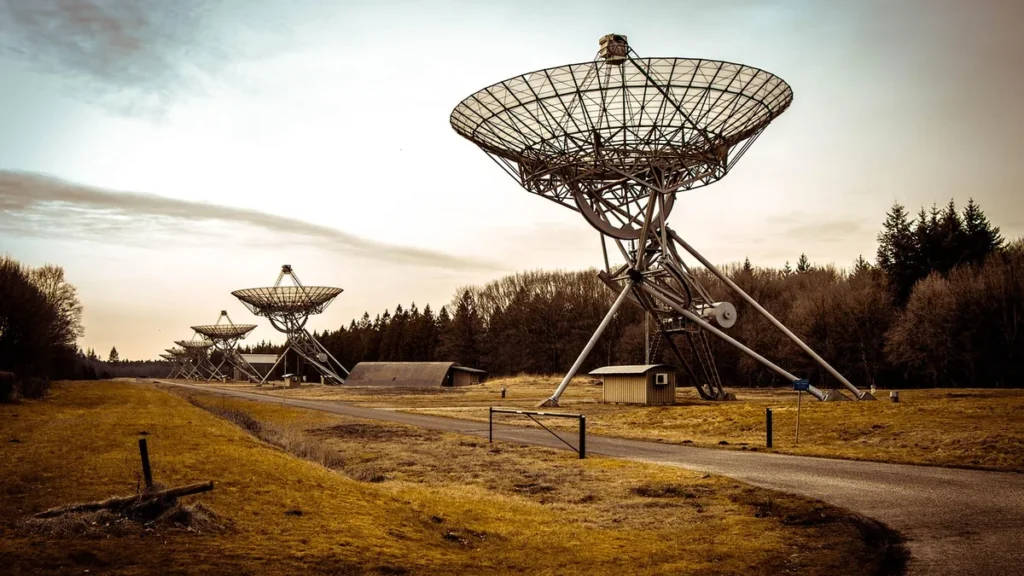
Exloo, Netherlands, hosts the LOFAR core. Stations across the Netherlands and partner countries hold more than 70,000 antenna dipoles, connected by fiber-optic network and computers to act as one trans-European antenna stretching over 1,300 kilometers. No other astronomical data collection is larger than the LOFAR data archive.
Huub Röttgering of Leiden University leads the LOFAR survey suite and said the telescope is unique in producing high-quality sky images at meter wavelengths. The team assembled optical, near-infrared, far-infrared and sub-millimeter observations of LOFAR-detected galaxies to help interpret the radio results. Cyril Tasse, who works at the Paris Observatory within University PSL, said recent mathematical advances made it possible to extract the deep radio images hidden in the data using large computer clusters.
The third data release of the LOFAR Two-Meter Sky Survey maps 13.7 million cosmic sources and appeared in Astronomy & Astrophysics on Feb. 20, 2026. “This data release brings together more than a decade of observations, large-scale data processing and scientific analysis by an international research team,” said Dr. Timothy Shimwell of ASTRON and Leiden University, who led the team.
Stations that make up LOFAR stretch across Europe with separations of nearly 2,000 kilometers, giving the telescope its large size and sensitivity. The LoTSS-DR3 dataset totals 18.6 petabytes. Radio waves from supermassive black holes in many galaxies stretch across millions of light-years. Martin Hardcastle of the University of Hertfordshire says black holes feature in the survey.
Dr. Andrea Botteon of INAF in Bologna says shocks and turbulence drive particle acceleration in galaxy clusters. Dr. Cyril Tasse of the Paris Observatory led algorithm development and called the software challenge enormous.
The work shows the potential of LOFAR2.0, an ASTRON upgrade with European partners that will enable more sensitive, wider high-resolution images. De Jong says LOFAR2.0 will stay competitive in the Square Kilometre Array era.
Founded in 2015, the LOFAR e-infrastructure group runs LOFAR processing on distributed e-infrastructure with SURFsara, Leiden University and ASTRON cooperating. It now partners with the GLOW consortium and the Poznan Supercomputing and Network Center on petabyte-scale data. LOFAR data collections reach tens of petabytes and call for e-Science solutions across Dutch and European scales. The group says it processes an archived LOFAR dataset within hours of its arrival in the LOFAR long term archive.
The LOFAR Surveys key science project and radio recombination line group include more than 200 active scientists. Over 20 scientific publications since 2017 have come from their work. ASTRON’s overview counts 1,097 refereed LOFAR publications from 2011 through September 2026.


Join the discussion