
ESA’s Mars Express orbiter sent back fresh pictures of Tharsis Tholus for its regular monthly survey of Mars, with ESA publishing the image in an article dated Nov. 18, 2026. ESA calls the observation this month’s Mars Express image. It shows the volcano sitting among bigger Tharsis peaks, including Olympus Mons, which is about 2500 km west and not in the picture.
The latest High Resolution Stereo Camera picture centers on the caldera of Tharsis Tholus, which is a large depression at the top of the volcano. ESA put out three 3D perspective views of the volcano built from the camera’s digital terrain model along with nadir and color data. These views appear with the article and show the volcano’s landscape. ESA stretched the vertical scale by three times in the released images to stress topography and make the 3D structure easier to see.
Tharsis Tholus rises about 8 km, like the tallest Himalayan peaks, yet ESA describes it as one of the more modest volcanoes on Mars. Its flanks slope at 10 degrees from the horizontal, which makes it among the steepest volcanoes on Mars. ESA compares the volcano to Mauna Kea and Vesuvius on Earth, saying it is steeper than Mauna Kea but less steep than Vesuvius.
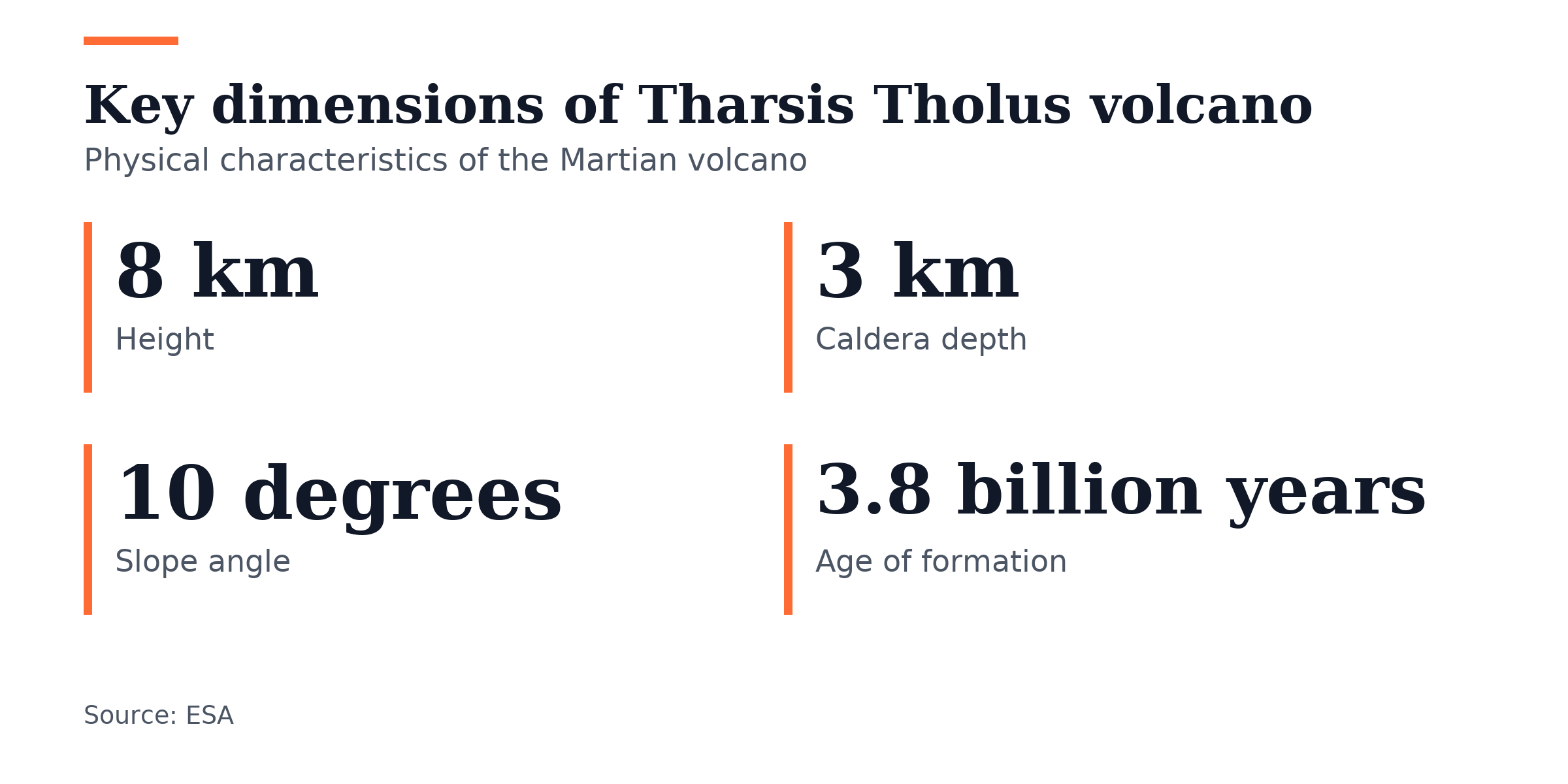
The image reveals signs of at least two collapses that formed calderas, with an older outer caldera and a younger inner one. These calderas reach nearly 3 km in depth and are unusually large for the size of the volcano. ESA links this to the volcano’s complex past, saying its flanks grew from lava flows and later showed impacts and surface deformation.
Over time, lava flows around the volcano piled up to form its flanks. Many steep cliffs known as scarps probably formed because the volcano pressed down on softer layers under the Martian surface, bending its shape. ESA counts these scarps among the deformation features seen on the flanks of Tharsis Tholus. Cracks across the flanks include faults, described as breaks in the Martian crust that twisted, pulled apart, and broke.
The flanks show grabens too, which ESA describes as sunken blocks of ground sitting between two faults. Small gullies run along the rim and steep sides of the Tharsis Tholus caldera, together with signs of landslides. ESA says both came from rocky debris moving down into the central pit, a process that also happens in calderas on Earth, at times with water.
Work on Tharsis Tholus began roughly 3.8 billion years ago, and the volcano is believed to have last pushed out lava about 0.2 billion years ago. ESA calls this timing recent in geological terms and points to the volcano as proof of a more volcanic past on Mars.
Martian volcanoes can become enormous because Mars has weak gravity, no active plate tectonics, and little continuing erosion, so they can stay undisturbed over magma sources for long periods. ESA sets this against Earth and notes that volcanism was common on Mars billions of years ago, though any leftover volcanic activity happens at a much lower rate. ESA points to activity observed and reported this month by ESA’s other Mars orbiter as an example of the lower-rate activity.
Olympus Mons stands nearly 22 km high, more than twice as tall as Mount Everest, and sits around 2500 km west of Tharsis Tholus, outside the image frame. ESA calls Olympus Mons the Solar System’s largest volcano and one of several major Tharsis peaks. The Tharsis volcanic province contains the giant shield volcanoes Arsia Mons, Pavonis Mons, and Ascraeus Mons, and every one tops any peak on Earth. ESA presents these as the chief volcanic giants that compete with Tharsis Tholus for attention.
The High Resolution Stereo Camera is one of eight instruments carried by Mars Express. Mars Express began its mission in 2003 and has charted Mars’s surface in colour and in three dimensions for more than twenty years. ESA says the orbiter has brought back insights that have greatly changed the understanding of Mars.
The German Aerospace Center, also called Deutsches Zentrum für Luft- und Raumfahrt or DLR, developed and operates the Mars Express HRSC. The DLR Institute of Space Research in Berlin-Adlershof handled the systematic processing of HRSC camera data. At Freie Universität Berlin, the Planetary Science and Remote Sensing working group used HRSC data to produce the image products appearing in the article.
Mars Express orbit 28331 has no color data, so the released images use color information from Mars Express orbits 17050 and 17444. ESA offers this technical detail about the image release.

Join the discussion