Key facts
- SpaceX will launch the classified USSF-266 payload for the U.S. Space Force from Vandenberg's Space Launch Complex 4 East on Nov. 23, 2026; the window opens at 7:55 a.m. PST, Spaceflight Now reports.
- USSF-266 will be SpaceX's fifth government mission this month, with four missions for the Space Force and one flight for the National Reconnaissance Office, per Spaceflight Now.
- USSF-266 is the third mission in a series flying under the 'TH' designation in public filings, following USSF-259/TH-1 on Sept. 16 and USSF-481/TH-2 on Oct. 15, Spaceflight Now reports.
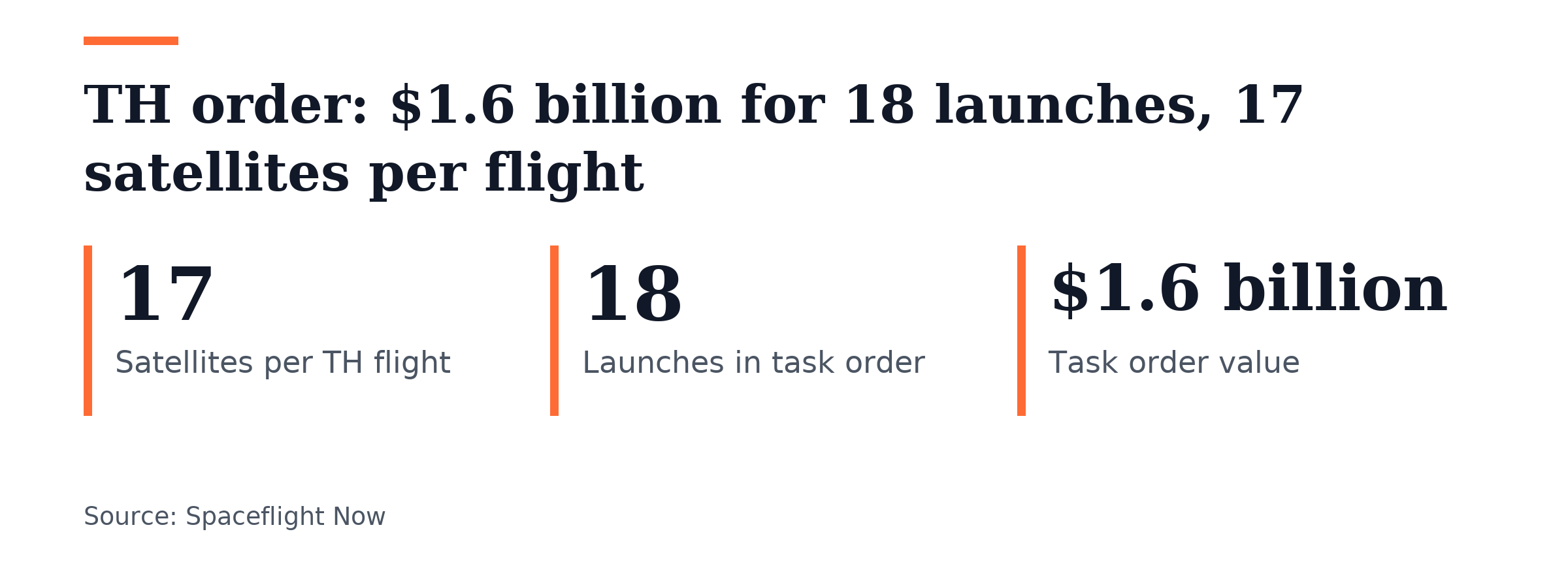
- Each earlier 'TH' flight added 17 satellites to the Space Force's orbital tracking catalogue, according to Spaceflight Now.
SpaceX will launch the classified USSF-266 payload for the U.S. Space Force from Vandenberg’s Space Launch Complex 4 East on Nov. 23, 2026, with the window opening at 7:55 a.m. PST.
USSF-266 is SpaceX’s fifth government mission this month, one of four missions for the Space Force alongside one flight for the National Reconnaissance Office. The launch is also the third flight in a series flying under the ‘TH’ designation in public filings, after USSF-259/TH-1 on Sept. 16 and USSF-481/TH-2 on Oct. 15. Each earlier flight added 17 satellites to the Space Force’s orbital tracking catalogue.
Officials believe the ‘TH’ missions belong to a $1.6 billion task order awarded in late July by Space Systems Command, according to Spaceflight Now. Observers believe the missions belong to that SpaceX task order for the Space Based Sensing and Targeting portfolio, the outlet notes. The order covers 18 SpaceX Falcon 9 launches for the portfolio and runs under the National Security Space Launch Phase 3 Lane 1 contract, built so many providers can compete for task orders involving payloads able to tolerate more risk, Spaceflight Now says.
Col. Eric Zarybnisky, who served as acting portfolio acquisition executive overseeing Space Access when the award occurred, said Phase 3 Lane 1 enabled a two-month period from requirement identification to award, with one month reserved for provider proposals. “We have set an unprecedented two-month acquisition timeline under the Phase 3 Lane 1 contract from requirement identification to award,” Zarybnisky said.
The Space Force declines to provide further details on the ‘TH’ missions, and public information remains limited, Spaceflight Now reports. Public filings use the ‘TH’ designation for this flight series.
SpaceX will fly Falcon 9 booster B1081 on its 29th launch. B1081 previously carried NASA’s Crew-7, PACE, and TRACERS missions, Spaceflight Now reports. B1081 will target a landing on the droneship Of Course I Still Love You in the Pacific Ocean less than 8.5 minutes after liftoff. A successful recovery would mark the 236th landing on that droneship and the 681st booster landing to date.
Spaceflight Now will begin live coverage about 30 minutes before liftoff.
Falcon 9 booster B1097 flew its 14th mission on Nov. 22, 2026. It had previously launched USSF-259 for the U.S. Space Force—the TH-1 mission flown on Sept. 16—along with NASA’s Sentinel-6B ocean-monitoring satellite, NROL-172, and eight Starlink missions, Space.com reports.
Kiko Dontchev, SpaceX’s vice president of launch, said via X on Nov. 22, 2026 that Pad 4E set a world record launch-to-launch turn of 32 hr, 3 min, 21 sec, beating the prior mark of 45 hrs from Pad 40. “This smashed the previous record of 45 hrs from Pad 40,” Dontchev said. The record followed back-to-back missions from Vandenberg’s Pad 4E after USSF-317, Space.com reports, and Pad 40 is at Cape Canaveral Space Force Station in Florida.
The Space Force describes assured access to space as having a launch provider able to meet mission schedules and deliver spacecraft to intended orbits, since delays can keep older satellites working longer or postpone replacements. Military satellite communications, GPS positioning-navigation-timing, and missile warning are among the capabilities at stake, though the Space Force disclosed no link between USSF-317 and any specific capability. Operators must replace satellites in the right orbits as older spacecraft reach the end of service life, and may need to expand regional coverage or field newer generations.


Join the discussion