Key facts
- Two anthropomorphic mannequins named Zohar and Helga flew aboard Orion during Artemis I in late November and early December 2022, each carrying radiation sensors.
- More than 10,000 tiny crystal detectors were embedded inside the two mannequins during the Artemis I mission.
- Lithium fluoride detectors function as passive fluorescent nuclear track detectors because charged particles create color centers in the crystal lattice that glow under blue light during optical readout.
- Radiation doses recorded inside the Artemis I mannequins were distributed almost uniformly throughout their bodies.
A Radiation Measurements paper led by Pawel Bilski of the Institute for Nuclear Physics of the Polish Academy of Sciences reported results from NASA’s uncrewed Artemis I mission on 1 September 2026, drawing on radiation data gathered aboard Orion during the flight to the Moon and back in late November and early December 2022.
Two life-size anthropomorphic mannequins named Zohar and Helga flew strapped into Orion passenger seats for the nearly month-long lunar flight, each measuring 3 feet from head to lower torso and made to mimic human bone and soft tissue. Zohar wore the AstroRad radiation vest while Helga flew without it, and both carried hundreds of radiation sensors spread throughout their bodies, including several dozen experimental lithium fluoride detectors developed by IFJ PAN with units highly enriched in the lithium-7 isotope. More than 10,000 tiny crystal detectors were embedded inside the pair.
The detectors included millimeter-sized lithium fluoride crystals grown using the Czochralski method and developed by IFJ PAN about a decade ago. Lithium fluoride detectors function as passive fluorescent nuclear track detectors because charged particles create color centers in the crystal lattice that glow under blue light during optical readout, eliminating the chemical etching step required for conventional plastic track detectors. IFJ PAN scientists also supplied nearly 600 thermoluminescent crystal detectors for the experiment.
A laser shone through each crystal under a microscope makes the color centers glow in blue light along the particle’s path, while microscope light bleeding in from layers above and below the focal plane makes it difficult to determine where specific rays originate. Particles striking the crystal perpendicularly appear as single bright points, while skimming particles leave longer, dimmer streaks. The research team built a mathematical framework to reconstruct the full radiation energy spectrum using microscope image stacks separated by one micrometer.
For intermediate energy transfer ranges, lithium fluoride results matched traditional plastic detectors placed side-by-side on Zohar, but for high energy transfers the lithium fluoride sensors overestimated radiation dose by around 30 percent compared with traditional plastic detectors. Researchers suspect the discrepancy stems from secondary neutrons knocking lithium atoms out of alignment inside the fluoride crystal and creating their own glowing tracks. The team used lithium-7 enriched test crystals to suppress these secondary reactions.
Across the entire overlapping range of energy deposition values after corrections and background-removal software were applied, the lithium fluoride measurements agreed with conventional track detectors to within 15 percent. Prof. Pawel Bilski said, “our results differed by no more than 15% from those obtained using conventional track detectors across the entire overlapping range of energy deposition values.”
Total radiation doses near the Moon are higher than in low Earth orbit, but the difference is not as large as one might intuitively expect. Pawel Bilski of IFJ PAN explained that low-energy protons trapped in Earth’s Van Allen belts account for most of the radiation dose in low Earth orbit, and this contribution disappears in the vicinity of the Moon. Radiation doses recorded inside the Artemis I mannequins were distributed almost uniformly throughout their bodies, unlike the uneven depth distribution seen in the decade-old MATROSHKA experiment on the ISS.
High-energy galactic particles near the Moon pass through the entire human body while releasing only part of their energy along the way, explaining the uniform distribution. The Van Allen belts do not extend into the lunar environment, so radiation near the Moon contains a greater contribution from high-energy particles originating elsewhere in the galaxy. Cosmic radiation beyond Earth’s magnetic field contains atomic nuclei ranging from hydrogen protons to heavy lead ions traveling near the speed of light.
The AstroRad vest weighs 57 pounds (26 kilograms) and shields lungs, stomach, bone marrow, breasts and ovaries. The US-Israeli startup StemRad and Lockheed Martin developed it, and a prototype had already been tested on the International Space Station for comfort and function, modeled after gear worn by nuclear disaster teams.
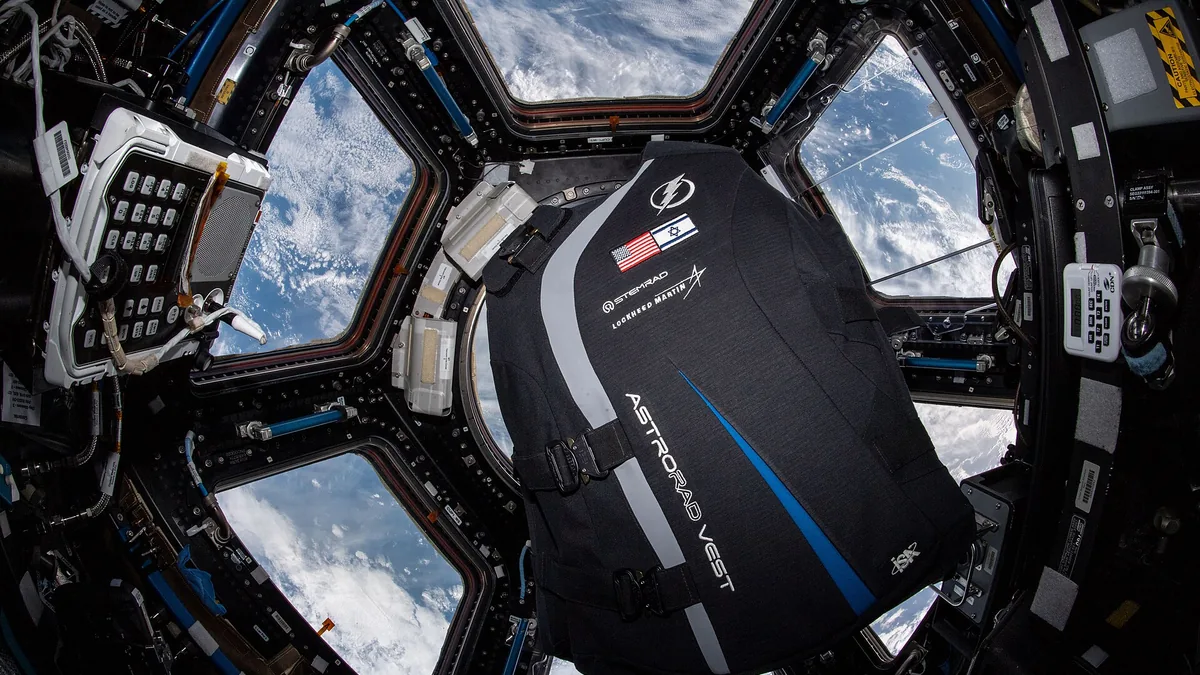
A Science Advances study found that the AstroRad vest worn by Zohar could reduce an astronaut’s radiation dose by about 60 percent in a 1972-like solar storm, avoiding 193 days of unnecessary deep space radiation exposure. The same vest study found the vest could reduce radiation dose by nearly 40 percent in an event mirroring the 1989 solar storm, avoiding 131 days of unnecessary deep space radiation exposure.
Artemis I encountered no major solar outbursts, so researchers simulated vest protection during extreme solar particle events like those in 1972 and 1989 using measurements from Orion’s passage through the inner Van Allen radiation belt. None of the Apollo moonshots exceeded two weeks, while NASA envisions moon-base stays lasting weeks if not months, and women are believed to be especially susceptible to radiation-induced cancer.
The 1972 solar outburst occurred between that year’s Apollo 16 and Apollo 17 moon landings, keeping those crews safe from potentially lethal radiation exposure. Jordan Houri, the study’s lead author from StemRad, called the experiment “the largest experiment ever conducted to determine astronaut radiation exposure beyond low-Earth orbit.”
Shielding garments could keep lunar crews safe during solar storms and allow them to venture beyond their shelters if necessary, and the scientists are using their observations to trim more weight from the vest without sacrificing protection while investigating how to make radiation shielding from items already aboard a spacecraft. The AstroRad vest did not travel with Artemis II astronauts because the mission is a short 10-day flight with limited room, but future moon crews may carry it.
Zohar and her AstroRad vest are now on display at Florida’s Kennedy Space Center, where their journey to the Moon began. The research team does not anticipate a need for further deep-space testing soon because Zohar and Helga provided an exceptionally large, high-fidelity dataset, which Jordan Houri described as having “provided us with an exceptionally large, high-fidelity dataset.”
The Radiation Measurements paper, “Application of LiF fluorescent nuclear track detectors for measurements of cosmic radiation at the lunar orbit within the MARE experiment” by P. Bilski et al., appeared in volume 198, article 107806, with DOI 10.1016/j.radmeas.2026.107806. A grant from the National Science Centre, Poland (NCN), under its OPUS program supported the MARE research. NASA, the German Aerospace Center and the Israel Space Agency funded the vest study.






Join the discussion