
Key facts
- NearSpace Launch Inc. announced that its TROOP-F6 spacecraft will fly on SpaceX's Bandwagon-6 rideshare mission scheduled for April 2027.
- The deployed systems include custom CubeSats, EyeStar transceivers, and Black Box flight recorders.
- Matthew Voss holds the position of President at NearSpace Launch.
NearSpace Launch Inc. announced that its TROOP-F6 spacecraft will fly on SpaceX‘s Bandwagon-6 rideshare mission from Cape Canaveral Space Force Station in April 2027.
NearSpace Launch will serve as both satellite owner and mission manager for the TROOP-F6 flight. The vehicle follows a multi‑mission SmallSat design aimed at mid‑inclination low Earth orbit.
TROOP-F6 will carry sensors that sample ionospheric plasma, measure radiation flux (the flow of high-energy particles) and spot solar particle events to aid space weather forecasting (predicting space conditions). Its tracking and telemetry gear (systems that determine a spacecraft’s position and send data) will look for orbital debris, check orbital paths (the routes spacecraft follow around Earth) and assess safety of space traffic (the movement of satellites and debris in orbit).
The vehicle relies on NearSpace Launch’s standard modular bus avionics (the standardized electronics that control the satellite) and the EyeStar real‑time radio link (a radio system for constant communication) for steady crosslink telemetry (data shared directly between satellites). It also supplies adaptable internal space (flexible room inside the spacecraft for equipment), regulated power feeds (steady electricity supply) and high‑speed data ports (fast connections for sending information) for customers who host their own payloads (instruments or experiments carried by the satellite).
TROOP-F6 follows the line of earlier TROOP test flights (previous demonstrations of the TROOP platform), such as TROOP-3 on Transporter-5 (a SpaceX rideshare launch) and TROOP-F2. Earlier, NearSpace Launch placed the SPEAR constellation (a group of sensors for monitoring space conditions) on a SpaceX Transporter-17 flight (a SpaceX rideshare launch) to deliver space‑environment sensors (instruments that measure conditions in space) for national‑security tasks (work related to defense safety).
NearSpace Launch has helped put over 1,000 individual systems and subsystems (individual hardware parts and smaller components) into orbit to date. Those units have comprised custom CubeSats (small, standardized satellites), EyeStar transceivers (devices that both send and receive radio signals) and Black Box flight recorders (devices that store spacecraft data for later analysis). Matthew Voss serves as president of NearSpace Launch.
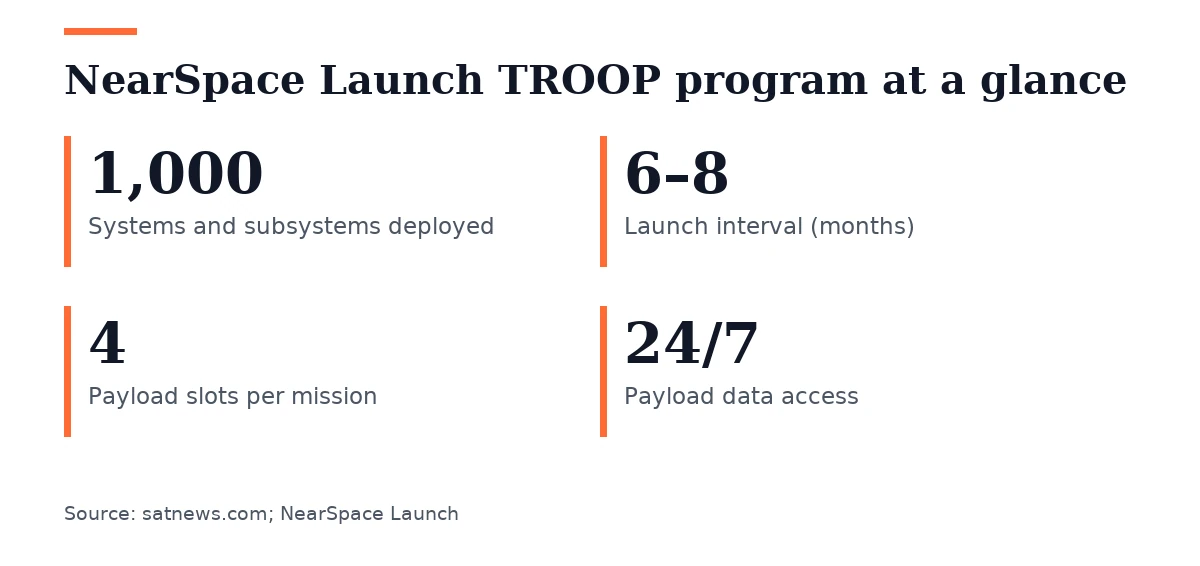
Under the TROOP scheme (NearSpace Launch’s regular rideshare program), payloads (instruments or experiments carried by the satellite) ride on commercial rockets (launch vehicles operated by private companies) roughly every six to eight months, with four slots (positions for payloads on the rocket) available per flight. Each mission gives quick, low‑cost access for research teams so they can advance technology readiness (the maturity level of a new technology) for government, industry and academia. TROOP supplies core hardware (essential physical components) like power systems, EyeStar radios (a radio system for constant communication), batteries and flight processors (the computer that runs the spacecraft), letting users concentrate on their own experiments (tests or investigations performed in space). NearSpace Launch supplies a payload emulator (a test version used to check fit and function) for pre‑flight bus checks (tests to ensure the satellite works with its main electronics before launch) and the EyeStar S4 radio on board (a specific model of the EyeStar radio for continuous data) provides round‑the‑clock data access (continuous, all‑the‑time) via the NSL Console (NearSpace Launch’s interface for viewing satellite data).



Join the discussion