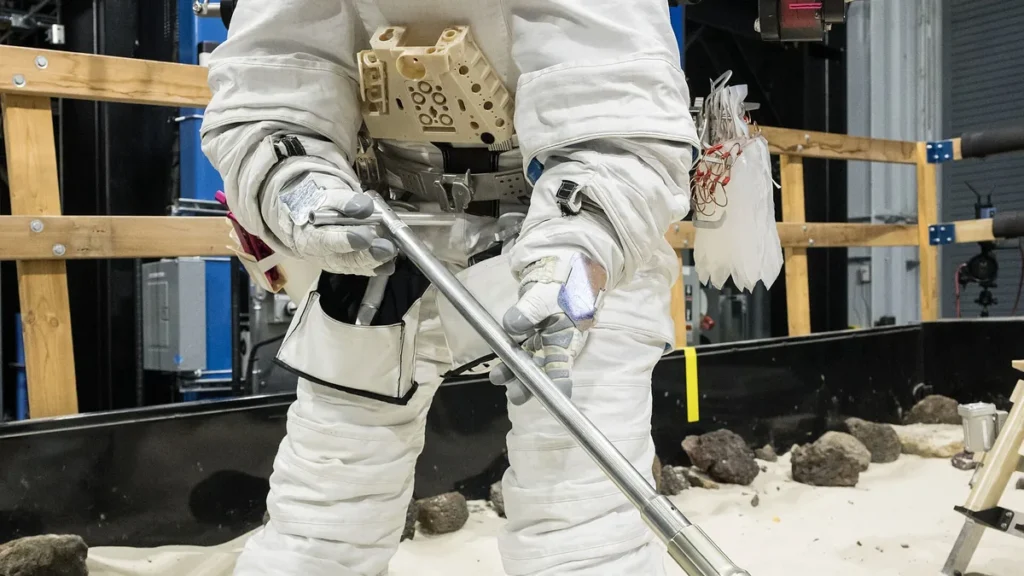
This is a new development in a story we reported earlier: NASA schedules Artemis III for 2027 as Moon landing rehearsal.
Key facts
- An April 2026 NASA inspector general report warned Axiom might miss the 2028 landing deadline and projected suit readiness could slip to 2031.
- Full-capability exploration suit work continues for later Artemis flights while the streamlined sortie suit protects the 2028 lunar landing target against China's planned 2030 Moon mission.
- The agency is reducing requirements for outer joint movement, life-support endurance, and suit mechanical complexity.
- Prada's Milan engineering and materials teams handle the AxEMU Liquid Cooling and Ventilation Garment, which uses seamless 3D knitting and specialized fibers to move chilled water through micro-tubing.
NASA told Axiom Space to develop a streamlined sortie suit for the first Artemis Moon landing while postponing a full-capability exploration suit, a decision the agency announced at an internal meeting on Sept. 2, 2026.
The eased requirements reduce demands for outer joint movement, life-support endurance and mechanical complexity, while the streamlined suit keeps fault tolerance and backup life support. Continuous operating time drops from the original six-hour exploration specification to roughly two and a half hours. NASA’s original requirements had envisioned demanding lunar exploration, including work in extremely cold environments near the Moon’s south pole, capabilities the agency says are not needed for Artemis IV.
An April 2026 inspector general report warned that Axiom might miss the 2028 landing deadline and that suit readiness could slip to 2031. NASA Administrator Jared Isaacman said the agency set unrealistic expectations for industry and called commercial contracting an “easy button” that needs recalibration. Isaacman joined NASA in December 2025 and found the Artemis Program significantly behind schedule. With Congress’s blessing, Isaacman has streamlined Space Launch System production, canceled the Lunar Gateway, and worked with SpaceX and Blue Origin.
NASA selected Axiom Space and Collins Aerospace in 2022 under the xEVAS agreement, which carried a combined ceiling above $3 billion. Collins exited in 2024 to focus on other programs, leaving Axiom as the only lunar suit contractor, and NASA has obligated at least $594 million to Axiom to date.
NASA awarded Axiom a $228.5 million contract to design and provide Artemis III spacesuits, and the two revealed the suit design at Space Center Houston on March 15, 2023.
At the reveal, Axiom engineer Jim Stein wore a black-orange-and-blue suit with a domed helmet on stage, while the lunar version will be mostly white for thermal reasons. The helmet included a light band on the visor assembly, an HD video camera on the side, and a hard upper torso rigid from the waist up. Astronauts enter from the rear through a back door hatch, and Axiom deputy program manager Russell Ralston said one person can put the suit on alone.
The backpack life-support system sits above the rear hatch — “You can think of it as like a very fancy scuba tank and air conditioner kind of combined into one,” Ralston said. The arms have several joints for maximum range of motion, and the gloves are enhanced for handling tools.
Boots are better insulated for colder lunar regions, and the legs allow more mobility, which Stein demonstrated with squats and lunges on stage. Ralston called the lower-torso joints a huge improvement over Apollo suits, and NASA Associate Administrator Bob Cabana said the suit is needed to learn how to operate on the Moon, use lunar resources, and prepare for travel to Mars.
Prada continues to take part in Axiom’s lunar suit work, and industry and contracting records confirmed its continued role on Nov. 7, 2026. The company’s Milan engineering and materials teams handle the AxEMU Liquid Cooling and Ventilation Garment, which uses seamless 3D knitting and specialized fibers to move chilled water through micro-tubing.

The garment manages metabolic heat and perspiration under the pressurized suit and supports spacewalks lasting as long as eight hours with a fully redundant cooling circuit and a separate ventilation loop. “Every minute astronauts spend outside their vehicle, the LCVG is working to keep them safe,” Ralston said. The ventilation loop delivers fresh oxygen across the astronaut’s face, washes away exhaled carbon dioxide in real time, and routes carbon dioxide back through the scrubber before oxygen recirculates.
Prada also supplied specialized weaving and pattern making for the suit’s white outer cover layer, built to deflect solar radiation and resist highly abrasive lunar regolith. Axiom and Prada announced the cooling garment in New York City, expanding a collaboration that began with the AxEMU outer layer in 2024. Prada’s contribution addresses material and construction challenges rather than engineering architecture, drawing on materials’ knowledge to source specialized fibers for repeated wear across long-duration missions.
NASA has sent technical specialists to Axiom’s Houston facilities for embedded engineering support, and Charlie Precourt, a former astronaut and member of NASA’s Aerospace Safety Advisory Panel, said leadership meets with Axiom six days a week to address schedule and performance issues. The agency needs replacement International Space Station spacewalk suits because the current ones have served for decades, with little time before the station’s planned retirement around 2030. Axiom says its lunar suits and station suits will be ready in late 2027, with advanced capabilities added later for future Artemis missions.
Astronauts assigned to Artemis III, targeted for 2027, will put on orange Orion Crew Survival System suits for low Earth orbit tests that include docking with test vehicles from commercial lunar landers. Crews will wear the orange Orion Crew Survival System suits during those tests. Lunar surface suits work as self-contained life-support systems, essentially personal spacecraft, unlike those Orion suits. A test of commercial lunar landing systems was added for 2027 ahead of the first crewed landing, and Artemis IV is targeted for early 2028.
NASA plans to fly the sortie suit on early landing missions using SpaceX and Blue Origin landers, aiming to lower suit mass, reduce complexity, and simplify interfaces between suits and landers. The sortie suit is expected to be a slimmer, less complicated version of Axiom’s planned AxEMU lunar suit, and full-capability exploration suit work continues for later Artemis flights.
The streamlined sortie suit is intended to protect the 2028 landing target as the United States competes with China’s planned 2030 crewed Moon mission. Private sources have voiced concerns about the speed of Axiom’s spacesuit progress despite the company’s continued commitment, and Axiom expects word from NASA soon on the simplified suit design.





Join the discussion