
Key facts
- NASA’s Lucy mission, launched on October 16, 2021, is the first to explore Jupiter’s Trojan asteroids, two swarms of asteroids orbiting ahead of and behind Jupiter.
- During its journey, Lucy performed three unplanned asteroid flybys in the main belt between Mars and Jupiter, testing navigation systems and making discoveries.
- On November 1, 2023, Lucy discovered that the asteroid Dinkinesh had a small moon, later named Selam, making it a binary system of three bodies: Dinkinesh, Selam, and Selam’s contact-binary structure.
- On April 20, 2025, Lucy flew past the peanut-shaped asteroid Donaldjohanson, confirming it is a contact binary with two lobes connected by a smooth neck and a complex, wobbling rotation.
NASA’s Lucy mission launched on October 16, 2021, as the first spacecraft to explore Jupiter’s Trojan asteroids, two swarms of primordial bodies trapped in stable orbits ahead of and behind the gas giant. Five years into its 12-year journey, Lucy has already made discoveries that challenge models of asteroid formation, while its upcoming encounters promise to reshape understanding of the solar system’s early days. The mission’s name honors the 1974 fossilized human ancestor found in Ethiopia, symbolizing its role in uncovering ancient solar system history.
Lucy’s path to the Trojans has included three unplanned flybys of asteroids in the main belt between Mars and Jupiter, serving as critical tests for its navigation and instruments. These encounters—with Dinkinesh in Nov. 2023, its moon Selam, and Donaldjohanson in Apr. 2025—revealed structures far more complex than expected. Researchers at the Southwest Research Institute (SwRI) confirmed these flybys validated Lucy’s ability to perform close-up observations and trajectory adjustments, essential for the precision required during its Trojan encounters.
The November 2023 flyby of Dinkinesh uncovered a surprise: the asteroid had a small moon, later named Selam, making it a binary system of three bodies. Selam itself is a rare contact binary—a single object composed of two touching parts—unexpected for a moonlet orbiting another asteroid. John Spencer, Lucy deputy project scientist at SwRI, said contact binaries occur across the solar system but that one orbiting another asteroid had never been seen before. “Though contact binaries seem to be fairly common in the solar system, we haven’t had the opportunity to see many up close,” Spencer said.
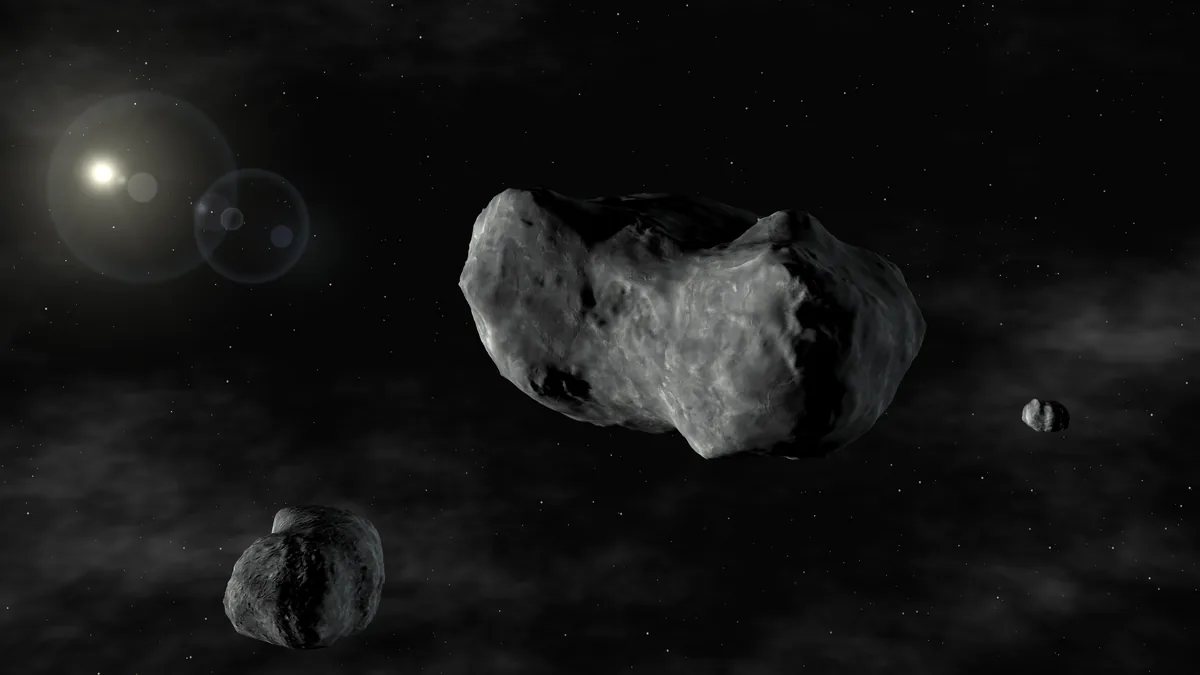
Lucy’s April 2025 flyby of Donaldjohanson delivered even more surprises. The peanut-shaped asteroid, composed of two lobes connected by a smooth neck, exhibited a complex rotation: it wobbles end-over-end every 10.5 Earth days while rocking around its lateral axis every 26.5 days. This behavior is driven by the YORP effect, a subtle torque from sunlight that alters an asteroid’s spin over millions of years. Simone Marchi, Lucy deputy principal investigator, described the asteroid’s structure as ‘remarkably smooth,’ highlighting its unique formation history. ‘The Donaldjohanson flyby revealed many surprises about the small asteroid,’ Marchi said.
Donaldjohanson’s surface also holds clues to its ancient past. NASA’s Lucy team reported in June 2026 that the asteroid’s iron-rich clay minerals indicate a brief exposure to liquid water approximately 155 million years ago. This contrasts with other studied asteroids like Bennu and Ryugu, which show prolonged water interaction. The findings, published in Science, suggest Donaldjohanson formed from a violent collision and later experienced limited water exposure, offering new insights into early planetary processes.
Marchi emphasized that comparing such diverse asteroids is key to reconstructing the solar system’s origins.
Lucy’s journey to the Trojans has relied on Earth’s gravity for acceleration. The spacecraft performed two gravity-assist maneuvers—first in Oct. 2022, passing 220 miles (350 km) above Earth, and again in Dec. 2024—which together added over 16,000 mph (25,750 km/h) to its speed relative to the Sun. These assists fine-tuned its trajectory for the Aug. 2027 encounter with Eurybates, the first of 11 Trojan asteroids Lucy will study. The mission will conduct a final Earth assist in Dec. 2030 to reach Patroclus-Menoetius in Mar. 2033, completing the mission’s exploration of both Trojan swarms.
Beyond its primary mission, Lucy has contributed to other scientific observations. In Sep. 2022, it captured images of NASA’s DART probe impacting Dimorphos, a moon of the asteroid Didymos, providing a unique perspective on the planetary defense test. Lucy also observed the interstellar comet 3I/ATLAS in Sep. 2025, offering insights from its vantage point in deep space. These observations complemented Earth-based views, expanding understanding of both planetary defense and interstellar objects.
Lucy’s mission has faced challenges, including a solar panel deployment issue shortly after launch. Engineers stabilized the array to ensure mission continuity, demonstrating the spacecraft’s resilience. NASA’s Goddard Space Flight Center manages the mission, with Lockheed Martin Space building the spacecraft and instruments provided by Goddard, Johns Hopkins APL, and Arizona State University. This collaborative structure reflects NASA’s Discovery Program, which funds high-impact missions with specialized expertise.
Key times
Lucy’s discoveries so far—from binary asteroids to signs of ancient water—highlight the mission’s potential to rewrite our understanding of the solar system’s early days. As it approaches its first Trojan encounter in 2027, the spacecraft’s findings continue to challenge existing models, offering a glimpse into the primordial building blocks of our cosmic neighborhood.


Join the discussion