Key facts
- NASA's twin ESCAPADE smallsats, Blue and Gold, are en route to Mars after completing powered Earth flybys on Nov. 7 and Nov. 9, 2026, nearly a year after launching on Nov. 13, 2025.
- The Rocket Lab-built pair fired their engines during both Earth flybys using the Oberth effect, a first for NASA sending a spacecraft to Mars via powered flyby.
- The post-flyby trajectories send both spacecraft toward Mars, with arrival separated by two days in September 2027.
- The mission will be the first to choreograph two Mars orbiters for coordinated observations of the planet's environment from two places simultaneously.
NASA’s twin ESCAPADE smallsats, Blue and Gold, are en route to Mars after completing powered Earth flybys on Nov. 7 and Nov. 9, 2026, nearly a year after launching on Nov. 13, 2025.
Blue completed its Earth close approach and engine burn at 5 a.m. EST on Nov. 7, 2026, at an altitude of about 1,600 kilometers. Gold followed a little more than 48 hours later at 6 a.m. EST on Nov. 9, 2026, at an altitude of about 1,050 kilometers.
The Rocket Lab-built pair fired their engines during both flybys using the Oberth effect, which uses an engine burn at a planet’s closest approach to gain extra speed, a first for NASA sending a spacecraft to Mars via powered flyby. The burns took place at each spacecraft’s closest approach to Earth. NASA Science says the trans-Mars injection engine burns lasted approximately nine minutes. Berkeley News calls the maneuver the first successful Earth-powered gravity assist for a deep space mission ever, noting it required perfect timing after flying through Earth’s radiation belts.
ESCAPADE launched from Cape Canaveral, Florida, on the second flight of Blue Origin’s New Glenn rocket. Earth and Mars were on opposite sides of the Sun at launch, preventing a direct trajectory, so the spacecraft entered a loiter orbit around the Earth-Sun L-2 point, a gravitationally stable location between Earth and the Sun. After nearly a year in the kidney-bean-shaped course, the two spacecraft returned to Earth once planetary alignment became favorable.
Advanced Space developed the trajectory to open Mars launch opportunities outside traditional windows, providing flexibility to launch almost anytime and use Earth’s gravity for a boost. Most Mars probes launch during a window that occurs about every 26 months.
The mission was originally planned to piggyback on NASA’s Psyche asteroid probe launch, but the plan fell through after the Psyche rocket was changed to the first flight of Blue Origin’s New Glenn due to technical issues. Project scientist Shannon Curry said the team recalculated the trajectory from scratch, leading to the L-2 loiter path.
Asal Naseri, acting associate flight director in NASA’s heliophysics division, said NASA executed the powered Earth flyby maneuver twice, flawlessly, in just two days, the first time for a Mars-bound spacecraft. “This is the first time NASA has used a powered Earth flyby to propel a spacecraft toward Mars,” Naseri said.
Mark Lewis, manager of SSL’s Mission Operations Center, said the approach is a standard Holman transfer but no one else has done it with a powered gravity assist, which would open the possibility to launch between transfer windows. “It’s a standard Holman transfer, but nobody else has done it with a powered gravity assist,” Lewis said.
The post-flyby trajectories send both spacecraft toward Mars, with arrival separated by two days in September 2027. Mars orbit insertion burns are planned for Sept. 7 and Sept. 9, 2027, with each spacecraft firing its engine for about 11 minutes to slow down and enter orbit. Berkeley’s timeline indicates Gold will burn on Sept. 7 and Blue on Sept. 9.
Mission officials expect science operations at Mars to begin in June 2028. After entering Mars orbit, the spacecraft will take months to maneuver into their first science formation.
The twin spacecraft will study how the million-mile-per-hour solar wind interacts with the Martian magnetosphere and atmosphere and how that drives atmospheric loss at Mars. The mission will be the first to choreograph two Mars orbiters for coordinated observations of the planet’s environment from two places simultaneously. Rob Lillis, principal investigator at the University of California, Berkeley, said formation flying will let researchers investigate how the dynamic Martian magnetosphere varies spatially and temporally.
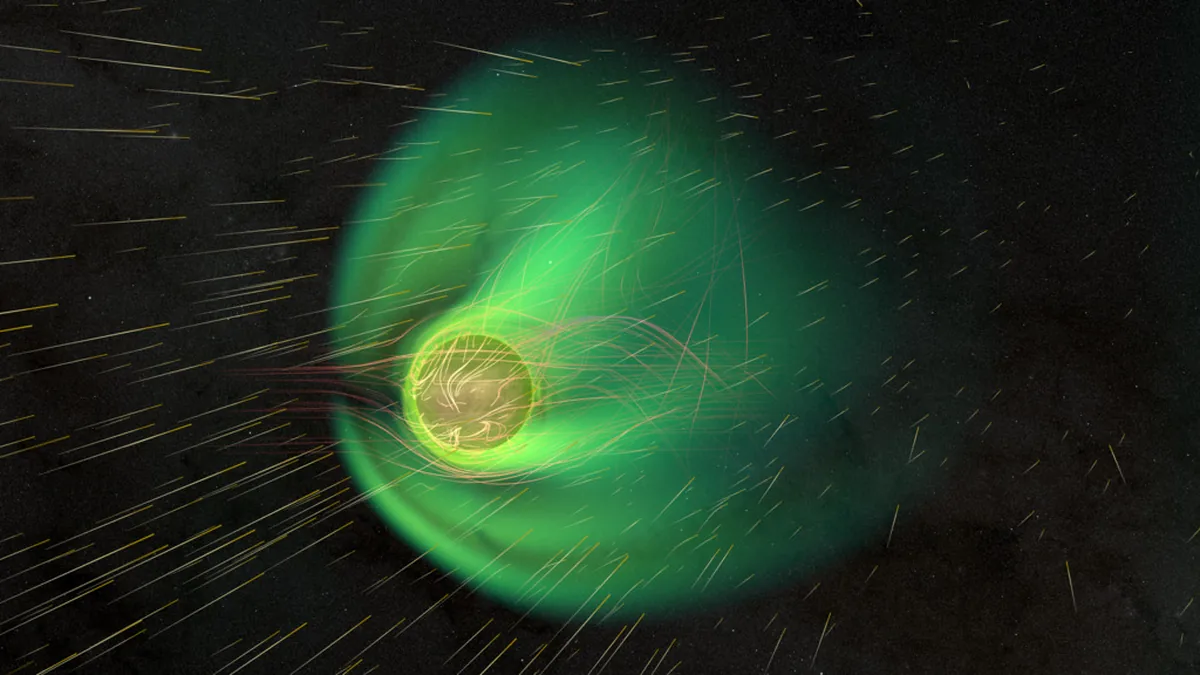
Initially the spacecraft will fly in the same orbit separated by up to 30 minutes to measure space weather variations over time, then shift into separate orbits with one observing incoming solar wind and the other studying Mars’s response. Their separation distance will oscillate between 2 and 30 minutes depending on their distance from Mars.
During the 10-month cruise to Mars, the spacecraft will study solar wind dynamics between Earth and Mars and perform trajectory correction maneuvers to stay on course. NASA Science says the spacecraft will perform a series of trajectory correction maneuvers along the way to ensure a precise course to rendezvous with Mars.
Michele Cash, ESCAPADE program scientist at NASA Headquarters, said better understanding of solar wind effects on Mars could help plan and prepare for future human exploration of the Red Planet. Skyler Kleinschmidt, ESCAPADE program executive at NASA Headquarters, said the mission carries forward the science of earlier Mars missions through new work by its team.
NASA’s SIMPLEx program selected ESCAPADE for development in 2019 with Janus and Lunar Trailblazer, but ESCAPADE is the only one still active. NASA canceled Janus in 2023 because Psyche launch delays stopped the rideshare from completing its planned asteroid flybys. Lunar Trailblazer malfunctioned shortly after its February 2025 launch, and NASA formally ended the mission five months later after unsuccessful recovery efforts. Two previous cubesat-class SIMPLEx missions, LunaH-Map and Q-PACE, also failed after their launches, and NASA, citing budget pressures, has not solicited proposals for new SIMPLEx missions or stated plans to do so for the foreseeable future.
Each spacecraft is about the size of a standard refrigerator, and Berkeley News describes the two ESCAPADE spacecraft as identical. The University of California, Berkeley’s Space Sciences Laboratory leads ESCAPADE with key partners Rocket Lab, NASA’s Goddard Space Flight Center, Embry-Riddle Aeronautical University, Advanced Space, and Blue Origin. NASA’s Heliophysics Division funds the mission.
During their loiter orbit, the spacecraft flew through Earth’s magnetotail many times and collected science observations of how the solar wind crushes and twists the tail. ESCAPADE reached about 2 million kilometers out in Earth’s magnetotail, hundreds of thousands of kilometers farther than any previous probe.
MAVEN reported in 2017 that approximately 65 percent of argon had been lost from Mars to space, serving as a yardstick for measuring atmospheric loss. Solar storms are thought to have been one of the primary causes of atmospheric erosion on Mars approximately 3 to 3.5 billion years ago. Note.com says one craft on its own, like MAVEN, can follow magnetic-field changes only across its orbital period, which runs several hours.
Each spacecraft fired its engine as it flew over southern Australia and should have been visible with telescopes from there as dim points moving against the stars. At closest approach the spacecraft were between 600 and 1,100 miles above Earth’s surface. IT-Online says each craft will look slow against the sky and take hours to pass from east to west overhead. Observers can use NASA’s Jet Propulsion Laboratory Horizons System to get coordinates for the two ESCAPADE spacecraft at different times for their viewing location.
The burn raised each craft’s speed by over 1,600 kilometers per hour, moving from roughly 10.1 kilometers per second to 10.8 kilometers per second, or Mach 30 to 31. At the post-burn speed, the spacecraft could fly from Washington, DC, to San Francisco in less than seven minutes. In Japan Standard Time, the first ESCAPADE probe fired around 7:00 PM on Nov. 7 and the second around 8:00 PM on Nov. 9, 2026.




Join the discussion