Key facts
- WALTzER’s simultaneous UV‑visible‑NIR coverage will allow the atmospheres of over 30 gas‑rich exoplanets to be detected and characterised.
- WALTzER observes near‑ultraviolet, visible and near‑infrared bands at once using two medium‑resolution spectrographs and a broadband photometer.
- WALTzER’s payload features a 35‑centimetre Cassegrain telescope that feeds three aligned channels through a common optical train to reduce systematics and boost efficiency.
- Data from WALTzER will support a wide variety of Solar System and Galactic astrophysics research beyond exoplanet atmospheres.
Astrobiology Web reported that the ESA F3 mission candidate WALTzER, detailed in an arXiv submission on 15 October 2026, aims to study transiting exoplanet atmospheres by performing simultaneous near‑ultraviolet, visible and near‑infrared observations to link lower‑ and upper‑atmosphere processes.
The paper introduces WALTzER as a response to the fundamental challenge of understanding how planetary atmospheres originate and evolve, especially the connection between their lower and upper layers. It notes that solving this problem requires data that span a wide swath of the electromagnetic spectrum while simultaneously tracking both the planet’s atmosphere and the host star’s variability. To meet these needs, WALTzER performs low‑resolution spectroscopy, which captures broad spectral features, together with high‑precision photometry, which measures small brightness changes, of transiting exoplanets during each transit event. By pairing modest‑detail spectral information with very accurate brightness measurements, the mission can identify atmospheric absorption features and distinguish them from stellar noise, improving the reliability of detections.
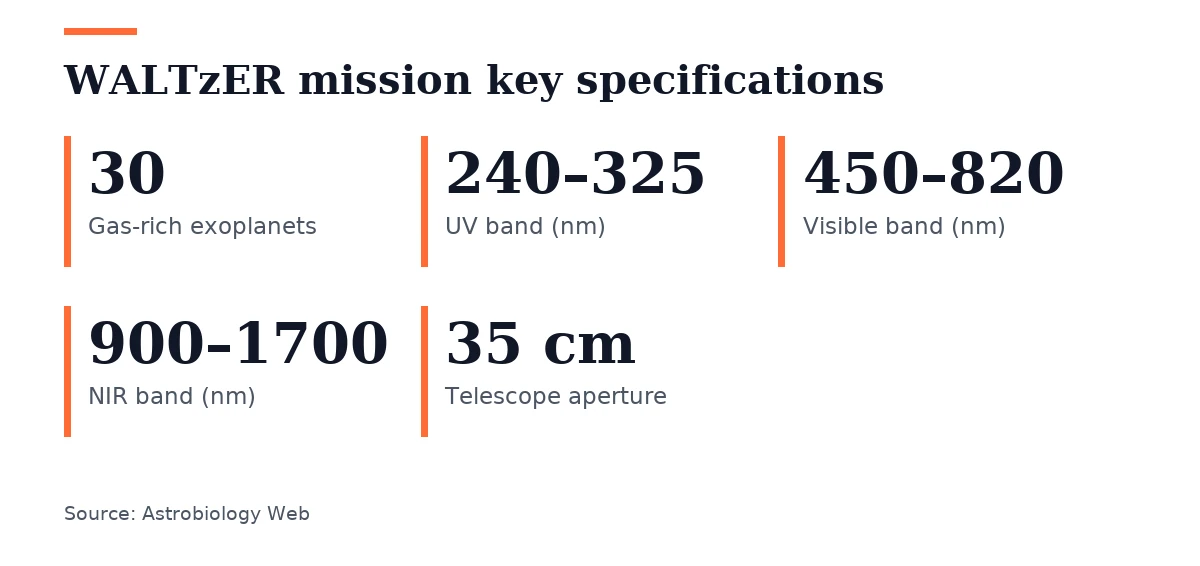
WALTzER will observe near‑ultraviolet light ranging from 240 to 325 nanometres, visible light from 450 to 820 nanometres and near‑infrared light from 900 to 1700 nanometres at the same time. The instrument splits incoming light into three co‑aligned channels, with the near‑ultraviolet and visible ranges handled by two medium‑resolution spectrographs and the near‑infrared range measured by a broadband photometer. All channels share a single optical train, which keeps instrumental differences low and boosts measurement efficiency. This simultaneous UV‑visible‑NIR capability is expected to yield detectable atmospheric signals for more than thirty gas‑rich exoplanets.
At the front of the payload lies a 35‑centimetre Cassegrain telescope, a design that uses a primary and secondary mirror to focus light, that collects light and directs it to the three aligned channels through the shared optical train. By using a single optical path for all channels, the design minimizes systematic differences between the near‑ultraviolet, visible and near‑infrared measurements. This approach improves the precision of combined data and enhances the overall efficiency of the instrument. The accompanying illustration indicates how the near‑ultraviolet (NUV), visible (VIS) and near‑infrared (NIR) sensors probe different atmospheric altitudes, with vertical bars marking the approximate depth sampled by each band.
Beyond exoplanet atmospheres, the broad wavelength coverage makes WALTzER’s data valuable for a range of Solar System and Galactic astrophysics investigations. By delivering simultaneous spectroscopic and photometric information, WALTzER will support a wide variety of research programs that benefit from multi‑band data. Its core objective, however, remains uncovering the origin and evolution of planetary atmospheres and how their lower and upper layers are linked.
The mission concept and instrument design were presented in an arXiv submission by A G Sreejith dated 15 October 2026, carrying the identifier arXiv:2610.21705. The paper is assigned the DOI 10.48550/arXiv.2610.21705 and appears under the subject categories Earth and Planetary Astrophysics, Instrumentation and Methods for Astrophysics, and Solar and Stellar Astrophysics. According to the submission record, the initial upload occurred at 11:25:47 UTC on 15 October 2026 and the file size was 7,261 KB. This identifier allows researchers to locate the exact preprint version of the WALTzER mission concept in the arXiv repository.
An illustration accompanying the paper displays vertical bars on the right‑hand side that indicate the approximate altitude range probed by each of WALTzER’s NUV, VIS and NIR channels. This visual aid helps readers understand how the instrument’s different spectral bands sample distinct layers of a transiting exoplanet’s atmosphere, from high altitudes in the near‑ultraviolet to deeper layers in the near‑infrared. By linking observations of the lower and upper atmospheric layers, WALTzER seeks to reveal how atmospheres form and evolve.





Join the discussion