Key facts
- Researchers Pranay Mudaliar and Jerin John of Concordia published a paper in the journal Langmuir proposing lecithin as an organic gelling agent for kerosene-based rocket gel fuel.
- Lecithin is an organic compound made of carbon and hydrogen, so it burns alongside kerosene instead of acting as noncombustible dead weight like many thickening agents previously used for gel fuels.
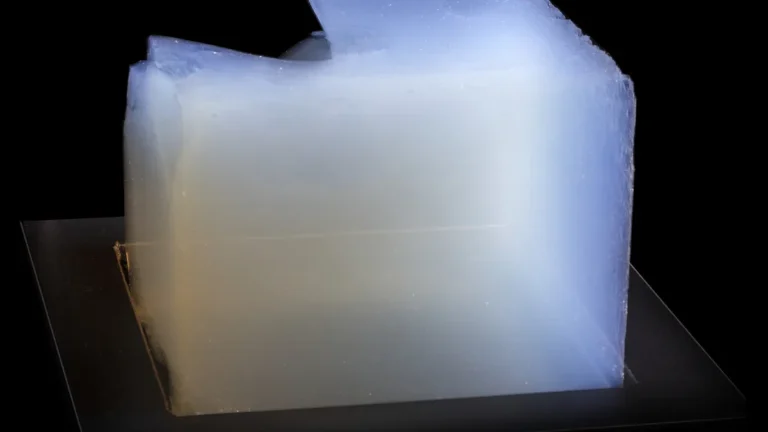
- The gel is clear, so researchers can observe it using optical high-speed cameras and lasers to study its structure and spray patterns.
- The new fuel has not yet been sprayed through high-pressure injectors intended for real rocket engines, nor has it been shown capable of withstanding launch vibrations and temperature shocks.
Researchers Pranay Mudaliar and Jerin John of Concordia published a paper in the journal Langmuir in 2026 proposing lecithin as an organic gelling agent for kerosene-based rocket gel fuel.
Solid rocket boosters, like those that powered the space shuttle, ignite quickly and stay stable but cannot be shut off once lit and must burn all their propellant at once. Liquid engines can be throttled and restarted, yet their fuels float and slosh in tanks, particularly in zero gravity. Sloshing can create vapor pockets that may damage a turbopump unless the vapor is filtered first. Liquid fuels also leak or evaporate over long periods, making them less suitable for multiyear journeys through the solar system.
Gels would sit in a tank like a dense solid but flow like a liquid into a combustion chamber, though practical gel fuels have historically struggled with shelf life and temperature-dependent phase changes. Lecithin is a common food emulsifier, an additive that keeps chocolate smooth and makes salad dressing cohesive, and it appears on thousands of supermarket labels. In the research, a trace amount of calcium chloride salt causes lecithin molecules to form microscopic wormlike structures called micelles that link into chains and build an invisible 3D mesh. The mesh traps and holds kerosene molecules in place.
Because lecithin is an organic compound of carbon and hydrogen, it burns alongside kerosene instead of serving as noncombustible dead weight like many thickening agents used for gel fuels. The gel demonstrates shear thinning: it holds its shape like gelatin in a tank, eliminating sloshing, but under mechanical pressure or shear force from pressurized fuel lines the micellar mesh breaks apart and the gel temporarily collapses into a liquid. Measurements show the gel’s viscosity drops by a factor of more than 100 under pressure, creating a fluid pumped and sprayed through injector nozzles, and the material snaps back to a gel when pressure stops.
Heating the gel to between 59°C and 68°C or splashing it with a small amount of ethanol liquefies it, giving engineers localized thermal or chemical triggers to liquefy specific amounts without liquefying the bulk fuel. The gel is clear, so researchers can observe it using optical high-speed cameras and lasers to study its structure and spray patterns.
The gel remained stable in a tank for more than a year with no visible signs of phase separation, which plagues many other gelatin-like fuels. Long shelf life addresses one of the traditional drawbacks of gel propellants and suggests the formulation may remain usable during extended missions. Yet engineers have not yet sprayed the new fuel through high-pressure injectors intended for real rocket engines, nor have tests shown it capable of withstanding launch vibrations and temperature shocks. These untested conditions mean the technology remains in early-stage benchtop development rather than flight readiness.
Concordia researchers continue developing the gel, which appears promising for use on a future mission, though the path from benchtop to launchpad remains long. Their paper appeared in Langmuir in 2026 under the title Rheology and Thermal Characterization of Lecithin-Based Kerosene Gels for In-Space Propulsion, with DOI 10.1021/acs.langmuir.6c01168.



Join the discussion