
Key facts
- The pre‑seed round was raised through SAFEs and was primarily angel‑funded.
- WarpWare originated from a question its founders had about reusing flight software for new vehicles; CEO Alex Reynolds and COO Mickey Mathew said the answer was almost none on October 19, 2026.
- WarpWare said LEAP saved $800K+ in non-recurring engineering (NRE) costs on development using its platform, on October 19, 2026.
WarpWare closed a $1.2 million pre‑seed financing round on October 19, 2026, in Colorado. The round was raised through Simple Agreements for Future Equity. It was primarily angel‐funded, with participation from Vesper Alpha, Marlboro Lane Ventures and individual angels.
Alex Reynolds said roughly 80 % of the space software stack is expensive and time‐consuming to build but is not proprietary. WarpWare officials explained that engineers often build flight software, GN&C, simulation, and testing from scratch for each new program, which drags out timelines, raises costs, and adds technical risk.
WarpWare officials said the company replaces the ground-up approach with a connected platform covering flight software, guidance, navigation, and control (GN&C), simulation, and testing. The platform wants agentic (AI‑driven) workflows to take on more of the work involved in building those subsystems. WarpWare officials said the platform includes a space-specific AI harness that connects to its tools and carries out multilayered testing on the generated outputs. WarpWare officials said engineers determine the role of AI, designate tasks that remain fully human-led, and approve outputs for advancement, while technical experts retain authority over mission-critical decisions.
WarpWare officials said 20+ organizations use its platform across a wide range of missions. WarpWare officials said the users span in-space power beaming, NASA science missions, cislunar operations and launch vehicles.
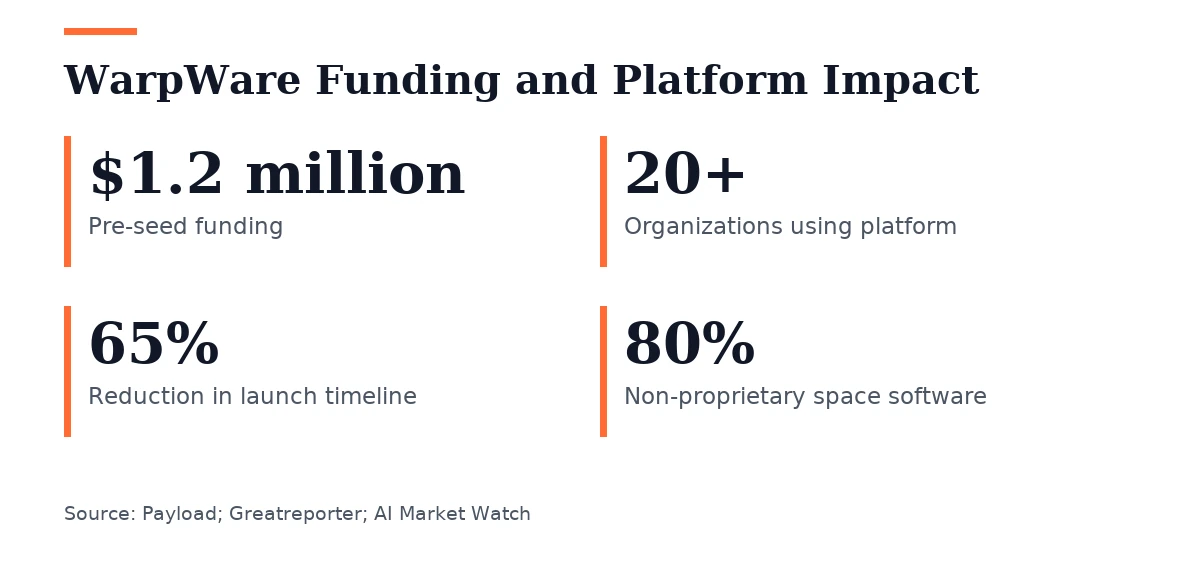
LEAP flew the full platform on its Bullfrog rocket, which cut LEAP’s timeline to launch by 65%. It reached flight readiness in less than six months on the integrated mission software platform. It saved $800K+ in non-recurring engineering costs on development using the platform.
WarpWare officials said the company is also supporting Argotec on NASA’s MiniCOR space-weather mission. The company said it is assisting a few startups preparing for their first flights.
WarpWare officials said the financing will extend agentic-engineering capabilities to more commercial and government space customers. The round will also fund expanded sales and marketing efforts to grow the company’s customer base.
Alex Reynolds said space teams ought not to spend years piecing together separate tools before they can show a mission’s viability. Alex Reynolds described WarpWare’s vision as an industry accelerator that enables quicker transition of promising technologies from concept to space via improved software. Reynolds said this financing round reflects both investor confidence in that vision and the demand the company is seeing from the market. He added that the round gives WarpWare the resources to bring the agentic engineering capabilities built internally into the platform and place them in the hands of more mission teams.
AI Market Watch said the AI‐market significance of WarpWare lies in developer tools tailored to a specialized engineering workflow. AI Market Watch noted that investors question whether the reported adoption will yield consistent delivery improvements.
WarpWare officials said engineering teams waste excessive effort recreating standard software, linking disparate tools, and re-testing identical capabilities for each mission. The company replaces repetitive development with a proven foundation that accelerates every mission. The platform, built on a unified software foundation, enables engineering teams to execute missions more swiftly, with reduced complexity and heightened confidence. WarpWare accommodates both new missions and existing engineering investments, scaling with mission complexity—from single components to full spacecraft—while helping next-generation space organizations accelerate development and lower engineering complexity.
WarpWare officials said the platform merges reusable software capabilities with a space-specific AI harness that performs multilayered testing on the generated outputs. They said engineers determine where AI participates and retain control over mission-critical decisions. Integration with simulation and verification is central to the product’s value proposition, as generating software is only one part of getting an engineering output ready for use.
WarpWare officials said the company is supporting a growing range of space companies and mission profiles. They noted that they plan additional customer and mission announcements in the coming months.
WarpWare originated from a question its founders had about reusing flight software for new vehicles; CEO Alex Reynolds and COO Mickey Mathew said the answer was almost none on October 19, 2026.


Join the discussion