Key facts
- WASP-107 b exceeds three-quarters of Jupiter's volume while weighing less than one-tenth of Jupiter's mass, ranking it among the least dense planets known.
- WASP-107 b circles its star at 5 million miles, roughly one-seventh of the Mercury-Sun separation, and receives too little stellar energy to account for its bloated size.
- The core of WASP-107 b is at least double the previously estimated mass, which fits better with standard planet formation models.
- David Sing said the scarce methane shows hot gas from the deep interior is churning upward into cooler layers, because methane breaks down at high temperatures.
Astronomers using the CRIRES+ instrument on the Very Large Telescope observed two transits of warm Neptune WASP-107 b and detected carbon monoxide and water vapor in its atmosphere, the Astronomy & Astrophysics study team reported Nov. 16, 2026. The planet lies about 210 light-years away.
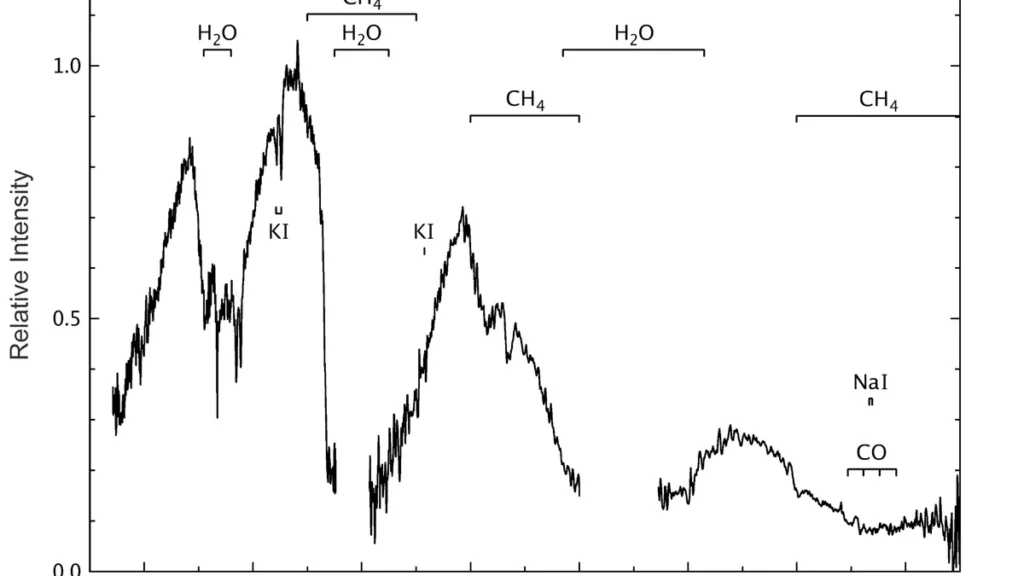
The researchers observed two transits of the planet with VLT/CRIRES+ and built cross-correlation templates of its atmosphere, drawing on results from previous studies – cross-correlation being a method of matching observed light against model templates to tease out faint signals. In maps of the planet’s expected radial velocity, carbon monoxide appeared at about six sigma significance and water vapor at about 4.5 sigma. The measurement was sensitive to whether the models included clouds, though less sensitive to different volume mixing ratios of atmospheric gases (the relative amounts of different gases).
Before examining the real data, the team produced simulated observations of WASP-107 b to predict the significance of detections they might expect from the cross-correlation technique. It also built alternative templates to test how varying the relative amounts of atmospheric gases and including or excluding clouds changed the outcome.
The carbon monoxide and water detection is the first time CRIRES+ has found molecular species in a target cooler than a hot Jupiter using transmission spectroscopy, which identifies gases by how they change starlight. The results support earlier space-based findings and show for the first time that CRIRES+ can detect molecules in cooler exoplanets through transmission spectroscopy. The researchers also report that the strongest signal appears far from where they expected it in the planet’s radial velocity maps, and they offer possible explanations for the consistent offset.
The paper frames ground-based and space-based spectroscopy as complementary methods, noting that each approach has strengths and weaknesses and both are valuable for cooler, smaller planets likely to contain many molecular species and cloud decks. “Each has its own set of strengths and weaknesses, so there are benefits to both approaches,” the Astronomy & Astrophysics study authors wrote. The authors call for further work in high-resolution spectroscopy and note that cool exoplanets come with a severely reduced error budget (the range of uncertainty in the measurements) compared with hotter worlds.
Two research teams paired James Webb Space Telescope observations with earlier Hubble Space Telescope data and found little methane in the atmosphere of WASP-107 b, pointing to a hotter interior and a much more massive core than estimated, according to results published May 20, 2024. Luis Welbanks of Arizona State University led one Nature paper, DOI 10.1038/s41586-024-07514-w, while David Sing of Johns Hopkins University led a parallel Nature paper, DOI 10.1038/s41586-024-07395-z.
Welbanks’s team built a wide spectrum spanning 0.8 to 12.2 microns with Webb’s NIRCam and MIRI instruments along with Hubble’s WFC3, while Sing’s team produced a separate spectrum from 2.7 to 5.2 microns with Webb’s NIRSpec. Using the spectra, the teams measured abundances of water vapor, methane, carbon dioxide, carbon monoxide, sulfur dioxide, and ammonia; methane appeared at just one-thousandth of the expected level for the planet’s assumed temperature.
David Sing of Johns Hopkins University said the scarcity of methane, despite the detection of other carbon-bearing molecules, indicates vigorous mixing of hot gas from deep inside the planet with cooler layers higher up, because methane breaks down at high temperatures. He explained that detecting little methane while other carbon-bearing molecules were present indicates the planet’s interior runs hotter than earlier estimates. “This is evidence that hot gas from deep in the planet must be mixing vigorously with the cooler layers higher up.”
Zafar Rustamkulov of Johns Hopkins University said internal heat is altering the atmosphere’s chemistry, destroying methane and raising carbon dioxide and carbon monoxide levels. That chemical shift follows from Webb’s detection of low methane, which pointed to a hotter interior than scientists had assumed.
Tidal heating is the likely source of the extra internal energy: as WASP-107 b follows its slightly elliptical 5.7-day orbit, the changing star-planet distance varies the gravitational forces, and the stretching produces heat inside the planet. The planet circles its star at 5 million miles, roughly one-seventh of the Mercury-Sun separation, and receives too little stellar energy to account for its bloated size.
The core of WASP-107 b is at least double the estimated mass, a figure that fits better with standard planet formation models. Daniel Thorngren of Johns Hopkins University said the planet’s energy content, together with the proportion of heavy elements relative to hydrogen and helium, makes it possible to calculate the core’s mass. Once researchers established that internal heat thoroughly churned the atmosphere, the spectra provided a new way to estimate core size based on the planet’s energy budget and heavy-element fraction.
Earlier models pictured WASP-107 b with a rocky core wrapped in an enormous envelope of hydrogen and helium, Luis Welbanks said, and he said he struggled to explain how a core so small could accumulate so much gas without the planet swelling to Jupiter’s mass. Mike Line of Arizona State University said Webb data indicates that planets like WASP-107 b did not require an unusual formation path built around a small core and a gassy envelope.
Line explained that researchers can start with a Neptune-like world rich in rock and short on gas, then heat it and swell it to match observations. If the core held more mass, the atmosphere would have contracted as the world cooled following formation, leaving it far smaller unless a heat source re-expanded the gas.
Researchers had proposed tidal heating as the explanation for WASP-107 b’s puffiness, but confirmation was absent until the Webb results came in. Sing said Webb suits WASP-107 b well because the planet is far cooler than the hot Jupiters researchers study and carries a Neptune-like mass.
He said the measurements should make it possible to quantify methane and other gases whose chemistry and internal dynamics stay hidden on hotter planets. Sing’s description of the planet as a cooler, Neptune-mass target explains why its atmospheric makeup works well for probing interior processes. The planet’s large size, puffy atmosphere, and edge-on orbit suit it to transmission spectroscopy.
WASP-107 b lies 210 light-years away, spans roughly three-quarters of Jupiter’s diameter, and holds only one-tenth of Jupiter’s mass. Its volume exceeds three-quarters of Jupiter’s, and it weighs less than one-tenth of Jupiter’s mass, which puts it among the least dense worlds known. Its equilibrium temperature is about 740 Kelvin. Most other puffy planets with low density run hotter and heavier than WASP-107 b, which makes this world harder to explain through conventional formation theories.
The pair of Nature papers gave researchers the first detailed look inside an exoplanet, helping solve the puffiness mystery. Sing said that a planet’s mass, radius, atmospheric makeup, and internal heat supply everything required to work out its core mass, an approach that works for many gas planets. He said researchers can now use the method on many gas planets in different systems, broadening the possibilities for characterizing their interiors. Webb is an international project managed by NASA together with ESA and CSA.
The Webb results might account for the puffiness of dozens of low-density exoplanets and help resolve a long-standing puzzle in exoplanet science.


Join the discussion