Key facts
- The solution indicates that the two black holes in this configuration can reach extremality together while each keeps its own event horizon.
- No evidence exists that Black Saturns actually exist or that our universe hides the extra spatial dimension they need, and the result is theoretical rather than observational.
- Researchers first described a Black Saturn mathematically in 2007, but that early model restricted the two black holes to rotation in just one plane.
- The work exists as an arXiv preprint that has not yet passed peer review.
University of Amsterdam physicist Jay Armas derived an exact solution to Einstein’s field equations in five-dimensional spacetime that describes a Black Saturn, with the result published as an arXiv preprint and reported by ScienceAlert on Nov. 21, 2026.
Armas’s work lays the groundwork for future research into the behavior of light and matter around Black Saturn configurations and the geometry of spacetime inside their event horizons. Such work gives physicists a way to explore what general relativity allows and to study gravity under conditions very different from those we observe.
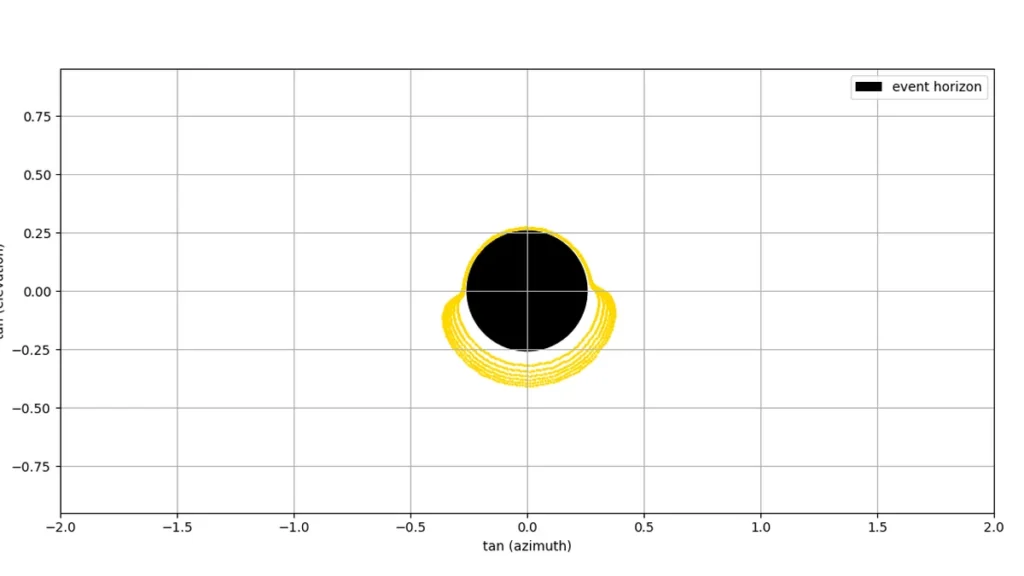
An ordinary black hole is a spherical region of space from which light cannot escape. A Black Saturn instead holds two separate black holes inside a single five-dimensional spacetime: a spherical black hole at the center and a ring-shaped one encircling it, with each object carrying its own event horizon. The event horizon marks the limit where fleeing the black hole would call for speeds faster than light, an impossibility.
The spacetime we inhabit has four dimensions—three spatial and one temporal. Adding one extra spatial dimension shifts the rules, although general relativity itself does not change; the same underlying principles still apply. The added dimension permits solutions and geometries unavailable in four dimensions. In five-dimensional spacetime, Einstein’s equations allow a ring-shaped event horizon to exist, making Black Saturns possible.
In five-dimensional spacetime, objects can rotate in two independent planes at once, unlike in the familiar four-dimensional case.
Researchers first described a Black Saturn mathematically in 2007, but that early model restricted the two black holes to rotation in just one plane. The single-plane limit persisted because including both planes makes the mathematics considerably more complicated. Theoretical physicist Jay Armas of the University of Amsterdam addressed the two-plane problem in a preprint on arXiv.
The new solution allows both black holes in the configuration to rotate in two independent planes at once. According to Armas, black holes in higher-dimensional vacuum gravity form a richer space than the four-dimensional counterpart.

ScienceAlert described the work as the first known exact solution showing two separate black holes reaching this state together in an otherwise empty five-dimensional spacetime. The solution indicates that the two black holes in this configuration can reach extremality together while each keeps its own event horizon. Earlier versions could not describe this simultaneous extremality because they were limited to rotation in a single plane.
Black holes have limits to how much angular momentum they can possess relative to their mass. That angular momentum limit is the gateway to the state known as extremality. To reach extremality in five-dimensional spacetime, a black hole must spin in both independent planes; otherwise the event horizon disappears altogether.
Frame dragging is the phenomenon by which rotating black holes drag the surrounding spacetime along with them. The ring-shaped black hole can induce rotation of the central black hole’s event horizon in a plane where that central black hole has no angular momentum of its own.
The ring-shaped hole stays in its donut shape only while it spins fast enough. If its angular momentum falls too low, its own gravity makes it collapse.
No evidence exists that Black Saturns actually exist or that our universe hides the extra spatial dimension they need, and the result is theoretical rather than observational. Armas’s work and earlier models explore what general relativity permits in higher dimensions, but this result is theory rather than observation and carries no effect on daily life.
The work exists as an arXiv preprint that has not yet passed peer review.



Join the discussion