Key facts
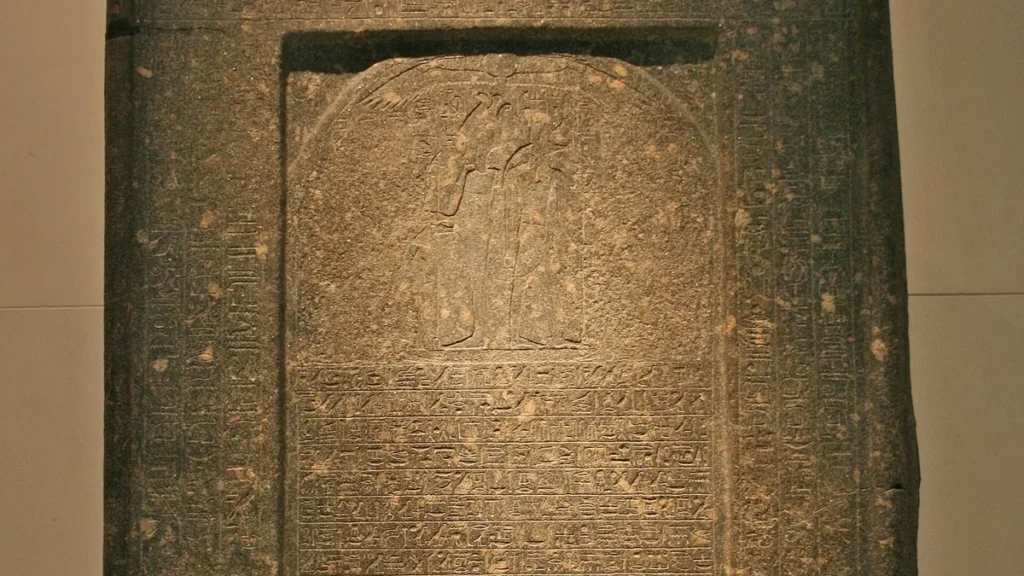
- The Merneptah Stele, a large inscribed granite monument, is held in the Egyptian Museum in Cairo.
- The inscription on the Merneptah Stele dates to the fifth year of Merneptah's reign.
- Workers discovered the Merneptah Stele in 1896.
- Pharaoh Merneptah was the successor to Ramesses II.
In 2017, Cambridge University researchers Colin Humphreys and Graeme Waddington claimed that an annular solar eclipse, which leaves a bright ring of the sun visible, appeared over Canaan on the afternoon of Oct. 30, 1207 B.C., matching the Old Testament book of Joshua’s description of the sun standing still over Gibeon. Space.com reported that the reading is disputed because it hinges on how the ancient Hebrew text is translated. The outlet says that if correct, it could be the oldest dated solar eclipse on record and could more accurately date Ramesses II’s reign. The researchers suggest Ramesses II ruled for roughly 1276 to 1210 B.C., give or take about a year. That timeline differs slightly from the dates the British Museum uses, 1279-1213 B.C. Egyptologists generally place Merneptah’s reign between 1203 and 1213 B.C., placing his fifth year near 1209 or 1208 B.C., by which time the Israelites were already in Canaan. Merneptah followed Ramesses II as pharaoh. A large inscribed granite monument called the Merneptah Stele sits in Cairo’s Egyptian Museum. Its inscription comes from Merneptah’s fifth year and tells of an Egyptian military campaign in Canaan that mentions Israelites. Workers found the stele in 1896. The source ties this succession to the monument and to Ramesses II’s chronology. Humphreys and Waddington calculated that the eclipse over Canaan ran for five minutes. They included changes in Earth’s rotation across many centuries in their calculations. Scientists can pinpoint where the moon’s shadow fell thousands of years ago by running Earth’s and the moon’s motions backward. The same celestial mechanics let researchers date past events when an ancient text reliably describes an eclipse, and running those calculations backward turns eclipses into precise historical timestamps, fixed dates that anchor events in the past. Treating an eclipse as a historical timestamp demands proof that someone saw it and recorded it. A total solar eclipse swept across northern Egypt on April 1, 2471 B.C., during the age of the great pyramid builders. No surviving Egyptian text records that event, so it cannot yet serve as a confirmed timestamp. The source mentions this boundary before turning to a better-documented eclipse from about 1,300 years after the 2471 B.C. event. In a 2025 paper, Giulio Magli from Milan’s Polytechnic University suggested that the eclipse might explain why Pharaoh Shepseskaf built a rectangular tomb at South Saqqara instead of a pyramid. The source calls this a tantalizing hypothesis but notes no surviving Egyptian text records the 2471 B.C. eclipse. The Old Testament book of Joshua contains a passage where Joshua asks for the sun to halt at Gibeon and for the moon to pause in the Valley of Aijalon. Ancient Gibeon lies roughly six miles, or 10 kilometers, northwest of Jerusalem. The article presents this biblical text as a contender for the oldest recorded solar eclipse ahead of the 2017 research that dates it to Oct. 30, 1207 B.C. “Sun, stand still at Gibeon, and moon, in the Valley of Aijalon.” Marinus Anthony van der Sluijs challenged the claim in a paper, arguing that the biblical text puts the sun over Gibeon and the moon over the Valley of Aijalon simultaneously, which excludes an eclipse. The source frames this as a challenge to the Humphreys and Waddington reading before moving to the unambiguous 2027 eclipse. Known as Ramesses the Great, Ramesses II ruled for 66 years during Egypt’s New Kingdom and lived past 90. He ordered the building of Abu Simbel and added major parts to Karnak and Luxor Temple. His rule stood as ancient Egypt’s peak of imperial power. The BBC calls Ramesses II the “Jupiter” of the pharaonic system, though experts still debate the exact dates of his reign. Those same calculations run forward to forecast a total solar eclipse over Egypt on Aug. 2, 2027, passing directly over Luxor, with totality starting at about 1:02 p.m. EEST and running for six minutes 22 seconds, according to Time and Date. The source offers this future eclipse as an example of cranking the celestial clock forward to forecast the moon’s shadow, unlike using the same calculations backward to date ancient history. About 4,500 years lie between the Aug. 2, 2027 eclipse and the April 1, 2471 B.C. eclipse, while 3,233 years lie between the 2027 eclipse and the Oct. 30, 1207 B.C. eclipse. The source says both events belong to the same celestial clock, which runs forward to forecast the future or backward to date history.




Join the discussion