Key facts
- CRISTAL-02 produces stars about three times as fast as a typical galaxy of its size at this distance, while losing gas at twice its star-formation rate.
- Galaxies seen as young in the early universe should contain plenty of gas and form stars readily.
- Astronomers do not know why early galaxies stopped forming stars so soon, though they have many theories.
- Some theories require dark energy to have had stronger early-universe influence than previously thought, profoundly affecting understanding of cosmic evolution.
Astrophysicist Rebecca Davies of Swinburne University of Technology led the team that identified a starburst-driven wind expelling gas from CRISTAL-02, a massive galaxy seen as it existed 1.1 billion years after the Big Bang, in research published June 10 in Monthly Notices of the Royal Astronomical Society.
Astronomy Magazine reported the finding. CRISTAL-02 belongs to a sample of around two dozen star-forming galaxies at a similar distance and age, meaning they are seen at similar stages of cosmic history. The observation marks the first direct evidence of a wind powerful enough to end star formation in a massive galaxy seen 1.1 billion years after the Big Bang. Before this, astronomers had never caught such a wind draining its host galaxy’s gas in the early universe, largely because distant galaxies are difficult to study in detail.
Observations revealed a huge plume of cold gas extending beyond CRISTAL-02, nearly as large as the galaxy itself. The plume moves toward Earth at some 60 miles (100 kilometers) per second. Fast-moving gas far from the galaxy indicates the gas is actively being pushed out by a wind-driven process.
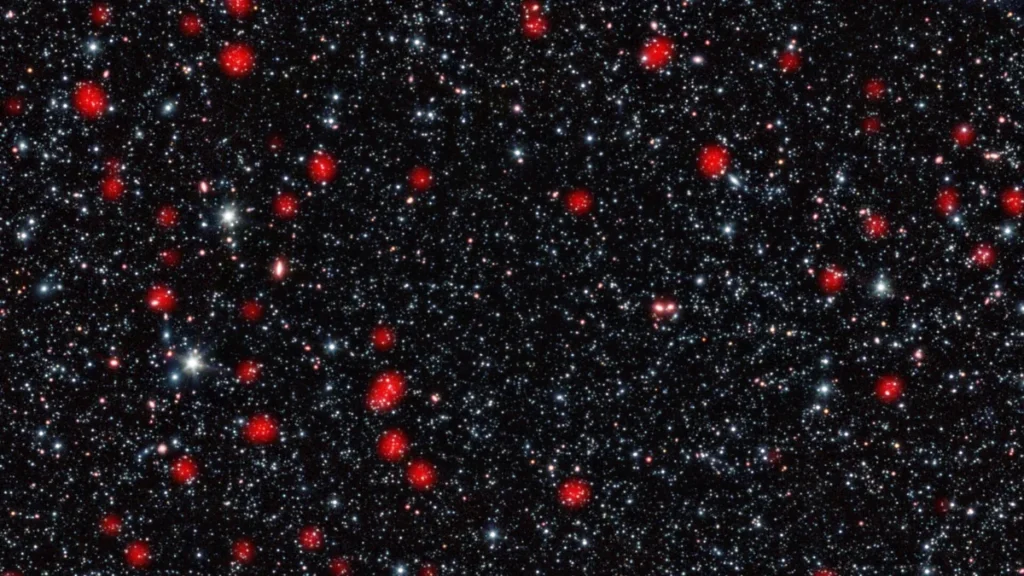
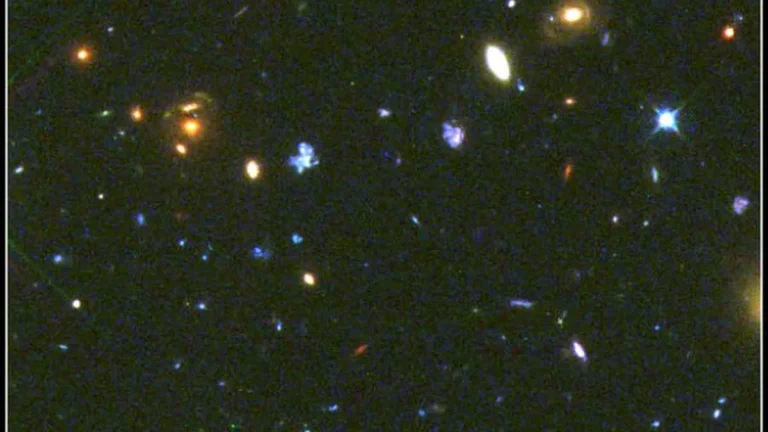
The team used a joint survey that combined ALMA observations from Chile, JWST infrared data, and archival Hubble Space Telescope data. To study early-universe star-forming galaxies, the team combined millimeter/submillimeter and infrared observations with older Hubble images. CRISTAL-02 produces stars about three times as fast as a typical galaxy of its size at this distance, while losing gas at twice its star-formation rate.
Davies’ team measured new star production by searching the galaxy’s spectrum for young, massive stars and measuring the brightness of those features. Massive stars live much shorter lives than lower-mass stars, so their numbers reveal how quickly a galaxy creates new stars.
Researchers used ALMA data to calculate plume mass, then combined it with gas velocity and distance from the galaxy’s center to quantify gas loss. CRISTAL-02’s outflow moves around 400 miles (640 km) per second, matching expectations for a starburst-produced wind.
In the local universe, quiescent galaxies are common and have lived for billions of years while gradually exhausting their star-forming gas. By contrast, galaxies seen as young in the early universe should still contain plenty of gas and form stars readily. Since beginning its survey, the James Webb Space Telescope has uncovered an excess of galaxies that stopped forming stars during the universe’s first two billion years, exceeding what formation models forecast. Astronomers do not know why early galaxies stopped forming stars so soon, though they have many theories.
Early-universe galaxy collisions can spark intense starbursts whose winds stop further star birth, offering a way to explain JWST’s many young quiescent galaxies without new dark-energy physics.
Some explanations require dark energy to have had stronger influence in the early universe than previously thought, which would substantially alter current views of cosmic development. One set of explanations invokes a greater role for dark energy in the early cosmos. The collision-driven wind idea offers an alternative that preserves existing dark-energy understanding. This offers a conventional explanation—starburst-driven supernova winds from galaxy mergers—for the large population of young, quiescent galaxies JWST found, without requiring revised dark-energy physics.
Star formation needs gas reservoirs that are dense and cold, low in energy, and likely to collapse inward. Astronomers use the term quenching for the shutdown of star formation, and one mechanism involves powerful outward flows that remove or heat the cold gas. Galactic winds are vast, high-speed flows of charged particles that can blow away or heat cold gas.
One possible energy source for these outflows is an actively feeding supermassive black hole at the galaxy’s core, known as an active galactic nucleus or AGN. The other proposed energy source comes from the deaths of short-lived massive stars, whose explosions inject energy into surrounding gas. According to Rebecca Davies, theoretical models expect the strongest outflows in massive galaxies to be driven by black-hole accretion.
Observations of the galaxy’s core revealed no evidence of an active galactic nucleus. Based on the population of massive young stars, the researchers determined that supernova energy is powerful enough to produce the observed plume. Davies said, “the result is surprising,” because it challenges the usual assumption that active galactic nuclei drive winds that end star formation.
Tremonti says nearly all theoretical models rely on AGN feedback to stop star formation in massive galaxies. Tremonti, an astronomer at the University of Wisconsin–Madison not involved in the study, states that supernova-driven winds generally stay below roughly 1,550 miles, or 2,500 kilometers, per second. Tremonti notes that outflow speeds above this threshold typically indicate an active galactic nucleus rather than supernovae.
The researcher offers the view that active galactic nuclei may maintain quiescence but might not be the initial trigger for shutting down star formation. Tremonti concurs that eliminating the possibility of a hidden or dormant black hole is particularly difficult. Davies cautions that a hidden or previously active black hole cannot be entirely excluded as a factor in the gas outflow.
Because the galaxy is interacting with several companions, the team had to consider whether the gas plume resulted from gravitational stripping during a merger instead of from a wind. Rebecca Davies explains that the origin of the gas required multiple lines of evidence rather than one observation, prompting the team to use several measurements together.
Rebecca Davies suggests CRISTAL-02 could be representative of a broader population, noting research indicating that around 40% of massive early-universe star-forming galaxies are undergoing mergers. Davies said in a press release that if the blowout keeps up, CRISTAL-02 could be dead in under 50 million years, which would explain massive dead galaxies in the early universe. The press-release estimate frames the blowout as a quick route to a dead galaxy, matching the population of massive dead galaxies seen early in cosmic history.
The galaxy’s ongoing star formation may by itself generate a wind strong enough to consume its gas reserves in a few tens of millions of years. The article describes an irony in which the galaxy’s current intense star formation is simultaneously driving the process that will end its ability to form stars. Future mid-infrared observations could peer through dust hiding a buried black hole and help close this gap.

Join the discussion