Key facts
- Planetary scientist Sara Seager and her son Max Seager began experiments in the summer of 2020 to test whether sulfuric acid could support life.
- Janusz Jurand Petkowski said concentrated sulfuric acid does not destroy all organic molecules or kill all life: sugars are unstable, but nitrogenous bases, amino acids and some dipeptides do not break down.
- Natalie Wolchover wrote about the implications of sulfuric-acid-tolerant organics for The New York Times on November 10, 2026.
In 2025, the journal Science Advances published a Wroclaw University of Science and Technology-led report that peptide nucleic acid, DNA’s structural relative, endured lab conditions built to imitate Venus’s perpetual clouds of sulfuric acid.
The international team drew on researchers from Cardiff University and Worcester Polytechnic Institute, the Massachusetts Institute of Technology and industry collaborator Symeres. The team put peptide nucleic acid into a sulfuric acid solution at 98% concentration and room temperature, watching it for two weeks to see if it would survive.
Janusz Jurand Petkowski led the study at Wroclaw University of Science and Technology, and he said the molecule breaks down in sulfuric acid once the temperature tops 50 °C. He said the next step is a genetic polymer stable in concentrated sulfuric acid from 0 °C to 100 °C across Venus‘s full cloud range, and he called these discoveries the first step toward that polymer. Stability shown under the lab conditions tested therefore covers only part of the cloud environment.
The Seagers found that certain organic molecules endure sulfuric acid, including DNA forms built with peptides in place of sugar molecules. Peptide nucleic acid is DNA’s structural relative, and the link matters because sulfuric acid destroys the sugar in DNA’s phosphate-and-sugar backbone, so a sugar-free molecule can survive where ordinary DNA could not.
The work traces back to the summer of 2020, when planetary scientist Sara Seager and her son Max Seager began asking whether life could survive in sulfuric acid. She was helping to design a new mission to Venus, and that mission motivated the acid tests. Its clouds carry droplets of sulfuric acid, so she first asked Max to check how metals and ceramics react with acid, although most such information was already online. Max Seager dropped an ant into the acid, which liquefied it, then tried a rhododendron leaf coated in wax that stayed mostly intact.
In 2023, experiments showed that the DNA letters adenine, thymine, guanine and cytosine stayed intact in sulfuric acid. Those letters normally sit on a phosphate-and-sugar backbone, and sulfuric acid destroys sugar, so the surviving letters belonged to a sugar-free DNA form. Worcester Polytechnic Institute is where Max Seager studied chemistry, and the pair returned to an old spectrometer for occasional follow-up tests.
In 2025, the Seagers tried an alternative DNA built with peptides rather than sugars; it stayed intact in the acid, and its peptides folded into the three-dimensional shapes required for biological work. That folding meant the molecules could do more than merely persist in the acid.
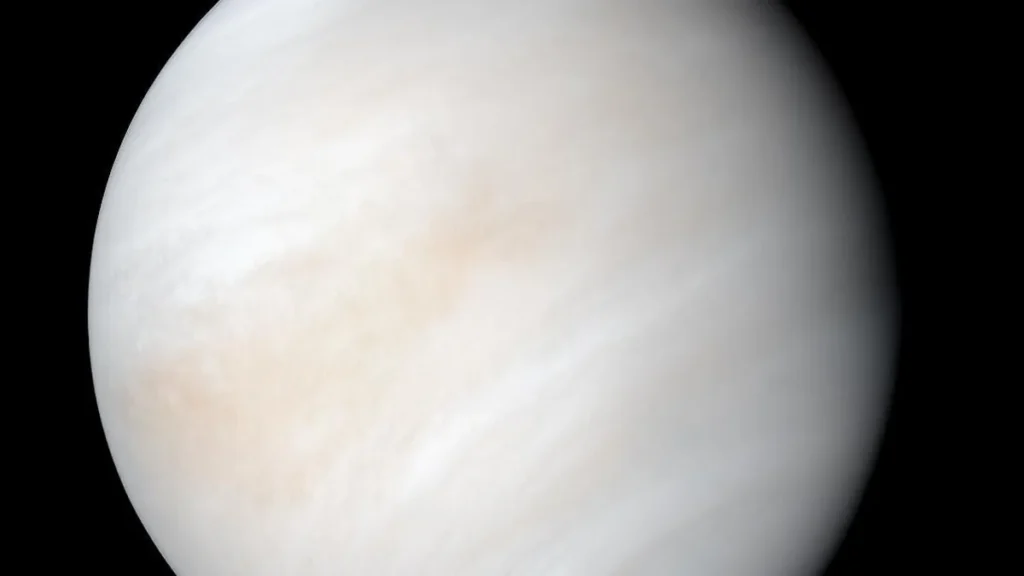
Venus’s clouds carry droplets of sulfuric acid along with chlorine, iron and other substances, and scientists long considered them too hostile for complex organic chemistry because water is missing. Research published in 2025 suggested the clouds contain less acid and more water than earlier estimates assumed.
According to Petkowski, concentrated sulfuric acid does not destroy every organic molecule or end all life: sugars fall apart, but nitrogenous bases, amino acids and some dipeptides hold together. The Wroclaw-led research shows peptide nucleic acid can survive under laboratory conditions like those in the clouds, adding to evidence that concentrated sulfuric acid can sustain a variety of organic chemistry that could support life unlike Earth’s.
Petkowski told The New York Times that stability in sulfuric acid is the norm for organic molecules, not the exception. That assessment echoes the Seagers’ finding that DNA bases and peptide-built DNA endured the acid, tying the newspaper account to the wider peptide nucleic acid effort.
EarthSky says the findings suggest sulfuric acid might serve as a solvent for life in places without liquid water, widening the range of planetary conditions viewed as potentially habitable. Carl Sagan wrote in Cosmos that he reluctantly confesses to being both a carbon chauvinist and a water chauvinist.
Vikki Meadows of the University of Washington in Seattle and the NASA-funded Virtual Planetary Laboratory said alternative solvents are worth studying, but she remains Team Water when it comes to detection. On November 10, 2026, Natalie Wolchover wrote for The New York Times about what sulfuric-acid-tolerant organics imply. EarthSky cited that article while asking whether acid could be life’s elixir and whether organisms could thrive inside it.
According to the research team, the findings open new ways to understand sulfuric acid chemistry, one of the most common industrial chemicals in use, and may lead to practical uses in the future. The practical side accompanies the astrobiological aim: a genetic polymer that remains stable in concentrated sulfuric acid across the full range of Venus’s cloud temperatures.
The phosphine story goes back to mid-2020: an Imperial College London team reported evidence of phosphine, a poisonous gas produced where oxygen is scarce, in Venus’s atmosphere, while a Cardiff University group shared preliminary results indicating ammonia that same year. Dr. William Bains of Cardiff University’s School of Physics and Astronomy worked on both studies and said ammonia and phosphine can serve as biomarkers of life, while also calling the clouds utterly hostile to any life like Earth’s. EarthSky says the jury remains undecided on the phosphine biosignature.

Join the discussion