Key facts
- A team led by NASA JPL researcher Raghvendra Sahai used ALMA to make the first direct observation of a star's final nuclear heartbeat, a fossilized transitional phase before a sun-like star becomes planetary nebula.
- The target star IRAS 06530-0213 lies about 12,000 light-years away in Monoceros, and its gas shell spans roughly half a light-year and was ejected around 6,500 years ago.
- The finding gives the first direct proof that a sun-like star undergoes a final explosive pulse shortly before entering its end-of-life stage.
- The hourglass-shaped planetary nebula around IRAS 06530-0213 began forming around 700 years ago, meaning the star's red giant phase ended recently in cosmic terms.
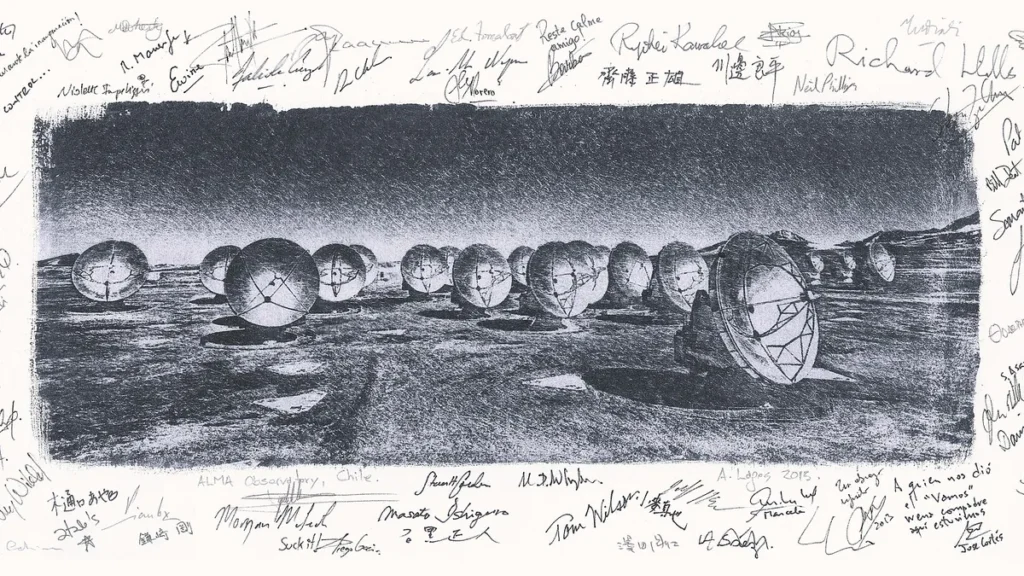
A team led by NASA JPL researcher Raghvendra Sahai used ALMA in northern Chile to make the first direct observation of a star’s final nuclear heartbeat, with the research appearing in The Astrophysical Journal on Nov. 20, Space reported. The observation captures a fossilized transitional phase before a sun-like star becomes a planetary nebula, offering a physical snapshot of an event previously inferred only from theoretical models. ALMA, the world’s largest radio telescope, uses 66 antennas.
IRAS 06530-0213 lies about 12,000 light-years away in Monoceros, and its gas shell spans roughly half a light-year, material ejected around 6,500 years ago. The hourglass-shaped planetary nebula around the star began forming around 700 years ago, meaning its red giant phase ended recently in cosmic terms. The nebula sits immediately around the star and is still taking shape. The red giant phase is relatively short-lived and follows the collapse of the core into a white dwarf.
The finding gives the first direct proof that a sun-like star undergoes a final explosive pulse shortly before entering its end-of-life stage, Space said. Sahai concluded that IRAS 06530 proves the narrative is more complex than the tidy model scientists have relied on, because dying stars often have hidden companions that reshape ejected material into bipolar or multipolar forms.
Researchers think mass loss from IRAS 06530-0213 ran at a lower rate for about 2,000 years after the pulse, then rose sharply across the next 1,000 years, creating a lumpy shell seen as tangled filaments. The filaments have a spiral shape, which could indicate an unseen partner orbiting the star and stirring the gas. This mass-loss history follows the thermal pulse and precedes the formation of the hourglass nebula.
ALMA detected more heavy isotopes of carbon, oxygen and nitrogen than expected around IRAS 06530-0213, conflicting with models of element forging and mixing in such stars, Space reported. ALMA also failed to detect the compact dust disk usually found with such dying stars, indirect evidence of a companion pulling material onto the star and shaping hourglass nebulae.
When a Sun-like star’s core hydrogen runs out, the outward pressure holding it up against gravity disappears and hydrogen-to-helium conversion stops, Space reported. Without this nuclear energy source, the star can no longer support itself against its own inward gravitational pull. As the core collapses into a white dwarf, outer layers where hydrogen is still fusing swell out, producing the relatively short-lived red giant phase. Over time, the outer layers cool and spread away, leaving a white dwarf at the center wrapped in debris called a planetary nebula.
Thermal pulses during the red giant phase occasionally rock hydrogen and helium shells around the core, flinging stellar material into space. These pulses are flares in nuclear activity that happen when the stellar core is surrounded by hydrogen and helium shells. The team studied IRAS 06530-0213 to better understand this phase of stellar evolution.
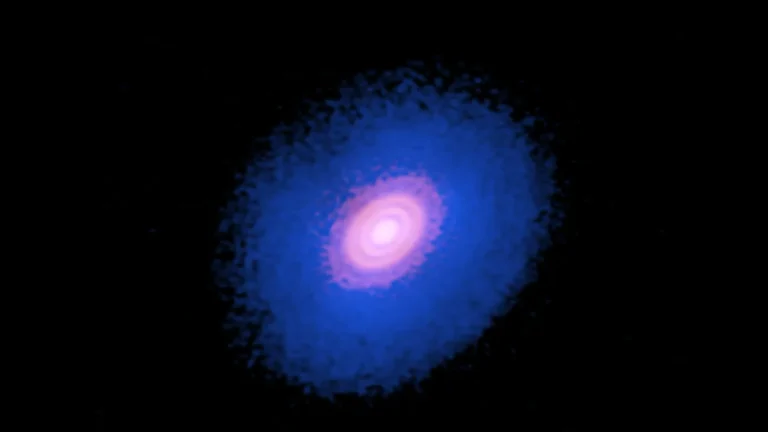
The array observed IRAS 06530-0213 and revealed the gas ring and hourglass-shaped nebula.

Join the discussion