Key facts
- Eastward-moving equatorial jet streams carry heated gas from the permanent day side to the cooler night side, inflating the evening atmosphere while the night side cools and deflates.
- The observed morning-to-evening temperature pattern matches theoretical predictions almost exactly, with Alderson saying WASP-17b fits the expected trend bang-on.
- Researchers used a technique called transmission strings, also called transit mapping, developed at the University of Bristol by astrophysicists Dr. David Grant and Dr. Hannah Wakeford.
- WASP-17b is tidally locked, with a morning edge temperature of 858 Kelvin and an evening terminator temperature of 1,522 Kelvin, a difference of 650 K.
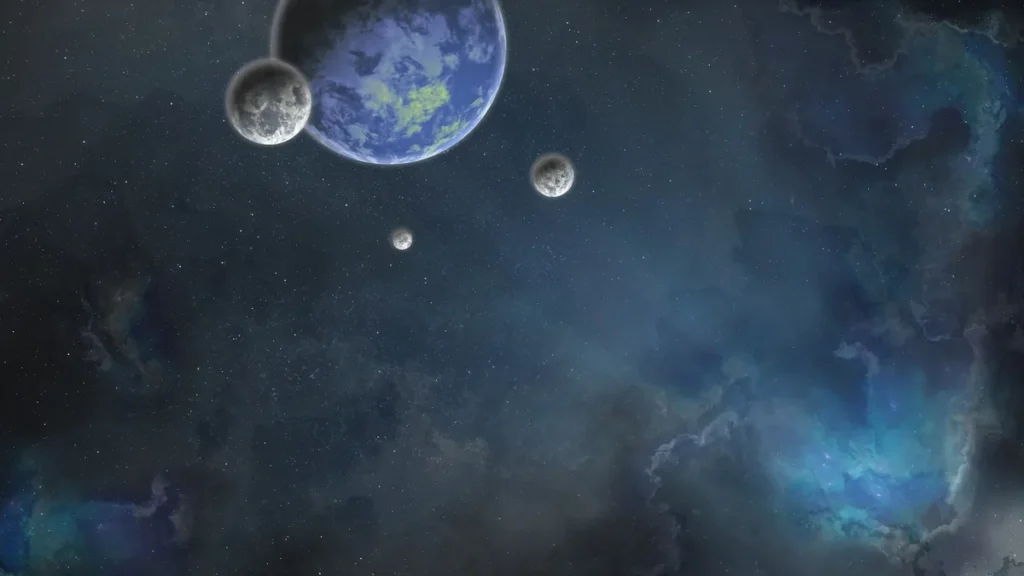
Astronomers using the James Webb Space Telescope have found that the atmosphere of exoplanet WASP-17b is lopsided, with one side extending farther outward than the other, marking the first time astronomers have detected uneven atmospheric contours on a planet. The finding appeared in Nature Astronomy on Oct. 14, 2026, in a paper titled “A Spatial Map of the Atmospheric Limb of a Hot Jupiter.” It establishes a benchmark for comparing atmospheric structures across the more than 6,000 confirmed exoplanets and demonstrates that planets are predictable 3D objects rather than computational abstractions. The detection gives astronomers one of the most detailed three-dimensional pictures of an exoplanet’s atmosphere ever produced.
WASP-17b is a hot Jupiter about 1,300 light-years from Earth in the constellation Scorpius. Discovered in 2009, it has a four-day year, roughly half Jupiter’s mass, nearly twice Jupiter’s diameter, and a density comparable to styrofoam. The planet is tidally locked, with permanent day and night hemispheres. Its puffed-up, low-density nature makes it a natural laboratory for testing atmospheric theories, and earlier studies had already mapped its dayside infrared heat, studied its nighttime heat glow, and detected quartz crystals in its upper atmosphere.
At the morning terminator (the line dividing the planet’s permanent day and night sides), temperatures reach 858 Kelvin. At the evening terminator, they hit 1,522 Kelvin, a difference of 650 K. At the hotter evening side, atmospheric thickness reached 1.8 times the morning side’s extent. The planet’s outline remains approximately circular, but its atmosphere is asymmetrical with one more extended side, giving it an egg-like profile rather than a spherical one, and from Webb’s viewpoint the uneven atmosphere makes the planet resemble an egg on its side rather than a sphere.
Researchers measured the asymmetry using transmission strings, also called transit mapping, a technique developed at the University of Bristol by astrophysicists Dr. David Grant and Dr. Hannah Wakeford. Traditional transmission spectroscopy averages light across the entire atmospheric limb into one spectrum, treating the planet as a uniform ring and ignoring separate chemistry at the morning side, evening side, or poles. The new method separates regions along the limb, so variations are not concealed. It allows astronomers to see differences between the morning side, evening side, and poles that a single average radius would hide entirely, and it reveals structure that older approaches averaged away.
The method relies on modeling software called Harmonica to treat the planet’s silhouette as an adjustable loop rather than a static circle during transit. Harmonica computes atmospheric-thickness changes around the edges at transit entry and exit, then splits incoming starlight by wavelength for each slice. The study used JWST observations from the TST DREAMS Guaranteed Time Observations program, also identified as GTO-1353. Nikole K. Lewis served as principal investigator of the program, and the observations came from the Space Telescope Science Institute, operated by AURA, Inc., under NASA contract NAS 5-03127.
The team mapped how WASP-17b’s atmospheric thickness varies with longitude and latitude by modeling JWST transit light at different wavelengths. Wavelength-by-wavelength modeling assigns a limb thickness to each longitude and latitude instead of one average radius, giving the atmosphere a true three-dimensional shape. Researchers measured temperature differences between the equator and poles and between day and night, consistent with previous modeling. The equator-pole and day-night temperature contrasts agree with earlier models, supporting the three-dimensional picture.
Eclipse mapping examines light changes as a planet passes behind its host star, while transmission strings examines the planet as it crosses in front of the star. By looking at the transit rather than the eclipse, the technique captures the limb as the planet moves into and out of starlight. That geometry is what lets Harmonica adjust the silhouette at each edge angle. Traditional transmission spectroscopy combines the entire limb into one average spectrum, so the new method reveals what the older approach concealed, and the distinction matters because it determines which part of the orbit the measurement samples.
Eastward-moving equatorial jet streams carry heated gas from the permanent day side to the cooler night side, inflating the evening atmosphere while the night side cools and deflates. The observed morning-to-evening temperature pattern matches theoretical predictions almost exactly. Alderson said WASP-17b fits the expected trend bang-on. Hot gas expands, so the large temperature difference drives noticeable atmospheric expansion around the limb, and the distortion matches where previous models predicted it would appear near the equator.
Water vapor and carbon dioxide spread evenly around the planet’s perimeter between the equator and poles. Methane and sulfur dioxide show changes directly at the poles, and they appear better able to survive away from WASP-17b’s jet streams. This chemical pattern complements the temperature and thickness asymmetry seen at the limb and links to the way the jet streams move heated gas around the planet.
ScienceDaily and ScitechDaily identify Dr. Lili Alderson, a Klarman Postdoctoral Fellow at Cornell University who began the work at Bristol, as lead author. She said the results prove planets are 3D objects, adding that seeing real data differs from computational exercises. Universe Today names Lili Anderson of the University of Bristol as team leader and credits L. Anderson et al. for the paper. No source explains the spelling or institutional difference between the two names.
Co-author Dr. Hannah Wakeford, an associate professor of astrophysics at the University of Bristol, described the atmospheric picture as structured and dynamical. She said planets are temperamental with complex and chaotic atmospheres. Wakeford emphasized that the structured picture of the giant world was exciting, and she noted that planetary atmospheres are complex and chaotic systems rather than uniform shells.
The result gives astronomers a benchmark for comparing atmospheric structures across more than 6,000 confirmed exoplanets. It demonstrates that planets are predictable 3D objects rather than computational abstractions. The technique could eventually be applied to smaller exoplanets to map weather-scale patterns in exoplanet climates. The technique helps distinguish conditions at different latitudes beyond day-night contrast, and the results establish a reference point for studying confirmed exoplanets.
Funding was provided by NASA through grant 80NSSC20K0586, the UKRI Science and Technology Facilities Council, and the Klarman Fellowship. NASA, UKRI STFC, and the Klarman Fellowship are listed as funders. The NASA grant number is 80NSSC20K0586. The Klarman Fellowship supports Alderson’s postdoctoral work at Cornell, and she began the research at Bristol before moving to Cornell.
Webb and more powerful telescopes planned for later this century can provide similar atmospheric-shape insight for many other exoplanets. JWST’s infrared camera was uniquely suited to the job and had high enough resolution to differentiate the edges of WASP-17b’s atmosphere. The research team obtained JWST time specifically for this measurement, and the camera’s resolution let them separate the atmosphere’s edges during transit. More powerful telescopes represent the natural extension of the first atmospheric-shape detection on a lopsided exoplanet.
The paper carries the DOI 10.1038/s41550-026-02986-4. The full author team and journal reference appear in the paper. The Oct. 14, 2026 publication date in Nature Astronomy is confirmed in the coverage.

Join the discussion